Over the past 10 years, from 2015 to now, there have been more revolutionary car-related innovations and changes than in the 90 years before that. Sure, the hybrid was developed around the year 2000, and the serious EV in 2008. But it took a long time for these to really become mainstream. 2015 feels like the year when car tech started to pivot, not only in powertrains, but also in other areas of technology. Many of the tech features we take for granted now, back then, were firmly in the realm of sci-fi.
Semi-Autonomous Driving.
Became Mainstream: 2017

Although self-driving has long been the dream of carmakers, the first real practical steps were taken in 2015, when Tesla rolled out the first Autopilot in a Model S. This system uses cameras and machine learning to allow the car to do most of the driving. Since then, Tesla has launched Full Self Driving, but even this was around Level 2 of autonomous driving, requiring drivers to stay alert and ready to take over.

By 2017, carmakers such as GM, Volvo, Audi, as well as companies in Singapore and China, introduced this technology at various levels of sophistication. Many car brands offer semi-autonomous driving today, mainly at Level 2, with some Level 3 creeping in. Companies like Waymo offer full self-driving taxis in geofenced areas like San Francisco, and Amazon and Tesla have recently launched their own versions.
360-Degree View Camera
Became Mainstream: 2017

Surround view cameras give you a 3D view of your car and the terrain around it. It uses four or more cameras and a lot of processing power to stitch the various camera views together into this view, and to keep it accurate even as the car turns. This system can even project your car and its surrounding space as if you were looking at it from the outside.

Surround view cameras were first introduced by Nissan back in 2007, and with Infiniti in the US the following year. It depended heavily on the camera technology used in the then-new iPhone. By 2017, there were more than ten cars fitted with this technology for the 2018 model year, including the Range Rover, BMW 7-series, and the Nissan Rogue.
Predictive And Adaptive Suspension
Became Mainstream: 2018
Predictive and adaptive suspension uses cameras and other sensors to scan the road ahead for things like potholes, speed bumps, or uneven surfaces, and then adjusts the suspension to raise the car’s body until the obstacle has been cleared. It can also tilt the car to one side to make cornering more comfortable for passengers, and even raise the body when the door handle is pulled to make entry and exit easier.

Mercedes-Benz developed predictive active suspension in the early 2010s, and the Audi A8 was the first production car to use this. By 2017, several Audi and Mercedes-Benz models used their own versions of this technology, and even some Ford Focus models had something similar, although much less sophisticated.
Remote-Control Parking
Became Mainstream: 2019
Remote-control parking allows the driver, from outside the car, to control the car into or out of a parking area, using a smartphone app or special key fob. This is very useful for tight parking spots, or narrow garages with not much room to open the doors, or places where tricky driving is required. The driver can stop the car at any time, and sensors will prevent the car from bumping into obstacles.

Remote-control parking’s roots go way back to when Tesla was a person and not a car. Nikola Tesla built a remote-controlled boat in the late 1800s. Toyota and BMW both worked on the technology, but it took until around 2019 for it to become mainstream. Carmakers like BMW, Mercedes-Benz, Volkswagen, and Hyundai all offered this technology in some of their models in that year.
Over-The-Air Software Updates
Became Mainstream: 2020

As Elon Musk recently remarked: “The car is a computer on wheels.” Computers in cars control everything from the safety equipment to performance and infotainment. The software and firmware that control these functions have to be updated regularly, like a cellphone or a PC. Rather than taking the car somewhere and plugging it in, over-the-air (OTA) updates can happen on the move, with the data exchanged via Wi-Fi or cellular network.

OTAs, although used in all kinds of vehicles, were initially crucial for EVs. Tesla launched the first OTA vehicles in 2012, but since the only other significant EV was the Nissan Leaf, this technology only became mainstream when EVs did as well. By 2020, Tesla had been joined by GM, Ford, Polestar, and many more EV and non-EV brands.
Advanced Voice Control
Became Mainstream: 2021

Advanced voice control in a car uses an AI voice agent for hands-free controls like navigation, climate, or media that would otherwise have required the driver to look away from the road. Previously, it could only understand short, clear commands, but now these systems can understand natural speech, understand context, learn driver behavior, and in so doing, become more intuitive, reliable, and accurate.

Honda worked with IBM in the early 2000s to develop this technology, while Apple used Siri for CarPlay in 2013, becoming the first to use a voice agent. By 2021, the technology was firmly embedded in most mainstream manufacturers, and by 2022, an estimated 73 percent of drivers were using it.
Smartphone Used As Car Keys
Became Mainstream: 2021

A smartphone can be used as a car key by using features called virtual or digital car key technology. This used NFC (near-field communication), Bluetooth, or UW (ultra-wideband) to lock, unlock, and start a car. These can be used as a ‘spare’ key or can be shared remotely with others. Remote sharing means you can park somewhere and send the key to someone else to drive the car. Both Apple and Android systems can use it, although specific manufacturers will have their own settings.

The mainstream use of smartphones sort of started in 2021, although there were a couple around a year or two before that. Car Key was an Apple product that could work with an iPhone or watch. By 2021 / 2022, BMW, Genesis, and Chinese auto giant BYD were all using this kind of technology, and the use spread rapidly in the years that followed.
Digital Side Mirrors
Became Mainstream: 2021 – 2023

Digital side mirrors replace the traditional side mirrors with cameras mounted on stalks, projecting the camera image on screens normally mounted inside the car at the base of the A-pillar. The digital wing mirror has several advantages:
- The view can change from wide for highway driving to narrow for parking
- They can auto-dim when bright lights are beamed from behind
- The cameras can adjust in low light, such as when entering a tunnel
- The narrow profile caused less aerodynamic drag and wind noise

Digital side mirrors were first used in the Lexus ES in 2018, and a year later in a Mercedes truck. By 2020, some European cars were using these. The USA and Canada still required cars to have actual wing mirrors, which, coupled with additional costs of these digital mirrors, slowed their mainstream acceptance. These digital mirrors are growing in popularity, and there is a large aftermarket segment supplying them.
V2L/Bi-Directional Charging
Became Mainstream: 2021

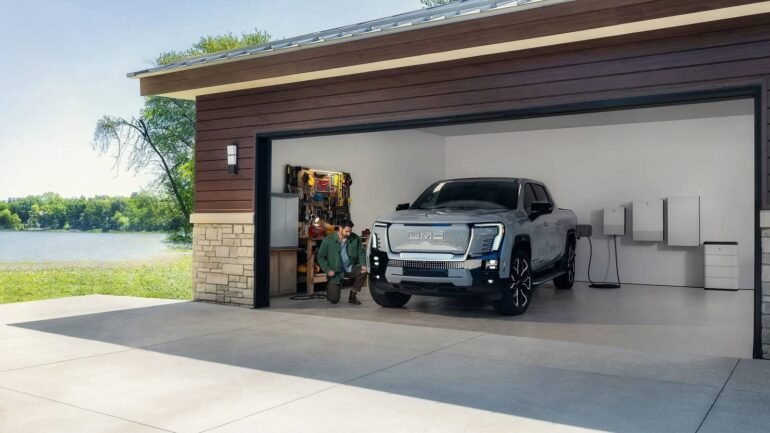
Vehicle to load (V2L) bidirectional charging means using the power in an EV to power a home, equipment on a worksite, or in a remote office, or even to store up power during low consumption, at cheap rates, and return to the grid during high demand. This technology was first used in the Nissan Leaf, specifically to power emergency equipment after natural disasters.

V2L bidirectional charging became a thing in 2021 when the Texas power grid failed after a blizzard. Owners of the Ford F-150 hybrid truck — which had an onboard generator system called Pro Power Onboard — used their trucks to power their homes and offices. True V2L charging can be done with the Ford F-150 Lightning, launched the following year, with a dedicated V2L plug-and-play system. This capability is also found in the Hyundai Ioniq, Kia EV6, and Ford Mustang Mach-E.
Biometric Access
Became Mainstream: 2024

We all know about using your fingerprint to enter a building, or facial recognition with Klarna, so it is no surprise that biometrics are used in car security too. Fingerprint scanners can be built into car door handles or on the steering wheel, while a camera can scan your face or even your iris to make sure you are you. Once you have this tech, it can also be used to personalize the car, adjusting the seat and climate control to your preference.

Hyundai Santa Fe introduced fingerprint recognition in its Santa Fe model in 2018, and Tesla added biometric security as early as 2021. But the growth of this technology has been slowed by consumer privacy fears, including in the large rental market. By 2024, it seemed the tide had turned. Commercial vehicle operators saw the benefits of this tech, and other consumers were by then quite used to using it on their phones or at work. BMW, Ford, Mercedes-Benz, and Audi are among the many that now offer this convenient technology.