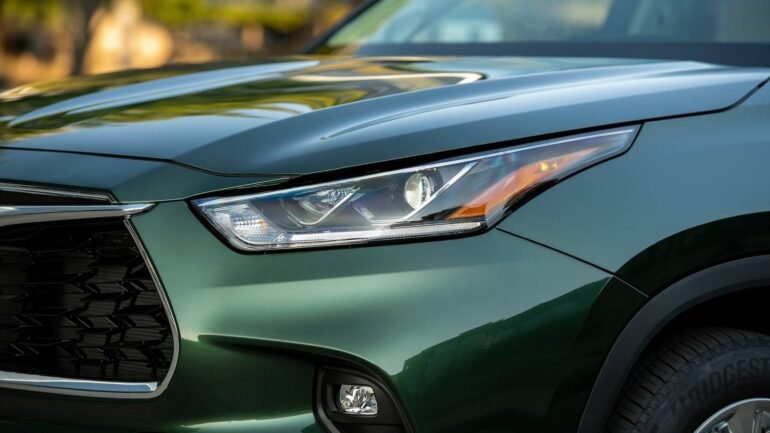
As the automotive world undergoes one of the biggest shifts ever witnessed over the last century, nameplates easily come and go. A brand would one day launch a new brand, only for it to be discontinued after only one generation or worse, even just one model year. Great cars, however, exist for generations, and thus, create a legacy that’s endearing to many.
Case in point, Toyota‘s first midsize crossover SUV, which is already 25 years old. In fact, Toyota created a special 25th Edition model to celebrate the nameplate’s endearing existence. Yes, that’s the Toyota Highlander, which, when it debuted in 2000, set the tone for today’s most popular three-row vehicle segment—the midsize crossover SUV.

How Much You’ll Save In Fuel Costs Driving The Toyota Grand Highlander Hybrid
Regardless of how your family uses the Toyota Grand Highlander, there are powertrain choices to help you save on fuel costs, including two hybrids.
The Pioneering Three-Row Midsize Crossover

In the late 1990s, the traditional SUV boom was real, but they were too big, too cumbersome, and thirsty for fuel. The compromise? Ditch the traditional ladder frame chassis for a car-based unibody chassis—a recipe that the Toyota RAV4 and Honda CR-V popularized in compact form. By 2000, the unibody crossover SUV was set to grow in size with Toyota’s introduction of the Highlander.
Leaving Minivans For Crossovers

The 2000 Toyota Highlander was one of the first midsize crossover SUVs to hit North American roads, and it immediately became a sales success. While similar in size to the 4Runner, the Highlander quickly found its footing as buyers appreciated the appeal of an SUV that drives and rides like a sedan. By the 2004 model year, a third-row option was finally added, further increasing its appeal among American families who would’ve otherwise opted for a minivan.
Actually, that is exactly the segment that crushed the popularity of minivans today. You see, an SUV comes with the social perception that you’re not a boring family. You go out to the woods thanks to your four-wheel drive (4WD) on weekends rather than to the mall (even if this is the reality for most families), especially since automakers marketed SUVs for their off-road capability. The thing is, many families buy SUVs not for their capability, but for their design, image, and the negative (perhaps boring) perception associated with minivans. A crossover SUV comes with the associated image of a traditional SUV, but with far fewer on-road drawbacks as a result of a crossover’s road-biased development.
Pioneering The Hybrid Crossover SUV

With Toyota also in the midst of spreading its hybrid know-how to other models, the first-generation Highlander also became Toyota’s first hybrid SUV and one of the world’s first hybrid SUVs, period. Inheriting the 3.3-liter V-6 series parallel hybrid system from the Lexus RX, which shares its platform, it had a strong system output of 270 horsepower.
As proof of Toyota using hybrid technology to make its vehicles both more efficient yet smoother, the Highlander Hybrid had a combined 26 MPG rating (using today’s revised EPA standards) versus just 19 MPG for the non-hybrid. Both figures are for their respective front-wheel drive (FWD) models, with AWD introducing a 1 MPG penalty.

10 Most Practical And Versatile Hybrids For Everyday Life
With EV incentives diminishing, and gas not getting any cheaper, hybrids can save thousands at the pump. Here’s 10 that are great for all buyers.
Evolving Carefully, Not Radically

The Highlander has become a sales success for Toyota, not just in North America, but also in Australia. As such, the Highlander carefully rather than radically evolved for the next three generations.
Familiar Second Generation

The second generation of the Toyota Highlander was introduced in the 2008 model year, featuring a careful refinement over the generation it replaced. The second-generation model still retained the Highlander’s signature boxy silhouette, but with more rounded edges and curves this time around. The Highlander was initially exclusively sold in seven-seater form, but a five-seater version with a 2.7-liter four-cylinder engine was reintroduced in 2009. The 3.3-liter V-6 hybrid remained unchanged, but the non-hybrid V-6 saw its size increase to 3.5 liters.
For this generation’s mid-cycle facelift, minor styling updates such as black lower bodywork went in sync with more standard features, along with a new 3.5-liter V-6 hybrid system. This boosted its system output to 280 horsepower (+10 horsepower), yet fuel efficiency increased to a combined 28 MPG. Speaking of efficiency, it is noteworthy that even the 2.7-liter four-cylinder of the five-seater versions saw an improved combined efficiency rating, too, rising by 1 MPG to 22 MPG.
Posher And Bigger Third Generation

By the 2014 model year, the Highlander witnessed another generation change–perhaps its biggest in its entire lifetime. Though the overall recipe of family-friendly accommodations and comfort remained, the third-generation Highlander experienced its biggest size increase. In fact, it’s now capable of accommodating eight occupants. Engine choices remained the same: a 2.7-liter four-cylinder FWD for lower variants, a 3.5-liter V-6 in FWD or AWD form, and a 3.5-liter hybrid V-6 in AWD. This is also where its design saw a more pronounced change, ditching the boxy silhouette for a more curvaceous–albeit more conventional look.
A mid-cycle facelift introduced styling and powertrain improvements. The six-speed automatic was replaced by an eight-speed automatic for the 3.5-liter V-6, which now received D-4S direct and port injection. Even the 3.5-liter V-6 hybrid got a new engine with D-4S direct and port injection, and this is arguably when the Highlander was reaching its peak in terms of outright power, to the tune of 306 horsepower. Yet despite reaching the 300 mark, its combined efficiency stood at 29 or 28 MPG, with the former for the base LE with smaller wheels.

The Two-Row Hybrid With Roomy Interior And Generous Cargo Space
A two-row hybrid SUV offers as much room as a three-row seater while bringing in more comfort for each row.
The Highlander In 2025

Today, the Highlander is now in its fourth generation. It went on sale in December 2019 for the 2020 model year, and a lot of things have changed, both with the vehicle itself and the vehicles it’s competing with in 2025. The Highlander is still going strong, but, in my opinion, it is now facing an existential crisis.
Hybrid Remains, V-6 Disappears

By the 2023 model year, the Highlander received a slew of changes. This came with the brand’s then-new Toyota Audio Multimedia infotainment with an intelligent personal assistant, along with a 12.3-inch digital gauge cluster. However, the 3.5-liter V6 with D-4S has been ditched in favor of a turbocharged 2.4-liter turbo that produces 265 horsepower and 309 pound-feet of torque. While power is down, torque is significantly higher, but there’s no denying that the V-6 was the smoother, more effortless engine. The hybrid has remained, thankfully, but the V-6’s disappearance is the least of its worries, because it now has a grand (pun intended) case of sibling rivalryto deal with.
A Grand Case Of Sibling Rivalry

That would be the mechanically-related and somewhat more significant Toyota Grand Highlander. Debuting around the same time as the current Highlander received a slew of updates, Toyota’s incrementally larger Grand Highlander has been stealing sales from the core Highlander model. Both vehicles are three-row midsize SUVs, but with a narrow price difference between certain variants of the Highlander and Grand Highlander, it’s no wonder that an increasing number of buyers would gravitate towards the larger vehicle. The 2026 Highlander starts at $45,270, whereas the 2026 Grand Highlander starts at $41,360.
Based on the latest publicly available data from Toyota’s North American sales figures as of September 2025, the Highlander dipped by 44.5 percent to 42,677 copies, while the Grand Highlander is already outselling the Highlander by more than twice, with 99,833 copies sold. That’s an 81 percent sales increase from 2024, which is its first full year of sales. Today, the Highlander’s existence is being challenged by a three-row SUV from Toyota’s own stable, which is only incrementally larger than the model it is based on, but enough for buyers to heavily favor as a result.