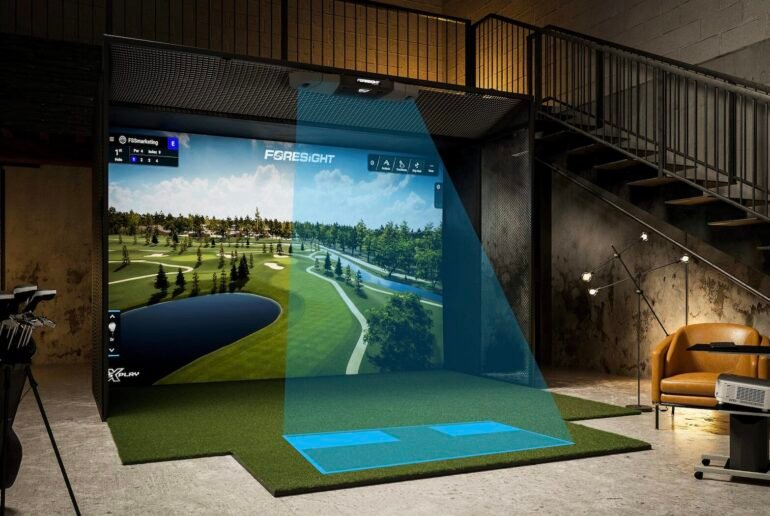
Indoor golf simulators have become more popular with golfers who want to practice at home.
These systems let players hit real golf balls and see their shots on a virtual course or range. However, buyers need to understand several important factors before they spend money on this equipment.
The right simulator depends on space, technology, budget, software, and equipment quality. Someone with a small room needs different features than someone with a large garage. The cost can range from a few thousand dollars to over twenty thousand dollars for professional setups. This article covers the main factors that help buyers choose a simulator that fits their needs and space.
Space Requirements and Ceiling Height
The room you choose for your simulator needs careful measurement. Most experts recommend a minimum space of 14 to 15 feet wide and 18 feet deep. However, these dimensions can vary based on your height and how you swing.
Ceiling height matters more than most people realise. The absolute minimum is 8.5 feet, but this leaves little room for error. A 9-foot ceiling works for many golfers, yet 10 feet provides the most comfort. Taller players or those with upright swings need more clearance above their heads.
Indoor golf simulators for training require enough space to capture accurate swing data. The sensor technology needs a proper distance from both the player and the impact screen. Without adequate room, your practice sessions become frustrating, and the data becomes unreliable.
Measure your available space before you purchase any equipment. Consider that you need room to move freely through your entire swing. The last thing you want is to hit the ceiling or feel cramped during your backswing.
Accuracy and Type of Launch Monitor (e.g., TrackMan, SkyTrak)
The launch monitor serves as the heart of any indoor golf simulator. It measures ball flight data and club performance to create realistic shot results. Different models offer varying levels of precision and price points.
TrackMan uses dual Doppler radar technology to track over 40 parameters throughout the entire ball flight. This system excels in both indoor and outdoor environments. However, it comes with a premium price tag that reflects its professional-grade capabilities.
SkyTrak offers a more budget-friendly option with photometric technology. It captures ball speed, launch angle, and backspin with solid accuracy for home use. The compact design fits easily into most indoor spaces.
The accuracy of a launch monitor directly affects the quality of practice sessions. Less precise units may give inconsistent data that can confuse rather than help a player’s game. Budget matters, but accuracy should remain the top priority for serious golfers who want meaningful feedback.
Compatible Simulation Software Options (e.g., E6 Connect, The Golf Club)
The software you choose will determine which courses you can play and what features you get with your simulator. Different programs offer various levels of realism, course libraries, and practice modes. Therefore, you need to check if the software works with your launch monitor before you buy.
E6 Connect stands out as a top choice in 2026. It offers 4K graphics and works across multiple platforms. The software includes customizable gameplay and regular updates that keep the experience fresh.
TGC 2019 remains popular because it gives players access to over 100,000 virtual courses. It works with most launch monitors and supports up to four players at once. However, the price and subscription model vary between different programs.
GSPro and FSX Play also compete in this space. Each option provides different strengths in terms of graphics quality, multiplayer features, and training tools. You should think about which courses you want to play and what practice modes matter most to you.
Budget and Total Cost Including Accessories
A golf simulator requires more than just the launch monitor. Buyers need to account for screens, projectors, enclosures, and software subscriptions. These accessories add up quickly and can double or triple the initial equipment cost.
Basic systems start under $1,000 for entry-level setups. Mid-range options typically fall between $2,000 and $5,000. Premium systems exceed $40,000 and include advanced technology with professional-grade accuracy.
The space itself may need modifications. Golfers should budget for impact screens, quality mats, and proper protection around the area. Software often charges monthly or annual fees that continue after purchase.
Hidden costs include computer requirements, mounting equipment, and potential room renovations. Some systems need specific ceiling heights or room dimensions to function properly. Therefore, buyers must calculate the complete investment before they commit to a purchase.
A realistic budget considers both upfront expenses and future maintenance. This approach helps golfers select a system that matches their financial limits without surprise costs later.
Screen and Enclosure Quality
The screen and enclosure protect the space around the simulator from errant golf balls. A quality impact screen absorbs the force of each shot without damage or bounce-back. Buyers should look for screens made from durable materials that can handle repeated impacts at high speeds.
The enclosure frames the screen and contains missed shots. It needs to be stable enough to stay in place during use. Metal frames tend to hold up better than lighter alternatives. However, the frame must also fit the available space properly.
Screen size matters for the projection area. The display should be large enough to show the full course image clearly. Most home setups work well with screens between 10 and 12 feet wide.
The screen surface affects image quality. A smooth, tight surface produces sharper visuals than loose or textured materials. Buyers should test or research how well the screen displays projected images before purchase. Poor screen quality can make it hard to see details on the virtual course.
Conclusion
A golf simulator can transform how someone practices and enjoys the game at home. However, buyers need to evaluate their space, budget, technology needs, accuracy requirements, and software options before they make a purchase. Each of these factors plays a direct role in how satisfied someone will be with their investment. The right simulator depends on individual goals, available room dimensions, and how much money a person wants to spend on both the initial setup and future upgrades.