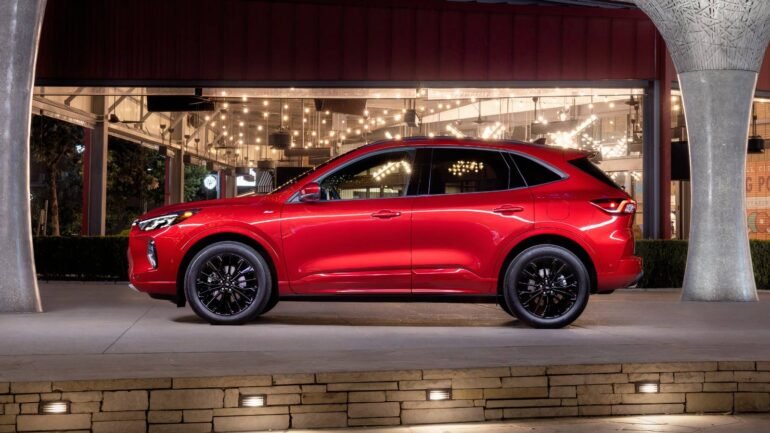
When word came from Dearborn in August that Ford would end production of the Escape crossover, understanding the logic behind the decision was not easy. Millions of Americans have owned Escapes and have relied on them for daily transportation.
Sure, its nameplate equity has been dinged by a series of unfortunate recalls (and inconvenient, to the owners), and if this is Ford’s way of addressing nagging quality issues by stopping production altogether, well, OK.

Why A Range-Extended Ford Lightning Will Be Great For The Pickup Truck Business
Newfangled Scout is already headed this direction, but Ford’s reboot is going to lift the entire pickup segment.
Recalls Certainly Haven’t Helped
But Ford also says the Escape’s lost sales volume will be picked up by its platform mate, the Bronco Sport crossover, and a number of recalls facing Escape have also applied to the Bronco Sport.
But the Bronco Sport, of course, isn’t going away, and it comes to the U.S. from Ford’s plant in Hermosillo, Mexico, which means it’s subject to a tariff (more on that later) that makes it less profitable for Ford, or more expensive for shoppers. The Escape, meanwhile, saw no U.S. tariffs from its assembly plant in Louisville, Kentucky.
Capacity Needed for EV Pickup

2025 Escape production ended last week at that plant in the Heartland, and crews are already retooling it for Ford’s future.
The automaker says the first vehicle from the updated plant will be a “fully connected midsize pickup truck,” starting in 2027 and springing from the Universal EV Platform that Ford has been developing for next-generation affordable, smaller, high-volume battery-electric vehicles that should actually make money.
Would Toyota Ditch Corolla Name?

For the bean counters, this probably all makes sense, and demographic data within Ford’s new world headquarters in Michigan probably suggest customers prefer the Bronco Sport because it is more stylish and carries the Bronco heritage and legacy even though it is less capable off-road than an actual body-on-frame Bronco.
Understood, the Escape is mainstream vanilla that doesn’t necessarily excite passions in the showroom, but then again, neither does the Toyota Corolla. How soon do you think Toyota will ditch the Corolla nameplate?
Escape Was Too Big For Its Segment

Base price for the departing 2025 Escape starts around $29,000 (and you might do better bargaining), making it Ford’s most affordable vehicle in the U.S. — and a few thousand dollars less than Bronco Sport (perhaps reflecting tariff pricing and more content).
Meanwhile, the rest of the industry has migrated to smaller crossovers like the Chevrolet Trailblazer, Honda HR-V, Toyota Corolla Cross, Nissan Kicks, Hyundai Kona, and Kia Seltos.
All of them have lower base prices than the Escape. Perhaps this is really why Escape is going away: because it’s too big for the segment’s shrinking dimensions while Ford has focused so intently on trucks and larger SUVs.
Playing Guitar With One Hand

Despite its numerous recalls, Ford sold 132,471 Escapes this year through November, outpacing both the Bronco Sport (122,380 units) and regular Bronco (132,216). If the Escape and Bronco Sport represent Ford’s right and left hands for entry-level shoppers, then eliminating the Escape is like cutting off one hand and expecting the guitar will still be played well.
For those of us old enough to remember, Ford used to make cars, trucks, minivans, and SUVs for everyone, at every price point. But the Focus, Fiesta, Fusion, Freestar, and Taurus are gone (leaving Mustang the only “car”), and Lincoln doesn’t offer a single sedan (apologies to Edsel).
Who’s Eating Whose Lunch?

I get it, crossovers, SUVs and trucks are more popular with shoppers now, but Ford, General Motors and Stellantis abandoning sedans years ago has been hard to swallow. Foreign brands didn’t give up on them so easily, yet. They are still there, fighting over those scraps, and growing overall market share in the process.
Ditching the Escape just feels like Ford is creating more opportunities for other automakers to eat their lunch.
Long-Term Plan For Affordable Vehicles

I’m no product planner, and the massive restructuring that Ford announced last week, which will cost it about $19.5 billion, might bear the necessary fruit to re-occupy the lower end of the market and make Ford products more affordable, in time. In three or four years, CEO Jim Farley might look like a genius for leading Ford down this path before other automakers (foreign and domestic) realize they need to do the same thing.
No More ‘Commodity Vehicles’

Ford’s strategy makes sense to analyst Stephanie Brinley because Ford doesn’t want to make “commodity vehicles” like the Escape anymore and because its manufacturing capacity in Kentucky is needed for the new EV architecture.
“I know what they’re trying to do, long-term,” says Brinley, associate director of AutoIntelligence for S&P Global. But she admits the Escape “is a difficult nameplate to give up. It was a terrific vehicle for Ford for a very long time. Of course, it brought them good volume and got them an entry into the (small SUV) market. It was the first compact SUV hybrid.”
Escape Returning Is A Possibility

Since its U.S. debut in 2000 as a 2001 model, Ford produced 6.34 million Escapes over the course of four generations, says Sam Fiorani, vice president for Global Vehicle Forecasting at AutoForecast Solutions. He says the more profitable Bronco Sport and Maverick — both launched from the Ford Escape’s C2 platform — “have been eating away at the Escape’s sales volume for years.”
As for disappearing nameplates, Fiorani reminds us that Bronco and Maverick were old Ford models that were later revived successfully. “With its own legacy, reviving Escape for a future model is not out of the question.”

Ford’s New HQ Reveals Mysterious Clay Models: What’s In Store?
Ford’s new HQ reveals intriguing future vehicle designs…
Many Powertrain Options If Escape Returns
As for the tariff hit on Mexican-built Bronco Sport (and Maverick), Fiorani says both comply with the U.S.-Mexico-Canada Agreement, with about 90% North American content. “This means that only about 10% of the vehicle is subject to the 25% tariff, making them no more expensive than a pre-tariff vehicle imported from Japan,” he says.
If a next-generation Escape comes along, might it be all-electric, internal-combustion only, hybrid, plug-in hybrid, or extended-range EV? It’s too early to say. But based on Ford’s announcement last week, all options appear to be on the table.
Source: Ford