By the year 2000, the “Gentleman’s Agreement” was in place. All the major manufacturers had agreed to limit high performance motorcycles to a top speed of 186 MPH (or 300 km/h). This was largely in response to how fast Japanese liter-class sports bikes were getting, as each of the big four traded blows in a bid to build the fastest production motorcycle all the way through the 90s. Safety, often taking a back seat in the name of performance, with pretty much all these bikes making far more power than their chassis, brakes and suspension could handle.
MV Agusta was not a major manufacturer, so it was not particularly surprising that when the F4 R 312 came out towards the end of the 00s with a claimed top speed of 312 km/h, or 194 MPH. Unfortunately, that top speed, while verified, could not be replicated by independent testers, which indicated some Italian “magic” may have happened before that run. By 2010, another European manufacturer was ready to put the “Gentleman’s Agreement” to bed, once and for all.
To give you the most up-to-date and accurate information possible, the data used to compile this article was sourced from various authoritative sources, including KBB. Whereas, the opinions are our own. Buying a used motorcycle always has an element of risk attached, so please do your research, and proceed with caution.
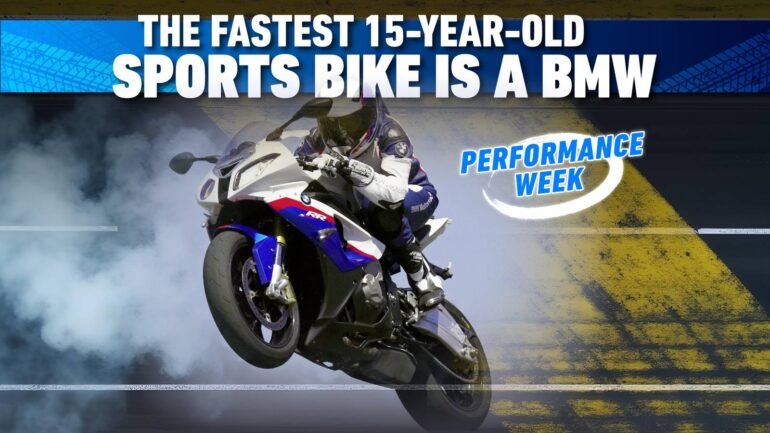
The 2010 BMW S 1000 RR Is The Fastest 15-Year-Old Sports Bike
Price Range: $7,000 – $11,000

BMW were one of the key figures lobbying for the 186 MPH limit, so it came as a bit of a shock when the S 1000 RR came out with a claimed top speed of 188 MPH. Unlike other manufacturers, this was independently verified, and once you look a little deeper it is easy to see why BMW was unafraid of ending the Gentleman’s Agreement. Manufacturers had moved on from top speed records, as modern superbikes were defined by lap times and straight line speed was defined by how fast you could get to a quarter-mile.
Even by modern standards, the 2010 S 1000 RR is an incredibly fast motorcycle, able to achieve a quarter-mile time of well under the 10-second mark. Today, trade value is sitting at $6,910. Retail value is set at just under $10k, which is impressive value for a bike that quite literally reshaped the superbike market when it came out.
Price Range
- Poor Condition: $7,000
- Trade Value: $6,910
- Good Condition: $10,000
- Great condition: $11,000
The S 1000 RR Had A Proper Superbike Engine
Power: 193 Horsepower

The S 1000 RR did have engine failures in this generation. Those rather tragic issues only affected the 2011 and 2012 models, though, and they were duly recalled. Conrod bolts on those models were not correctly torqued at the factory and had the ability to work themselves loose at high revs. Naturally, this would have rather explosive results within the engine, and because it would happen under load it was pretty dangerous, too. This issue did not affect the 2010 model.
At the time, it was one of the most powerful motorcycles on the market. Before it was launched, 200 horsepower motorcycles were all heavily modified. This made 193 horsepower from the factory. Not only had BMW made the most powerful liter-bike, but also the most sophisticated. To harness all that power required more than just a great chassis and suspension, it needed some electronic assistance.
Engine Specifications
|
Engine Type |
Inline-4, liquid-cooled |
|
Displacement |
999cc |
|
Max Power |
193 HP |
|
Transmission |
6-speed |
The S 1000 RR Brought Superbikes Into The Digital Age
In an effort to protect consumers from themselves, BMW offered the S 1000 RR with ABS as standard fitment. A ride-by-wire throttle was also standard fitment, but the world had seen these things before. The truly revolutionary rider aid came optional, and back when these bikes were new most customers had it fitted. It was one of the first superbikes to get lean-sensitive traction control, and cornering ABS. Up until this point in history, this was a feature largely fitted to bigger, heavier bikes where performance was not going to be affected by the added weight. BMW found a way to make the system lighter and more functional on a high-performance motorcycle.
This was a game-changer. Suddenly, a 200 horsepower motorcycle was more accessible than ever before. Not just in terms of price, but also in terms of ridability. All the way through the 00s, superbikes got a reputation for being wild machines that would punish inexperienced riders severely. BMW brought us into the digital age, where superbikes are still dangerous, but not necessarily lethal in the wrong hands. All the other major manufacturers followed suit, and soon pretty much every halo model came equipped with an IMU of some sort. Its chassis and suspension were good, and adjustable. But that was not why you would be buying this bike.
Standard Features
- ABS
- Ride-by-wire throttle
- Ride modes
Optional Features
- Cornering ABS
- Traction control
- Quickshifter
Chassis, Suspension, And Weight Specifications
|
Chassis |
Aluminum twin spar |
|
Front Suspension |
46 mm adjustable USD forks (4.9-in travel) |
|
Rear Suspension |
Monoshock, preload and rebound damping adjustable (5.1-in travel) |
|
Front Brake |
Dual 320mm discs |
|
Rear Brake |
220mm disc |
|
Weight |
450 lbs |
The S 1000 RR Faced Stiff Competition From Italy

All the Japanese bikes offered a similar rider experience, but were all restricted to 186 MPH, and the tech would only follow a year or two later. Ducati was already embracing technology, but 15 years is a long time for Italian wiring, so a pretty comprehensive test ride will be the order of the day.
2010 MV Agusta F4 1078 RR 312

Gorgeous. One word sums this bike up pretty well, but underneath its pretty facade lies the beating heart of a monster. It claimed to have achieved the fastest ever recorded top speed for a production motorcycle, and proudly displayed the speed in its name, but it proved difficult to replicate. All Italian bikes are made with heart and soul, and none are the same, so it stands to reason that some will be that fast, and others won’t. It certainly wasn’t as sophisticated, and will also cost more than the BMW on the used market thanks to its scarcity.
2010 Ducati 1198 S

While not officially as fast as the BMW, it was pretty close and, for all intents and purposes, the difference in top speed was negligible. The difference in base price wasn’t, though, as it was a fair bit more expensive back in the day. It was one of the few bikes that had traction control but, unlike the BMW, it wasn’t lean-sensitive and ABS was nowhere to be seen. Depreciation has been a little harder on the Ducati, so you can now have one for around as much as the BMW.
All three of these amazing superbikes had a pretty big impact on the motorcycle industry at large. But, it was the BMW which proved to be truly revolutionary thanks to how competitively it was priced – as long as you only checked the necessary options boxes – and it forced answers out of all the big manufacturers.