PARIS — For Virgil Abloh, Paris was much bigger than just Fashion Week.
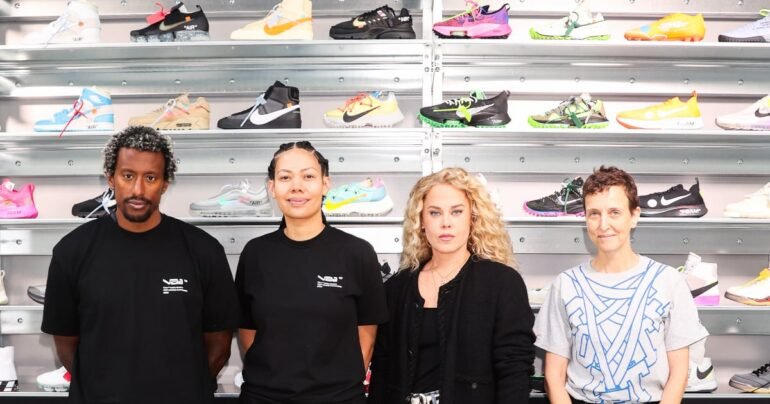
“It was home, where he lived with his family,” said Chloé Sultan, who curated the new exhibition “Virgil Abloh: The Codes” with her husband, Mahfuz Sultan. “He cared deeply about Paris — not just as a fashion capital but as a city. He collaborated with local rappers, skaters, Arabic-speaking kids and francophone performers who otherwise wouldn’t have gotten a spotlight. This was the city where so many of his dreams were realised.”
Spanning two floors in a wing of the Grand Palais, “The Codes,” which opens Tuesday on what would have been Abloh’s 45th birthday, is the centrepiece of a 10-day tribute to the late designer, who died in 2021. The ambitious event, titled “Virgil Abloh: World’s Fair,” was organised by the Virgil Abloh Archive — an arm of Virgil Abloh Securities, the entity conceived by Abloh’s widow, Shannon, to preserve his creative works and make them accessible — and underwritten by Nike, one of Abloh’s key collaborators. It takes its queues from the uniquely multidisciplinary, collaborative approach Abloh took to his projects throughout his lifetime, and includes activations and pop ups with the likes of 0fr., Abloh’s favourite Paris bookstore; Castor Fleuriste, a florist he often worked with; and Baccarat.

Abloh’s personal archive included more than 20,000 catalogued objects spanning fashion, design, music, art and ephemera, around 700 of which “The Codes” displays for the public for the first time. Highlights include a reproduction of Abloh’s office at Louis Vuitton, where he became the first Black artistic director in the history of the house, not only designing its men’s collections but giving the overall Vuitton brand fresh energy.
“Virgil was a collector and physical archivist from a young age. He was always interested in preserving parts of cultural history that were important to him, his own practice of remembering them,” said Shannon Abloh via email. “The mission of the Virgil Abloh Archive is to keep his ideas alive.”
It’s a mission that’s been complicated by last year’s sale of Off-White, the once white-hot label Abloh helmed, to Bluestar Alliance, under which it’s become increasingly detached from the designer’s vision.
Keeping the Legacy Alive
As Sultan puts it, “This show isn’t the end of the story — it’s one public chapter of the archive’s work. Virgil cared so much about his audience bringing their own point of view. That’s the spirit we hope continues.”
The exhibition doesn’t shy away from the full range of Abloh’s practice. The walls are carefully adorned with sneakers, letterman jackets, bags and luggage from the different brands Abloh designed for throughout his career. A computer station allows visitors to view blueprints from Abloh’s digital files.

“Virgil had the eagle view,” said DJ and radio host Benji B, who worked closely with Virgil as music director for his Louis Vuitton shows. “What you see here is not someone who worked for different companies, it’s someone who had different companies as vehicles for his big picture vision. It’s a through line that connects what he did for Nike with Louis Vuitton, Off-White and so on.”
Few understood the power of Abloh’s work as early as Sarah Andelman, co-founder of Colette, the Paris concept store that sold streetwear alongside high-fashion brands long before others.
Colette, which stocked t-shirts from Abloh’s first brand Pyrex Vision and went on to carry Off-White before the shop closed its doors in 2017, is having a mini-revival as a kind of gift shop selling exclusive Abloh-linked merch, from sweatpants to keychains, towards the entrance of the exhibition. “I couldn’t refuse when they asked Colette to take part,” Andelman said “They’re even screening the film ‘Colette Mon Amour.’”

“Even when he was doing a few t-shirts with Pyrex, he already had a vision for an empire,” Andelman recalled. “At Colette, we had the ground floor for T-shirts and sneakers, the first floor for luxury. Virgil’s brand sat right in the middle,” she recalled. “It was rare that I didn’t know where to put a brand!”
She sees the multi-layered format of “World’s Fair” as quintessentially Abloh. “He wouldn’t limit himself to one community — he was too curious. Paris was so important for him, and it makes sense the project unfolds across the city. That’s how Virgil worked — always bringing things together.”
Virgil Was Here
For Andelman, Abloh’s legacy lies in the doors he opened. “He showed many that everything was possible. You don’t need to study fashion in a classic way to become a creative director. You need to work hard, be curious and stay open-minded. Wherever you come from, you can make it.”
Before he died, Abloh had a hand in staging his own retrospective, “Figures of Speech,” which opened at MCA Chicago in 2019 before touring to Atlanta, Boston, Brooklyn and Qatar. Spanning fashion, art, design, music and ephemera, it was the first exhibition to capture the full scope of his practice.

“Virgil himself co-curated ‘Figures of Speech,’ so there was complete continuity between his intention and the reality of that show,” said Sultan. “‘The Codes’ is different — it’s the story told through his archive, what he left behind. It’s as much a time capsule of his era as it is a portrait of his work.”
It also emphasises the networks of collaboration and cultural currents he both drew from and amplified.
“People still feel deeply emotionally connected to, inspired by and moved by Virgil,” said Shannon Abloh. “His focus on building community and fostering belonging continues to be extremely powerful and moving. There continues to be a deep emotional need for this sort of real, authentic community-building in our cultural space.”