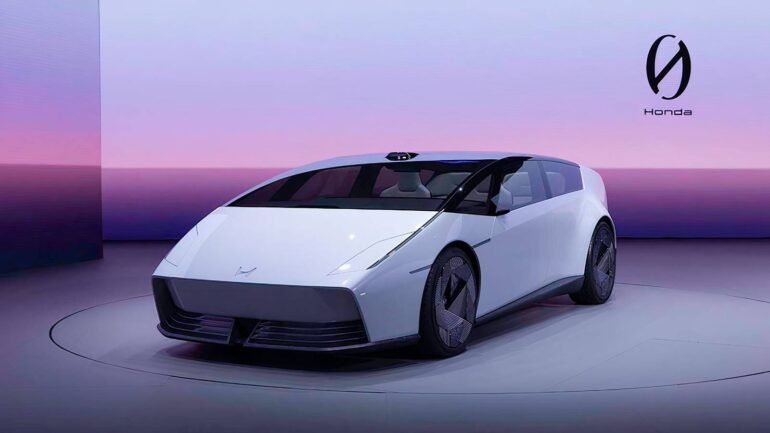
Honda aims to achieve carbon neutrality across all its products and operations by 2050 by eliminating CO2 emissions from its mobility lineup. Electric vehicles play a central role in this effort, but widespread adoption remains limited due to high costs and restricted driving range. Like many other brands partaking in the EV race, Honda is advancing battery technology and focusing on developing all-solid-state batteries in-house to address these challenges. Unlike conventional lithium-ion batteries, these next-generation units promise higher energy density, faster charging, and improved safety.

Available Models
Honda
- Founded
-
24 September 1948
- Founder
-
Soichiro Honda
- Headquarters
-
Hamamatsu, Japan
- Owned By
-
Publicly Traded
- Current CEO
-
Toshihiro Mibe
The Japanese brand has been taking a slow approach to EV adoption, but this will change in the coming years, as it already has a whole catalog planned for the American market before the decade ends. Honda’s goal extends beyond laboratory success as it works toward large-scale production that will make the technology viable for everyday vehicles. By integrating these batteries into future models, Honda plans to deliver high-performance and more affordable electric vehicles, accelerating the transition to cleaner mobility and supporting its long-term vision of a zero-emission future.
To give you the most up-to-date and accurate information possible, the data used to compile this article was sourced from various manufacturers and other authoritative sources.
Honda Is All In On Solid-State Batteries
The Japanese Brand Continues To Heavily Invest In The Technology

Honda continues to advance the development of solid-state batteries, with a focus on mass production from the earliest stages of research. Since no automaker has yet commercialized these batteries, Honda sees an opportunity to explore flexible production methods that balance innovation and practicality.
It is possible to build small experimental cells that prioritize material performance, but Honda designs its batteries with future manufacturing scalability in mind to ensure each unit meets model-specific needs for size, cost, and efficiency. The company recognizes that factors such as electrode size, structure, and stamping methods directly influence performance, cost, and quality. Its engineers, therefore, work to align material properties with production techniques to achieve a consistent standard suitable for real-world application.
Laying The Groundwork Before Taking The Production Leap

Honda evaluates the ideal battery size for the space beneath the floor and sets clear design targets based on range, cabin space, and driving dynamics when considering installation in a vehicle, simplifies material selection, and shortens the overall development cycle by integrating production feasibility into early-stage research and development. The company states that it has also taken the lead in creating proprietary technologies for manufacturing all-solid-state batteries that can be fitted to its vehicles.
Building on initial research milestones, Honda now aims to enhance battery performance further and accelerate testing toward commercialization. The company’s goal is to introduce vehicles equipped with its solid-state batteries before the end of this decade, marking a key step in its long-term strategy for electrification and carbon neutrality.
How Honda Is Turning Solid-State Into A Reality
Key Designs And Developments

Honda continues to refine the complex manufacturing process behind all-solid-state batteries, which differ fundamentally from conventional lithium-ion units. While lithium-ion batteries use a liquid electrolyte that allows ions to move easily between the anode and cathode, all-solid-state batteries rely on a solid electrolyte that requires specialized material choices and fabrication techniques to enable efficient ion flow. One key step involves stamping to increase the density of the solid electrolyte’s internal structure and applying advanced processing to create strong contact between the electrodes and the electrolyte.

Achieving this balance is a delicate process, as excessive pressure during stamping can damage the material’s microstructure, reducing performance or harming other components. With no established standard linking electrolyte density to performance, Honda approaches development with an equal focus on mass-production feasibility and functional improvement. The company says that it views this research as critical to understanding the interaction between design precision, material behavior, and manufacturing efficiency. Recognizing the advantages of roll pressing for faster production speeds, Honda has invested in mastering roll press technology as a core step toward scalable production.
Getting The Customers Involved
Honda Looks To Its Users For Answers

Honda approaches all-solid-state battery development through a human-centered philosophy that prioritizes real-world value for customers. Unlike traditional development that focuses first on verifying performance before considering production, Honda began its all-solid-state program with mass production in mind to deliver solutions that address social and environmental needs as soon as possible. Engineers first determine the ideal battery shape for vehicle integration, then identify suitable materials and production methods that balance performance and cost.
The Japanese brand follows its core “Genba, Genbutsu” principle, which revolves around developing directly at the site of creation and learning through hands-on trial and error, and identifies challenges early and sets precise goals that guide every design refinement by physically building and testing each concept.

Honda also integrates its engineering expertise with the mindset of a manufacturer deeply involved in EV production by recognizing the battery as a central element of electric vehicles. The company’s long-standing Monozukuri culture involves craftsmanship that turns research into practical products, driving its pursuit of all-solid-state battery commercialization. Its broader goal of achieving carbon neutrality across all products and operations by 2050 reinforces this direction.
As a tangible step, Honda plans to operate its demonstration line for solid-state battery production to validate and refine manufacturing technologies and will use this foundation to advance battery performance, scale up production, and move closer to installing these next-generation power units in future electric vehicles.
The Expansive Facility That Will Develop The Battery
The Factory Runs On Renewable Energy

On November 21 last year, Honda unveiled its independently developed demonstration production line for all-solid-state batteries, marking a major step toward mass production. Built at its research and development center in Sakura City, Tochigi Prefecture, the expansive facility replicates every process needed for large-scale manufacturing. It includes systems for weighing and mixing electrode materials, coating and roll pressing electrode assemblies, forming cells, and assembling modules.
With construction completed in early 2024 and key equipment now installed, Honda has already begun producing batteries on the line since the beginning of this year. This stage will focus on verifying mass production technologies, refining cell specifications, and analyzing cost efficiency. Drawing from its experience with lithium-ion batteries, Honda has incorporated a roll-pressing technique that increases electrolyte density and improves interfacial contact between electrodes and the solid electrolyte.
This method allows continuous pressing, raising productivity and reducing production time per cell. Honda is also implementing measures to cut indirect costs, such as power consumption, by optimizing production control and managing environmental conditions efficiently. The company aims to make its all-solid-state batteries cost-competitive through streamlined manufacturing while preparing to expand their use beyond cars to motorcycles and aircraft, leveraging economies of scale to further reduce costs.

Honda’s deep manufacturing expertise, proven through the successful commercialization of technologies like solar and fuel cells, underpins its progress. Development teams in materials and production engineering work in parallel, ensuring that design, structure, and manufacturing methods align with vehicle integration requirements. It’s a collaborative approach that allows Honda to establish the demonstration line quickly and advance toward full-scale production. The company targets the second half of this decade to introduce models powered by its all-solid-state batteries, reinforcing its commitment to innovation and carbon-neutral mobility.
Source: Car and Driver and Automotive News