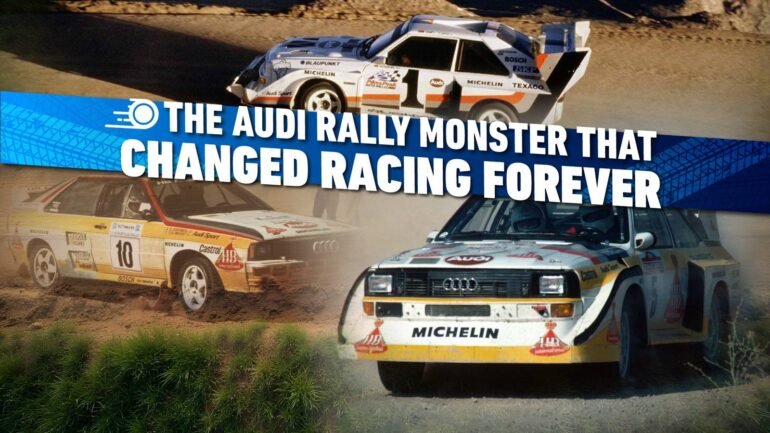
Few cars have reshaped motorsport history as profoundly as the Audi Quattro. When it roared onto the rally scene in 1980, it reinvented what was possible. At a time when two-wheel-drive cars ruled the dirt and gravel, Audi arrived with something radically different: a turbocharged, all-wheel-drive beast that defied convention and physics alike. It was the first rally car to harness full-time all-wheel drive for performance rather than utility, and its success would forever change how manufacturers approached speed, traction, and control.
Born from the engineering minds of Ingolstadt, the Quattro was a masterpiece of innovation, combining a ferocious turbocharged five-cylinder engine with a drivetrain that gave it unmatched grip in any condition. It wasn’t long before the Quattro began rewriting rally history, toppling legends and turning Audi into a motorsport powerhouse. But beyond its victories, the Quattro’s influence extended far beyond the stages of the World Rally Championship. It became a symbol of progress, defining Audi’s performance DNA for decades to come and cementing its place as one of the most important cars ever built.
From Ingolstadt to Immortality: How the Sport Quattro Rewrote Rally History

In the late 1970s, rally racing was dominated by lightweight, rear-wheel-drive cars like the Lancia Stratos and Ford Escort RS1800. These machines danced across gravel and snow with precision, but they were also prone to traction issues on slippery surfaces. Enter Audi, a company not typically associated with motorsport glory. Engineers in Ingolstadt saw an opportunity: take their experience with all-wheel-drive technology from military vehicles and adapt it for rallying. The idea was met with skepticism. Many believed that AWD systems were too heavy and complex for competitive racing. But Audi’s engineers, led by Jörg Bensinger and Ferdinand Piëch, persisted, convinced that the benefits of improved traction would outweigh the drawbacks.
When the first Audi Quattro appeared on the rally stage in 1981, it stunned spectators and rivals alike. Suddenly, the snow-covered stages of Sweden and the muddy tracks of Wales became Audi territory. The Quattro annihilated the competition, using its superior grip to accelerate, corner, and brake in ways no two-wheel-drive car could match. Hannu Mikkola and Michèle Mouton became legends behind the wheel, piloting the car to a series of victories that turned Audi from an underdog into a powerhouse. By 1982, Audi had claimed the manufacturers’ title in the World Rally Championship, proving that their revolutionary approach was a gamble that paid off.
Drivers could maintain a blistering pace even on surfaces that previously required a delicate touch. This consistency when things got slippery gave Audi a competitive edge that rivals struggled to counter. The Quattro’s success forced every major manufacturer, Lancia, Peugeot, Ford, and Toyota, to rethink their designs. Rallying had changed forever, and the term “Quattro” would become synonymous with performance and control .
Turbocharged Five-Cylinder Brilliance: The Powertrain That Shook the Competition

At the heart of the Audi Sport Quattro was a powerplant that became as iconic as the car itself: a turbocharged 2.1-liter inline-five. This engine was a masterpiece of engineering, compact, light, and immensely powerful. Producing up to 306 horsepower in its Group B rally trim (and much more in later evolutions), it combined the distinctive howl of a five-cylinder with the explosive force of turbocharging. The result was an unmistakable soundtrack that echoed through rally stages, a war cry that announced Audi’s arrival long before the car appeared.
The choice of a five-cylinder configuration was no accident. Audi engineers wanted an engine that balanced the smoothness of a six-cylinder with the compactness of a four. The result was an engine layout that offered excellent balance and torque delivery, ideal for the unpredictable terrain of elite rally racing. Turbo lag, a common issue in the early 1980s, was minimized through clever engineering, including water-cooled intercoolers and advanced fuel injection systems. When the boost arrived, it did so with ferocity, catapulting the Quattro forward.
Models like the Audi Quattro Coupe, the S2, and even modern RS models like the RS3 trace their lineage back to this motor. It proved that forced induction and all-wheel drive could coexist. The engine’s distinctive growl remains one of the most recognizable sounds in motorsport history.
Quattro – When All-Wheel Drive Became a Winning Formula

Before the Audi Quattro, all-wheel drive was seen as unnecessary for racing cars. It was associated with off-road trucks and agricultural vehicles, not high-performance machines. Audi shattered that perception entirely. Their Quattro system wasn’t a crude transfer case setup it was a precision-engineered drivetrain that distributed power seamlessly between the front and rear axles. Using a center differential, it provided constant torque to all four wheels, ensuring maximum grip regardless of surface conditions. This gave Audi’s drivers a level of confidence and control that competitors at the time could not match.
The brilliance of the Quattro system lay in its simplicity and effectiveness. Unlike other systems that required driver input to engage, the Audi’s AWD setup was permanent, always active and adaptive to road conditions. Whether carving through gravel, snow, or tarmac, the Quattro delivered unflappable stability. Drivers could apply power earlier in corners, brake later, and maintain higher average speeds without losing control. Rally spectators quickly noticed the difference the Quattro didn’t slide as much as its rivals, but it was devastatingly fast, gliding through turns with clinical precision while others fought for traction.
What started as a rally experiment quickly filtered into Audi’s road cars. The brand realized that Quattro wasn’t just a motorsport advantage it was a selling point. By the mid-1980s, Quattro technology had become a cornerstone of Audi’s identity, appearing in performance sedans and coupes. It redefined how consumers viewed all-wheel drive, transforming it from a niche feature into a hallmark of performance and safety. The Quattro system helped the brand carve out a unique position in the global automotive market.
The Homologation Special That Defined Group B

To compete in the legendary Group B rally era, manufacturers were required to build a limited number of road-going versions of their competition cars. For Audi, this meant the birth of the Sport Quattro a shorter, more agile, and more powerful version of the original. Introduced in 1983, the Sport Quattro was Audi’s ultimate homologation special, a car designed purely to dominate the world’s most dangerous and exhilarating motorsport category. Only 214 units were produced, making it one of the rarest and most coveted rally-derived cars ever built.
The Sport Quattro’s design was all business. Its wheelbase was shortened by nearly 12 inches to improve agility, while the body made extensive use of lightweight materials like Kevlar and fiberglass to offset the weight of the AWD system. Under the hood, the upgraded turbocharged five-cylinder engine produced more than 300 horsepower, while advanced suspension tuning allowed for razor-sharp handling. It may not have been as nimble as later Group B legends like the Peugeot 205 T16 or Lancia Delta S4, but it paved the way for them.
As Group B escalated into an arms race of speed and danger, the Sport Quattro became a symbol of both the glory and the madness of the era. It demonstrated what could be achieved when engineering was pushed to its absolute limit, but it also foreshadowed the tragic end of Group B in 1986. When the FIA banned the category due to safety concerns, the Sport Quattro’s competitive career was cut short, but its legend was sealed. Today, collectors and enthusiasts view the car as a piece of motorsport history, a testament to Audi’s audacious spirit and uncompromising pursuit of innovation at the time.
Legacy of a Legend: How the Sport Quattro Shaped Audi’s Future Performance DNA

The legacy of the Audi Quattro extends far beyond its rally victories. It transformed Audi’s identity from a conservative automaker into a symbol of cutting-edge performance and engineering excellence. Every modern Audi performance model from the RS3 to the R8 owes a debt to the Quattro philosophy. The principles that defined the rally car balanced power delivery, all-weather traction, and turbocharged performance, became core elements of Audi’s DNA.
Technological innovations that debuted with the Quattro would evolve over time into advanced systems like Audi’s torque-vectoring all-wheel drive and adaptive suspension. Even as the automotive landscape shifted toward electrification, the essence of Quattro lives on in the brand’s e-tron models. These vehicles use electric motors on each axle to mimic and enhance the same traction and stability principles that made the original Quattro unbeatable. In a sense, Audi’s rally heritage has been reimagined for the electric age, ensuring that the brand’s performance identity remains intact even as its powertrains evolve.
More than four decades after its debut, the Audi Quattro continues to command respect from enthusiasts. It stands as proof that innovation often comes from daring to defy convention. In a world where rear-wheel drive was considered the only path to performance, Audi’s engineers took a different route and changed everything. The Quattro laid the foundation for how modern cars deliver power and control. From snowy mountain passes to high-speed racetracks, the Quattro spirit endures as a reminder that true legends never fade.