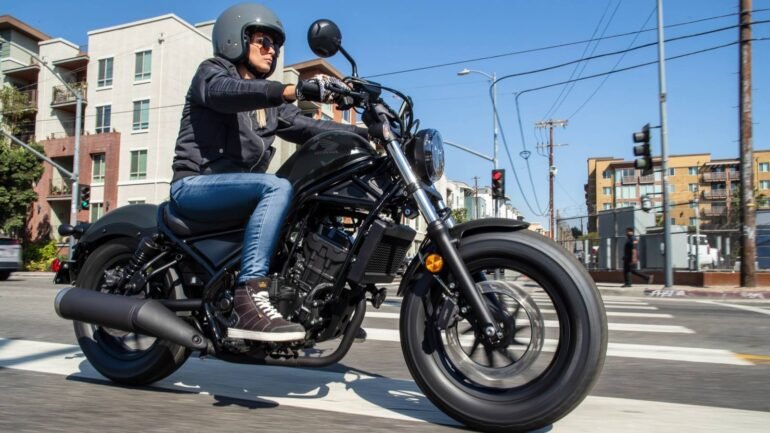
There are a few reasons why small cruiser motorcycles make excellent first bikes. They’re low, comfortable, and simple, while boasting predictable power delivery. But things can always get better, and this is something Honda usually tries to prove with incremental updates. Doing just that for MY26, the bikemaker has whipped up arguably the perfect beginner cruiser for city riding. All that is down to an innovative technology never seen before in this segment (or even a segment above). It does come with a couple of catches, though. More on that later.
To give you the most up-to-date and accurate information possible, the data used to compile this article was sourced from authoritative sources, such as Honda Powersports.
The Rebel 300 Now Has Honda’s New E-Clutch Technology
No Need To Use Your Left Hand When Shifting

We all know the Rebel 300 has one of the most reliable entry-level engines in the market today. It’s also proven to be really good at city duties, both in terms of smoothness and fuel efficiency. Building on that idea, the latest update brings Honda’s E-Clutch technology to the baby cruiser, replacing the conventional setup on the 2025 bike.
This means you can now go up or down the transmission without physically using the clutch lever. More importantly, you don’t have to feather the clutch while riding off from a standstill. That’s something new riders usually struggle with, so it means extra convenience. Oh, and don’t forget about bragging rights since no other bike offers this in the segment.

As a refresher on the engine, you get a 286cc single-cylinder mill with a 76 mm bore and 63 mm stroke, paired with a six-speed transmission. Along with liquid cooling, the baby Rebel churns out 27 horsepower and 20 pound-feet–one of the highest figures in the sub-300cc segment, second only to the Chinese-made Benda Chinchilla 300. It’s a sports bike-derived mill, though, so you’ll need to rev this a bit.
Honda E-Clutch Benefits
- More precise than hand shifting
- No need to use the clutch while downshifting or upshifting
- Uses throttle-by-wire tech
- No clutch needed when pulling off from a standstill
- Can be disengaged anytime if you want full clutch control
2025 Honda Rebel 300 Engine Specs
|
Engine |
286cc, single-cylinder |
|
Power |
27 horsepower (Europe) |
|
Torque |
20 pound-feet (Europe) |
|
Compression ratio |
10.7:1 |
|
Transmission |
Six-speed |
|
Fuel efficiency |
~57 MPG (tested by CycleWorld) |
Compact Dimensions Help The Rebel 300 Remain Easy To Live With
Although The New Clutch Makes It Heavier Than Before

There’s a small price to pay for the E-clutch. The weight of the Rebel rises from 364 pounds to 379 pounds. While that’s a sizable jump, it’s still one of the lightest bikes in the segment today. Other than this, nothing has changed in the underpinnings department. A tubular chassis houses the single-cylinder engine, while being suspended on telescopic forks and dual rear shock absorbers. This is topped with 16-inch alloy wheels, each of which houses a single disc brake.
What also hits home for the Rebel is its easy-going dimensions. The saddle height is low (27.2 inches), and the wheelbase is tight (under 60 inches). Add to that the low rider-only saddle and slightly forward-set pegs, and this is a comfy position newbies will appreciate. While all of it follows the norm in the segment, we would’ve appreciated some upgrades here. After all, the Rebel has been unchanged in this aspect ever since its inception.
2025 Honda Rebel 300 Underpinnings And Dimensions
|
Chassis |
Tubular steel |
|
Front suspension |
41 mm telescopic forks |
|
Rear suspension |
Dual shock absorbers |
|
Wheels |
16/16-inch alloys |
|
Brakes |
Single discs with Nissin calipers |
|
Weight |
364 pounds |
|
Seat height |
27.2 inches |
|
Wheelbase |
58.6 inches |
Lack Of Modern-Day Features Remains A Pain Point On The Rebel 300
You Do Get A Handful Of Accessories, Though

As much as we appreciate the inclusion of the E-clutch, we can’t help but feel sad about the lack of overall features on the 2026 Rebel 300. It is as basic as entry-level bikes come, comprising features like a simple LCD instrument cluster that shows basic information like speed, fuel level, and RPM. Neither ABS nor smartphone connectivity is present, which is something all of its rivals boast.
It’s the same story with the design. Round lights, exposed chassis, and chunky tires have all been carried over, and so has the distinct upswept fuel tank we see on other Rebels. You do get new colors, though, namely Pearl Smoky Gray and Matte Black Metallic. If you want more pizazz, we’d suggest you delve into the accessories catalog. It’s surprisingly vast, with a handful of affordable yet quality bits.
2025 Honda Rebel 500 Official Accessories
- Headlight cowl: $100.25
- Custom seat: $69.95
- Tank pad: $19.02
- Passenger backrest: $119.95
- Passenger seat and pegs: $154.95
- Leather saddlebags: $209.95 (saddle stay sold separately)
The New Rebel 300 Now Costs Over $5,000
Pricier Than All Of Its Direct Rivals

Finally, with the E-clutch comes a sizable price revision for the Rebel 300. The base price now sits at $5,349–a sizable $500 hike over the 2025 model. There’s no option to have the non-E-clutch model, either, so this is what you’ll have to pay now. At this price, the Rebel becomes pricier than all of its direct rivals. For instance, the Royal Enfield Meteor 350 and Benda Chinchilla 300 are both $500 cheaper than the Honda while offering more features. So it all comes down to whether you truly value a clutchless experience on your first cruiser. Else, the extra money doesn’t seem justified on paper.
Honda Rebel 300 Vs Rivals
|
Specs |
Rebel 300 |
Chinchilla 300 |
Meteor 350 |
|
Engine |
296cc, single-cylinder |
298cc, V-twin |
349cc, single-cylinder |
|
Power |
27 HP |
30 HP |
20 HP |
|
Torque |
20 LB-FT |
19.5 LB-FT |
20 LB-FT |
|
Transmission |
Six-speed |
Six-speed |
Five-speed |