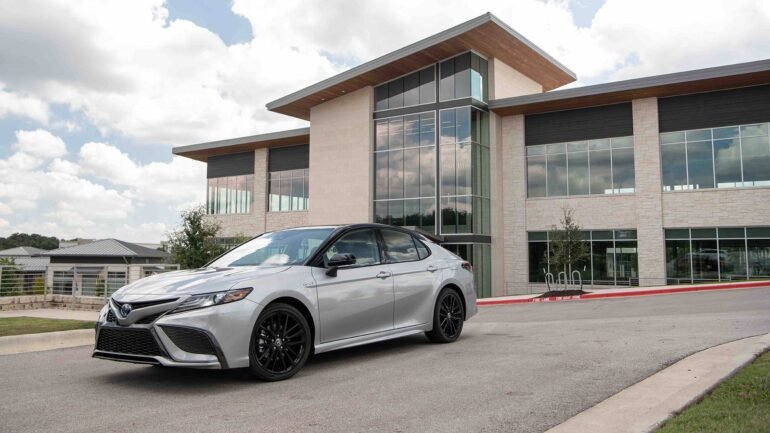
The Toyota Camry remains a competitively priced and in-demand midsize sedan in the American market, which is a considerable feat considering how crossovers and SUVs have all but taken over. Brands are positioning these high-riding options as more versatile and practical family cars, but there are many who still see the value in owning a sedan.
With the 2026 model year now starting at $29,000 for the base LE, there are many that are starting to find this option to be a bit out of their budget. With that in mind, there may be a bit of value in considering a slightly used 2023 model year option. While they are technically different generations, the now defunct ICE range remains a modern sedan that’s mechanically very similar to the new-generation one.
The 2023 Toyota Camry’s Appealingly Low Ownership Costs

The Edmunds True Cost To Own calculator indicates that a base 2023 Toyota Camry SE will cost you $43,821 to own over five years. $10,313 accounts for depreciation, while you’ll find yourself spending $5,329 on maintenance and $1,685 on repairs. Owner reviews from the same publication currently sit at 4.5/5, with most owners applauding its overall dependability and reliability.
2023 Toyota Camry True Cost-To-Own
|
Year 1 |
Year 2 |
Year 3 |
Year 4 |
Year 5 |
Total |
|
|---|---|---|---|---|---|---|
|
Insurance |
$1,336 |
$1,376 |
$1,417 |
$1,460 |
$1,504 |
$7,093 |
|
Maintenance |
$700 |
$474 |
$2,240 |
$724 |
$1,191 |
$5,329 |
|
Repairs |
$106 |
$256 |
$375 |
$437 |
$511 |
$1,685 |
|
Taxes & Fees |
$2,312 |
$208 |
$201 |
$190 |
$179 |
$3,090 |
|
Financing |
$1,646 |
$1,329 |
$986 |
$620 |
$225 |
$4,806 |
|
Depreciation |
$3,683 |
$1,083 |
$1,762 |
$1,694 |
$2,091 |
$10,313 |
|
Fuel |
$2,167 |
$2,232 |
$2,299 |
$2,368 |
$2,439 |
$11,505 |
|
True Cost to Own |
$11,950 |
$6,958 |
$9,280 |
$7,493 |
$8,140 |
$43,821 |
According to Kelley Blue Book, you can expect to pay as little as $27,084 for a used 2023 Toyota Camry. Pricing depends on the example’s overall condition and specification. J.D. Power indicates that you can pay as much as $23,196 to $38,070, but there are a couple of examples on Edmunds that sell for as little as $22,000. When new, the 2023 Toyota Camry’s pricing started at $26,320 for the base SE, which means that the range benefits from a really impressive value retention rate that outperforms most of its rivals in the segment. iSeeCars‘ valuation on the 2023 Camry indicates that you can expect this model to lose $10,829 in value since new, reflecting a 62.3 percent value retention.
The Camry V-6 Will Cost More To Own

If you want the more aspirational Camry V-6, available in XSE, XLE, and TRD trims, Edmunds indicates that you can expect to spend $52,616 in five years of your ownership experience. This includes $5,793 on maintenance, $1,685 on repairs, $13,149 on depreciation, and $14,153 on fuel. Toyota put this engine option to rest with the new-generation model due to low demand and to place a stronger focus on electrification.
An Impressive Market Reputation

The 2023 Toyota Camry is the best option for you to consider if you’re looking for a used sedan that will surpass 200,000 miles without any significant mechanical issues and cost you less than $30,000 up-front, excluding the high trim and V-6 variants.

Including the hybrid and V-6, J.D. Power gives the 2023 model an 88/100 quality and reliability rating, together with an 81/100 driving experience and 83/100 resale value rating. This brings the overall score up to 84/100. iSeeCars issues the very same model an 8.9/10 score for reliability, indicating that it will last 12.9 years without any noteworthy mechanical faults, together with a 31.3 percent probability of reaching 200,000 miles. This is the publication’s highest-rated used midsize sedan under the $30,000 mark.

Beyond reliability ratings, the 2023 Toyota Camry also proves itself to be a well-rounded car. Several reviewers highlight its impressive fuel economy, standard advanced safety and driver assistance features, comfortable ride, easy-to-use controls, and abundant trunk space as key positives of the user experience. However, you do need to be mindful of its poor braking abilities on wet surfaces, limited access due to the lowered ride height, and finicky phone pairing software. The V-6 also earns some respect for performance, but this comes at a considerable cost of fuel consumption.
Understanding The Camry’s Impressive Market Reputation

The Toyota Camry earned its strong reputation in the U.S. through decades of consistent reliability, affordability, and comfort that align with American driving priorities. Introduced in the early 1980s, it quickly became the benchmark for midsize sedans by combining efficient performance with a solid reputation for longevity, often exceeding 200,000 miles with routine maintenance. Toyota sold the Camry in most global markets, but today the moniker only exists in a few regions, including the U.S. and some parts of Europe, as the SUV craze has made it obsolete in other regions. Even the Japanese market doesn’t have access to this midsize sedan anymore.

Toyota’s conservative engineering approach favored proven powertrains and durable materials, helping the Camry maintain dependable operation even as competitors focused on more complex or performance-driven designs. Its ride quality, quiet cabin, and strong resale value made it a staple choice for families, commuters, and fleet buyers alike. The Camry has always come under fire for being a boring and mundane option, but the sales results and its reputation speak for itself. It continues to stand in a segment where many others have considerably failed.

Up until now, the availability of both four-cylinder and V-6 engines has ensured a balance of fuel economy and smooth power delivery. The modern hybrid models now appeal to the more popular cost-conscious drivers seeking better fuel consumption returns. The Camry’s interior design emphasizes practicality, with user-friendly controls and robust build quality that stand the test of time better than most rivals. Standard safety features, especially after Toyota’s inclusion of Safety Sense technology, also reinforce its trustworthiness. Camry owners are also traditionally more hands-on with maintenance, which is why they typically present themselves in better condition, making them more trustworthy used purchases.
Impressive Performance Returns From The V-6

The entry-level Toyota Camry models feature the same 2.5-liter four-cylinder drivetrain that you’ll find in the current-generation hybrid-only model, but obviously without the electrical assistance. Regardless of whether you opt for the front-wheel drive or all-wheel drive system, you get to make use of 203 horsepower and 184 pound-feet, sent to the wheels via an eight-speed automatic. The result is an eight-second zero to 60 MPH acceleration time and 115 MPH top speed.
2023 Toyota Camry Performance Specs
|
Powertrain |
2.5-Liter Four-Cylinder |
3.5-Liter V-6 |
|
Horsepower |
203 HP @ 6,600 RPM |
301 HP @ 6,600 RPM |
|
Torque |
184 LB-FT @ 5,500 RPM |
267 LB-FT @ 4,700 RPM |
|
Transmission |
Eight-Speed Automatic |
Eight-Speed Automatic |
|
Driveline |
Front-Wheel Drive or All-Wheel Drive |
Front-Wheel Drive |
|
0-60 MPH |
8.0 Seconds |
5.8 Seconds |
|
Top Speed |
115 MPH |
130 MPH |
Toyota only sold the 3.5-liter V-6 with a front-wheel drivetrain, also driven by an eight-speed automatic. This produces 301 horsepower and 267 pound-feet, which is enough to get it to cover a zero to 60 MPH sprint in 5.8 seconds before hitting a limited 130 MPH top speed.
Appealing Fuel Consumption Returns

When it comes to fuel efficiency, the four-cylinder 2023 Camry models offer highly attractive fuel consumption returns. The front-wheel drive model returns a 28/39/32 MPG estimate on the city/highway/combined cycle, while covering 506 miles on a single 15.8-gallon tank. You can expect to save $1,000 in fuel costs over the course of five years, spend $1,400 on fuel every year, and $2.36 to drive 25 miles. The tank also costs about $48 to refill. Upgrading to the all-wheel drive model worsens the consumption to 25/34/29 MPG and cuts the range to 418 miles. You’ll still save $250 in fuel costs over five years, spend $1,550 on fuel every year, and $2.60 to drive 25 miles. This features a smaller 14.4 gallon fuel tank, meaning you’ll spend $43 to refuel.
2023 Toyota Camry EPA Fuel Consumption Estimates
|
FWD |
AWD |
V-6 |
|
|
Gas Consumption (city/highway/combined) |
28/39/32 MPG |
25/34/29 MPG |
22/33/26 MPG |
|
Range |
506 Miles |
418 Miles |
411 Miles |
|
Five-Year Fuel Savings |
$1,000 |
$250 |
-$750 |
|
Annual Fuel Cost |
$1,400 |
$1,550 |
$1,750 |
|
Cost To Drive 25 Miles (EV/Gas) |
$2.36 |
$2.60 |
$2.90 |
|
Cost To Fill The Tank |
$48 |
$43 |
$48 |
|
Tank Capacity |
15.8 Gallons |
14.4 Gallons |
15.8 Gallons |
The V-6 returns 22/33/26 MPG and covers 411 miles. Being front-wheel drive, it retains the 15.8-gallon tank. You will find yourself spending $750 more on fuel compared to the average new car over five years, spending $1,750 on fuel every year, and $2.90 to drive 25 miles.
Sources: Edmunds, iSeeCars, J.D. Power, and the EPA