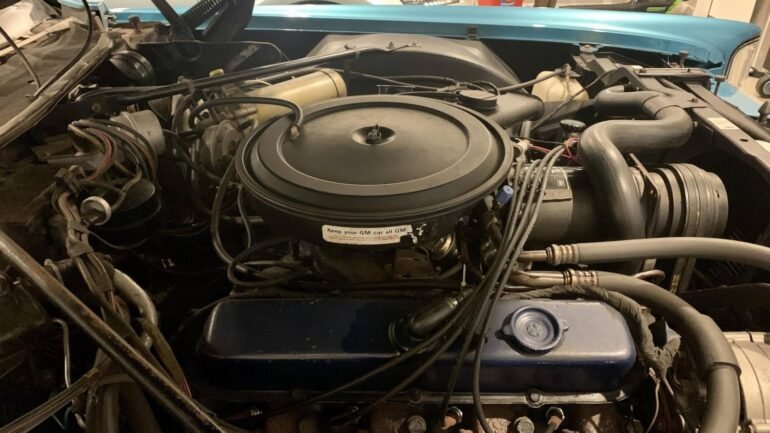
The V8 engine configuration has single-handedly carved the iconic American car industry. Sure, there have been plenty of iconic six-cylinder car engines like the Slant Six and Pentastar, and America has also not shied away from going mental with mighty V10s, like the Dodge Viper V10. However, the V8 remains the foundation of power, torque, brute force, and cool nicknames.
We have curated ten legendary American V8s that powered everything from rare, iconic cars dating back to the 1940s to muscle cars, to now-defunct vehicles from the likes of AMC and Oldsmobile. Ford, Chevrolet, Buick, and Cadillac (among many) have impactful stories to tell about specific V8 engines that are extinct now. However, its fame, glory, and nicknames are still quite widespread among gearheads.
This list is organized in increasing order of base horsepower ratings, from the least powerful to the most powerful legendary American V8 engines.
10
Ford “Y-Block” V8
The Tower Of Power (130–300 Horsepower)

This V8 engine got the “Y-Block” name from its rigid and deep-skirted block design. The “Y-shaped” design was in place to increase strength. This design provided sufficient strength to support the crankshaft and reduce engine vibrations, a significant improvement over older flathead V8s. Other notable engine features include an overhead-valve (OHV) design. In fact, this engine was Ford‘s first-ever mass-produced OHV V8, which translated into better breathing and higher performance.

The engine design also repositioned the distributor to the back of the mill, unlike other popular Ford V8s of the time. This engine was produced from 1954 to 1962 for passenger cars and up until 1964 for trucks and in various displacements, including 239, 256, 272, 292, and 312 cubic inches. Power ranges from 130 to 300 horsepower, and torque ranges from 214 to 415 pound-feet. Notable cars that packed the “Y-Block” Ford V8 include the Thunderbird, the Fairlane, the Customline, the Ranchero, and Mercury and Edsel models of the 1950s.
Cool Trivia
- Used in early 1950s-60s Fords
- Nickname came from its tall, stacked design.
- Overshadowed by the later Windsor and Cleveland engines
9
Oldsmobile Rocket V8
Rocket Power (135–400 Horsepower)

This engine is often considered to be the first mass-produced, high-compression, overhead-valve V8 from General Motors. It is famed for features such as a short-stroke design that reduces internal friction. This, and features like high-compression ratios and overhead-valve setups, were considered bleeding-edge for the time. This engine was offered in various displacements, from a peppy and powerful 303 cubic-feet to a chunky 394 cubic-feet.

The initial models produced 135 horsepower and 283 pound-feet of torque, while the later, larger version produced as much as 400 horsepower in some configurations. Its performance makes it a popular option for hot-rod builds, and the Rocket V8 was also used in the original “Rocket 88” race car, which was highly successful in early NASCAR races and even influenced rock ‘n’ roll music. Notable cars utilizing this V8 include the Cutlass, the Toronado, and the 442. It was later adapted for use in GMC heavy-duty trucks.
Cool Trivia
- Among the first high-compression V8s in the ’40s
- Nickname got commercialized out of gearhead culture.
- Became a household name… then vanished.
8
Chevrolet 283 V8
Little Demon (185–290 Horsepower)

This iconic V8 pushed the envelope of performance in the 1950s and 1960s. It is considered the first production engine to achieve one horsepower per cubic inch (when equipped with the Ramjet fuel injection system). It is known for its high-revving character and use of high-performance parts like solid-lifter cams. Despite its performance appeal, the Chevy 283 V8 is also known for its durability and reliability. It was built with a thick cylinder block casting to prevent distortion.

Furthermore, various configurations, ranging from milder two-barrel carburetor versions to the high-performance Ramjet fuel-injection models, made the 283 quite the versatile mill. It was used in everything from Chevy passenger cars and trucks to the mighty Corvette, for which this V8 is most popular. Power ratings ranged from 185 to nearly 290 horsepower. Other notable cars powered by this engine include the El Camino, the Bel Air, and the Impala.
Cool Trivia
- Predecessor to the 327 and 350
- Known for screaming at high RPMs in light bodies
- Lost in the shadow of its bigger brothers
7
Cadillac 500 V8
Torque King (190–400 Horsepower)

The highlighting feature of this V8 is its insane size. The Cadillac 500 V8 is an 8.2-liter giant designed to churn out meaty low-end torque and offer a luxury-oriented, durable driving experience. At the time, the Cadillac 500 V8 was the largest American V8 in a passenger car. It has a 4.304-inch bore and 4.304-inch stroke and produces 550 pound-feet of torque, with most of it available from as low as 3,000 RPM.

The engine was built on a fresh-sheet design, featuring a more modern combustion chamber and a bypass-style thermostat for improved cooling efficiency. Initially, this mill was exclusive to the 1970 Front-Wheel Drive Cadillac Eldorados. However, by 1975, this V8 was available on a wider range of Caddys, including the Deville and the Fleetwood.
Cool Trivia
- The biggest production V8 of its time
- Torque figures that shamed muscle cars
- Now forgotten in the era of downsizing
6
AMC 390 V8
Rebel Rumbler (315–340 Horsepower)

The 390 V8 is known for its high-performance character and is one of those underrated American V8s of yesteryear. Durability is a strong point thanks to features like a forged steel crankshaft and connecting rods, and unique design elements (for the time) like a larger oiling capacity for the distributor gears. In terms of size, it produced notable muscle, with 315 horsepower and 420 pound-feet of torque on later 1960s models.

It was dialed up to 340 horsepower and 430 pound-feet of torque on the mighty 1970 Rebel Machine. Other notable engine features include a large lifter foot, providing greater cam lobe contact area and reduced unit loading; two-bolt mains; and a short-stroke design. Notable AMC cars that utilize this engine include the AMX, the Rebel Machine, and even the Ambassador and the Matador. This engine was also offered, in different states of tune, on the Jeep CJ and even larger AMC cars like the Hornet, Gremlin, and Pacer.
Cool Trivia
- Found in the AMC Rebel Machine
- Nickname died with the brand, but the power was absolute.
- AMC fans still whisper it at car meets.
5
Pontiac 389 V8
Tri-Power Goat Stoker (315–368 Horsepower)

This engine is built like a tank, with a cast-iron block. But the 398 V8 became a sensation for its muscle, especially on the early Pontiac GTOs. The jacked-up tri-power carburetor system is a legendary option of the 398 V8, featuring three twin-barrel carburetors that significantly increase power to nearly 370 horsepower. For reference, the 1960s Lamborghini Miura produced 345 horsepower!

An innovative feature of this engine was its “gusher” cooling system and mounted rocker arms on ball pivots, which provided more consistent valve action. Apart from the GTO, this engine was also utilized on the Grand Prix and the Bonneville models. Furthermore, even the full-sized Pontiac Catalina also came with various versions of the 389, including two-barrel, four-barrel, and even the mighty “Tri-Power” configurations.
Cool Trivia
- Made famous in early GTOs
- Nickname tied to its triple-carb setup
- “Tri-Power” was phased out as emissions tightened
4
Chevrolet 409 V8
Bubbletop Bruiser (340–425 Horsepower)

The Chevy 409 V8 has a special place in American pop culture. It was immortalized in the popular Beach Boys’ song “409”, which has now made it a highly sought-after engine for collectors. This mill has a unique combustion chamber design, located in the cylinder instead of the head, which helps with a highly turbulent fuel mixture for increased torque and knock resistance. Features like dual four-barrel carburetors and solid lifters prioritized high torque, which is why it has earned its cultural status as a legendary muscle car engine.

Power ratings range from 340 to 425 horsepower. It also featured bleeding-edge components for the time, like forged pistons, large intake valves, and a mechanical camshaft. This V8 engine was used in various full-sized Chevys from the early 1960s, including the Impala, Biscayne, and Bel Air. It was more popular as the go-to high-performance option for the Impala SS trim.
Cool Trivia
- Immortalized in the Beach Boys song
- Often paired with the early Impala “bubbletop” coupe
- Faded as the 396 and 427 took over
3
Buick 455 V8
The Earth Mover (350–360 Horsepower)

This engine is famed for its lightweight construction. The 455 V8 has a thin-wall casting, which made it the lightest GM big-block of the time. Simplicity was also a key highlight here, with this engine featuring a distributor-driven oil pump and through-pushrod oiling. Refinement levels were on the higher end when compared to other powerful V8s of the time. This engine has a 4.31-inch bore and a 3.90-inch stroke, and is known for insane torque figures. The base model produces 350 horsepower and 510 pound-feet of torque.

But that’s not all: there is a more powerful Stage 1 version, introduced in 1970, rated at 360 horsepower and 510 pound-feet of torque. But many dyno runs done later on estimated this mill to pack closer to 400 horsepower. Buick used the 445 V8 in various models from the early to mid-1970s, including the Grand Sport (GS), Skylark, and Centurion. It also powered a bunch of other full-sized cars like the Electra, LeSabre, Riviera, and Estate Wagon.
Cool Trivia
- Famous for torque, not revs
- Nickname faded as muscle cars died off.
- A legend in full-size Buicks and GS models
2
Mopar 413 Max Wedge V8
Ramcharger (410–410 Horsepower)

Maximum Performance Wedge (or popularly called — Max Wedge) was an engine option by then Chrysler-owned Mopar in the early 1960s, reserved for the B platform Dodges and Plymouths. While it was offered in two iterations (413 and 426 cubic feet), it is the latter that tickles our senses. The 413 V8 was offered in 410 and 420 horsepower versions. Dodge called it the “Ramcharger 413,” while Plymouth called it the “Super Stock 413.” The Max Wedge V8 was actually a high-performance version of the 413 RB Block motor from Chrysler. The Max Wedge was in development since 1959 and is now famed for its “short ram” induction system.

This engine, although street-legal, was intended for racing purposes. Notable features of the 413 Max Wedge V8 include wedge-shaped combustion chambers, a cross-ram intake with twin four-barrel carburetors, and large-port cylinder heads for improved airflow. Notable cars that packed this engine include various 1962-1964 Dodge and Plymouth models. Dodge offerings include the 330, 440, Polara, and Polara 500. Plymouth models include the Savoy, the Belvedere, the Fury, and even the Sport Fury.
Cool Trivia
- Not just a truck name—refers to high-performance 413s
- Rare and wild, with cross-ram induction
- Preceded the HEMI but is now mostly forgotten
1
Ford 427 SOHC V8
Cammer (616–657 Horsepower)

This high-performance V8 engine from the 1960s is known for its innovative single-overhead-camshaft-per-bank layout, hence the “Cammer” nickname. The 427 V8 also features hemispherical combustion chambers and a radical valvetrain design. Many other performance-oriented features helped the 427 achieve insane power ratings, including over 600 horsepower in its race trim. Its lightweight valvetrain setup allowed this V8 to rev to over 7,000 RPM. Its “hardcore” fame was cemented when NASCAR banned this V8 from the stock racing league for being too powerful.

Technically, this engine was not offered in production cars since it was a high-performance racing engine. But today, we do come across custom-built specimens like this ERA 427SC Roadster. However, heavily modified and, of course, de-tuned versions of this mill were available for a limited time in cars like the Ford Galaxie, the Mercury Marauder, and even the 1960s Mercury Cougar GT-E and Ford Fairlane 500s.
Cool Trivia
- Designed for NASCAR, banned before it could shine
- “Cammer” referred to its overhead camshaft design.
- Now, a rare unicorn known only to the hardcore
Sources: Hemmings, Classic.com