We live in a pivotal moment in the automotive world, where the market has become increasingly competitive—more so outside the United States, where open competition from Chinese automakers is prevalent. Brands like BYD have placed pressure on other automakers with their quick development times, which can be as short as 18 months.
This is both a positive and a negative aspect. For one, it is good in the sense that new cars keep consumers interested, but too many new cars being rolled out means the market can be saturated with too many new models, where there aren’t enough new buyers relative to the speed of the product cycles. Toyota, however, has reportedly decided that, according to Nikkei, the Japanese automaker will now double the product life cycle of its vehicles. Is that the right strategy for Toyota, or is that too long of a product life cycle?

10 Legendary Toyota Engines That Refuse To Die
These are the engines that built Toyota’s legacy of reliability.
Nearly A Decade Life Cycle

Traditionally, Toyota would completely redesign a vehicle at around the four or five-year mark, with an accompanying facelift in the middle of its life. This time, however, Toyota is doubling that to nine years, or basically nearly a decade, but it must be noted that the Nikkei says that this will be applied to its flagship models.
Heavy Refresh To Be The Norm

With this long product cycle, Toyota seems to be implementing a strategy where its vehicles will receive a heavy facelift in the middle of their generational life cycle. The changes are significant enough that they will come with a boost in features and an improved driving experience, but the mechanics underneath and the platform it will use are still heavily related to the models they are replacing. With this strategy, Toyota can redesign a vehicle significantly enough, but the platform and mechanicals are largely the same as the model they’re replacing—albeit with significant redesigns under the skin.
Software-Driven Improvements

But if the vehicle hardware is going to stick around for nearly a decade, how will Toyota keep its products fresh for that long? Well, that’s where this shift towards software-defined vehicles (SDV) comes into play. The SDV era is coming closer to Toyota with the release of its Arene operating system (OS). Developed by Woven by Toyota, Arene OS can add or improve vehicle functionality through a mere over-the-air (OTA) update, just like how you’d update your smartphone these days.
OTAs will definitely improve the value of the vehicle. Usually, in a non-SDV vehicle, you’re pretty much stuck with whatever features you got when the car was purchased. Here, even in a couple of years, your Toyota will still be able to receive new features. If this level of consistent software updates are maintained throughout the nearly a decade life span, your Toyota will still be as modern software-wise as any new Toyota model on the market. This also helps maintain its resale value, since the car remains relevant even when it’s already nearly a decade old.

The 2-Year-Old Toyota Hybrid SUV That You Should Buy Used
This hybrid SUV is still one of the best-selling ones on the market, and here’s why even a two-year-old model is worth looking at today.
It’s All Strategic

Keeping a car mechanically similar for nearly 10 years seems like the perfect recipe for having outdated vehicles. However, as Toyota will reportedly only apply this to its flagships, this is all strategic for them.
Long Demand, Stable Interest

If you want an example of a flagship Toyota model where the company is having a hard time keeping up with demand, that would be the Land Cruiser 300. At some point, there was even a two-year wait list for the Land Cruiser 300, which, unfortunately, if you go to the Japanese website, you still can’t order one for yourself. This full-size SUV is already four years old, and yet, even by this time, Toyota has not fulfilled all orders for the Land Cruiser 300.
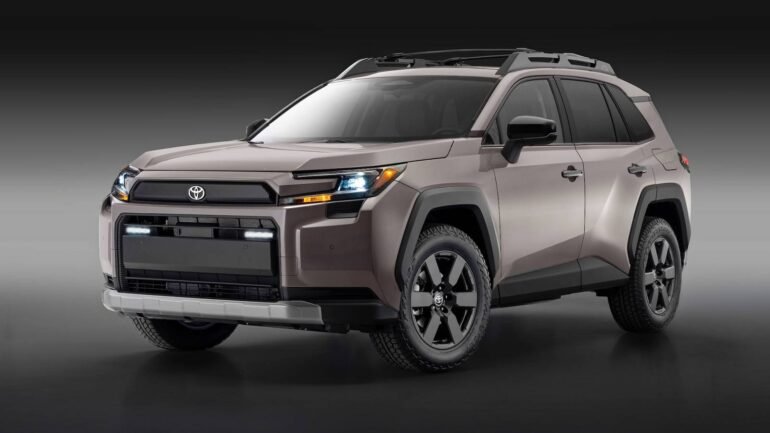
This is the same case with the outgoing RAV4, where demand has remained stable versus a year prior, even if a new-generation all-hybrid model is hitting showrooms this winter. If the product interest is high even at the five-year mark, then Toyota really isn’t compelled to reinvent the vehicle completely. This helps them save on development costs, since the car is still good enough for a huge chunk of buyers.
Real-Life Examples

Speaking of the RAV4, this vehicle is already a hint of Toyota’s long-term product strategy. Though the exterior and interior redesigns are significant, the platform underneath is still the TNGA-K platform of the outgoing model. This didn’t carry over unchanged, though, as significant improvements have been made to improve its handling. The hybrid system, though new and more powerful than the one in the outgoing model, isn’t a clean sheet redesign.
Another prime example is the Camry, which saw a generational change more than a year ago. Even that midsize sedan didn’t get a completely new platform, as it likewise inherited the previous TNGA-K platform from the previous model. Also, though the design changes inside are significant, the exterior design still has hints of the previous generation model.

Every Toyota 7-Seater SUV You Can Buy Today
Toyota’s rugged and roomy SUVs deliver modern comfort, convenience, tech, and more. Here are the ones that seat seven.
Flexibility Is Key

All of this is meant to keep Toyota flexible in the coming years, as electrification growth worldwide is fragmented. Though global EV sales are still rising, they’re not even spread across all markets. For instance, EV sales in the United States are expected to decline in the latter half of 2025 due to the removal of the $7,500 Federal Tax Credit.
Budget For Electrification

Electrifying your lineup isn’t cheap, especially if you’re just starting to invest in the technology, and the accompanying Toyota, however, was right in going for the multi-pathway approach, especially as EV growth worldwide is fragmented. As a large automaker, it has the financial capacity to spread its resources. Yet at the same time, by saving on development costs, it has enough research and development budget to create compelling EVs when the time is right. And that’s what you’re somehow witnessing now with the heavily updated bZ and C-HR, both of which now have compelling range, performance, and tech features to cater to the growing EV demand in markets like Europe.
Whilst Remaining Profitable

If you’ve checked a lot of automotive news lately, particularly with brands that went aggressive with their EV commitments, they are now backtracking on their decision. These brands are also facing stiff competition from far more affordable Chinese EVs, which are driving prices down and thus reducing the profit margins of all brands in general. For those committed too aggressively to the EV shift, such as Porsche and Mercedes-Benz, most of them are facing declining profits and/or reduced demand due to alienating their customer base or finding their EVs too expensive.
Toyota, which has remained flexible in its carbon neutrality path, can remain profitable since it didn’t invest too aggressively in EVs. Now that they’re set to reduce development costs by lengthening product cycles, they’ll be in an even better financial position when the world starts to accept EVs in droves.