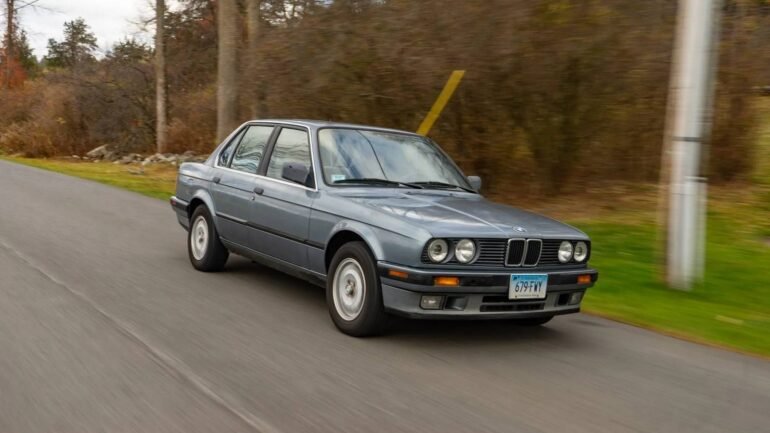
There’s a certain mythology that follows BMWs. The brand has built its reputation on sport sedans that turn commuters into believers and believers into zealots, promising a mixture of mostly performance and some luxury that should, in theory, make them perfect everyday cars. But mythology can be a tricky thing. Ask anyone who’s owned an older BMW, and they’ll tell you plenty about cooling systems, bushings, and electrical gremlins. Ask someone driving a brand-new 3 Series, and you’ll hear about refinement, quiet cabins, and shockingly “normal” maintenance schedules. So the question stands: Can a BMW really be your daily driver, or is it still a weekend toy with a warranty?

BMW
- Founded
-
1916
- Founder
-
Karl Rapp
- Headquarters
-
Munich, Germany
- Owned By
-
Publicly Traded
- Current CEO
-
Oliver Zipse
BMW’s entire pitch has always been strangely practical: build fast, balanced, rear-wheel-drive sedans that don’t punish you for using them. The 3 Series, possibly the benchmark for sport sedans, was never meant to be stored under a cover waiting for sunny Sundays. It was built for commuters, mountain pass tourers, and everything in between. So, why do we question BMWs?

The Most Reliable BMWs Of The 1990s That Still Run Strong
If you want the best the era had to offer, it was likely one of these picks.
A Brand Built On The Idea Of Everyday Performance

BMW has spent decades building its identity around cars that you can wring out on a back road without regretting it the next morning. From the earliest 3 Series models to today’s turbocharged lineup, the brand’s core philosophy has always been that performance shouldn’t be relegated to the weekend. Car journos, enthusiasts, and casual drivers have echoed this for years, praising BMW’s ability to blend sharp handling with the kind of day-to-day tractability that doesn’t punish you. Even the high-strung M cars, once notorious for being too stiff and too serious, now feature adaptive suspensions and comfort modes that make the daily grind far less punishing than you’d expect from something wearing a tri-color badge.
“To move people with products that evoke emotions.” – BMW
That balance—usability leaning toward capability—is what keeps BMW relevant in a market where crossovers threaten to sterilize driving altogether. Modern models like the 3 Series and X3 prove that you can still get a car designed for commuters that, when faced with school runs, grocery stops, and highway commutes, you can still have some fun. The company knows that the average owner isn’t spending much, if any, time at the track. So BMW engineers its cars to feel special even when nothing special is happening, blending just enough refinement with just enough edge to remind you why you bought a BMW in the first place.
BMW Ride Quality: Surprisingly Civilized For Something This Fast

One of the most surprising things about modern BMWs is just how well they behave in civilized society. Multiple tests from publications like Road & Track and MotorTrend consistently highlight the brand’s mastery of adaptive dampers. These systems soften the ride for city driving yet tighten seamlessly when the fun begins. Take the current 3 Series. In Comfort mode, BMW’s engineers have given it enough compliance to smooth rough patches without turning the cabin into a sensory deprivation pod. It still feels like a driver’s car—you always know you could boogie if the need should arise—but the bumps no longer feel medieval torture.
Move up to something like a 5 Series or even the BMW X3, and the daily comfort jumps a notch. These models run a wide range of cars/SUVs with varying performance and comfort. Even in the most aggressive 5-Series, the 717-horsepower M5, can go from mild to wild with a few button pushes. Unless you’re ripping around in an M4 with carbon bucket seats and performance tires, BMW doesn’t demand too much sacrifice in the name of performance.
Steering, Handling, And The Joy Of The Commute

A big part of making a car a good daily driver is how it feels when you’re doing absolutely nothing exciting in it. And BMW has always had a great handle on this intangible quality. The brand’s steering tuning has seen ups and downs, but modern BMWs are still more engaging than many competitors when you’re stuck in traffic or meandering through city streets.
Even in their tamest driving modes, most BMWs offer a certain weight and precision that makes mundane trips feel at least mildly fun. You don’t have to be hustling up a mountain road at half-pinned to feel what the car is doing. This is where performance doesn’t get in the way of daily usability—it enhances it. Commuting is boring. A car that feels awake makes the experience less like a chore and more like a conversation.

These Are The First 10 Production Cars In History With Factory Turbochargers
We may love a good turbo today, but they had to start somewhere – here are the first 10 production cars to boast a turbocharged engine under the hood.
Reliability: Reputation vs. Reality

This is the part people worry about. BMW’s reliability has a reputation, and it does not inspire confidence. But reputations age. Modern BMWs are far more reliable than the memes would suggest. Yes, maintenance is still pricier than most other brands. Yes, software updates and electronic components have introduced new kinds of headaches. But when you look at the actual data, the picture is much less dramatic.

J.D. Power often ranks recent 3 Series and 5 Series models above average in quality and reliability. Modern BMW turbocharged engines, especially the B58 inline-six, have earned high praise from MotorTrend for durability and consistency under stress. Long-term fleet tests from Car and Driver rarely show catastrophic issues; the problems tend to be minor annoyances rather than mechanical meltdowns, which, in fairness, is in part what gives the brand that reputation.
BMW Maintenance

Long-term fleet tests from Car and Driver rarely show catastrophic issues; the problems tend to be minor annoyances rather than mechanical meltdowns, which, in fairness, is in part what gives the brand that reputation. Are BMWs maintenance-free? Absolutely not. Oil changes cost more, tires wear faster, and brakes aren’t cheap. But for the average owner who keeps up with routine service, modern BMWs don’t implode at 60,000 miles. The reliability stigma largely stems from older models—particularly those from the early 2000s—when cooling systems and suspension components seemed engineered with expiration dates.
These days, BMWs aren’t hand grenades waiting to blow. Even in the old days, comparing BMWs to hand grenades is a teeny bit hyperbolic, but they still aren’t paragons of dependability either. If exact, timely, and pricey maintenance is required in order to keep it from blowing up, I think the argument is easily made that while they are technically reliable under specific conditions, we are using the word pretty liberally.

Fuel Economy: Better Than You’d Expect

BMW’s modern engines are turbocharged, efficient, and surprisingly frugal in daily use. Even the powerhouse M3 can return reasonable real-world MPG if you’re not constantly testing its launch control. Most non-M models deliver impressive fuel economy for their performance, with the 330i and 530i routinely hitting real-world numbers that surprise testers from MotorTrend and Car and Driver.
Hybrid models, like the 530e, take that even further, offering genuine EV-only commuting in short bursts. For the driver who wants performance without constant gas-station visits, modern BMWs strike a compelling balance.
Costs And Ownership Experience

Here’s where the calculus gets real. BMWs cost more to maintain than Hondas. No surprise there. But BMW’s complimentary maintenance program for the first few years offsets some of the early expenses, and long-term ownership costs are predictable as long as you don’t ignore service intervals.
Insurance, premium fuel, and higher-cost wear components do make daily driving pricier than average. But the tradeoff is that BMW still delivers a driving experience few rivals can match. If the goal is to enjoy the daily routine instead of merely tolerating it, BMW remains a strong contender.

10 Used BMW M Models That Are Affordable In 2025
The used market offers plenty of opportunities for enthusiasts to experience BMW’s Motorsport engineering without breaking the bank.
So… Can A BMW Really Be Your Daily Driver?

Absolutely—if you value the right things. Today’s BMW lineup sticks to that philosophy, at least on paper. Even the M cars—the ones that seem engineered to run with supercars—retain usable seating, decent trunks, and cabins that now skew more digital-luxury than analog-sport. BMW hasn’t lost the plot; it’s just updated it for touchscreen compatibility. Whether that helps or hurts, we’ll leave that up to you. But fundamentally, BMW still builds cars that are supposed to be driven, not displayed. The brand never promised perfection—it promised engagement. And that’s a pretty good starting point for a daily driver.
Modern BMWs are comfortable, quiet, quick, and more reliable than their reputation suggests. They’re engaging when roads get interesting, and civilized when they don’t. They have enough tech to make daily life easier and enough personality to keep driving from becoming a dull obligation. They do cost more to own, and they require an owner who actually follows the maintenance schedule. But if you’re willing to make that investment, there’s no reason a BMW can’t be the car you rely on every single day.