The 1980s were a golden era for performance cars, a decade defined by radical engineering, turbocharged experimentation, and manufacturers who weren’t afraid to take risks. But while American buyers enjoyed Mustangs, Camaros, and a handful of imported sports coupes, the rest of the world was experiencing a very different kind of automotive excitement. From rally-bred monsters carved directly from the demands of Group B and Group A competition to lightweight hot hatches and refined grand tourers, some of the most thrilling and culturally important cars of the era simply never made it to the United States. Whether due to strict federal regulations, limited production numbers, or the perceived tastes of the American market, these machines remained forbidden fruit, cars U.S. enthusiasts could only dream about until import laws finally opened the gates decades later.
This story explores the coolest 1980s cars that never reached America, each one representing a unique blend of performance, attitude, and engineering that defined the decade. They’re the cars that made Europe and Japan the epicenters of automotive innovation, and left American enthusiasts wondering what they missed.
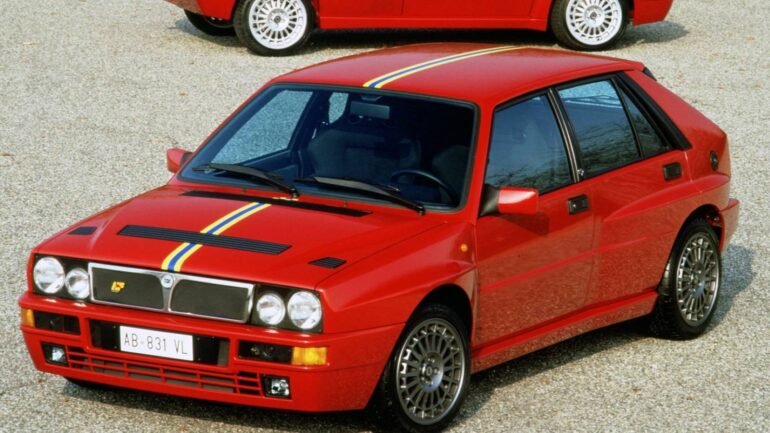
Lancia Delta Integrale

If there’s a single car that embodies the spirit, chaos, and brilliance of Group A rallying in the late 1980s, it’s the Lancia Delta Integrale. While Americans were stuck with boxy sedans and the earliest forms of bland crossovers, Europeans were carving through mountain passes in turbocharged, wide-arched hatchbacks that looked like they belonged on a WRC podium, because they did. The Integrale was the road-going reflection of Lancia’s dominance in rallying, delivering all-wheel drive grip, explosive boost-laden acceleration, and a chassis tuned with the kind of precision only motorsport engineers could dream up. It was compact, aggressive, and unmistakably Italian, giving drivers an experience far removed from anything found in U.S. showrooms.

The reason it never crossed the Atlantic had nothing to do with capability and everything to do with regulations. U.S. emissions standards, crash testing requirements, and the low-volume nature of the model made federalization nearly impossible for Lancia. As a result, Americans could only admire the Integrale from afar, often in grainy magazines or rally VHS tapes, while Europeans enjoyed one of the most intoxicating performance cars of the decade. Today, the Integrale’s absence only amplifies its legend among American enthusiasts, who now import them in droves as soon as they hit 25 years of age.
Renault 5 Turbo

Where the standard Renault 5 was a humble economy hatch, the Turbo was an unhinged, mid-engined, rear-wheel-drive rally special built purely out of necessity and a little French insanity. Designed for Group 4 homologation, Renault essentially ripped out the rear seats, shoved a turbocharged engine where the groceries were supposed to go, widened the body by several inches, and created one of the most entertaining and unpredictable cars of the era. It was loud, raw, and hyperactive, a tiny mid-engine supercar disguised as a hatchback.

America never saw it because Renault, despite owning AMC at the time, never had the confidence or infrastructure to federalize such a niche performance model. The 5 Turbo was expensive, complex, and purpose-built for European rally stages rather than U.S. highways. While American buyers got the Alliance and Encore, Europeans got a 160-horsepower pocket rocket capable of embarrassing full-size sports cars. The absence of the R5 Turbo on American soil remains one of the decade’s greatest “what ifs.”
Toyota Celica GT-Four

Before the Supra became Toyota’s flagship performance nameplate, the Celica GT-Four was the brand’s rally-bred hero. Introduced in the late 1980s, the GT-Four (known as the ST165) packed a turbocharged 2.0-liter engine and a sophisticated all-wheel-drive system designed to take on the world’s best in Group A competition. On tight tarmac or loose gravel, it delivered a level of balance and boost-driven punch that American Celicas of the era couldn’t dream of. It was the beginning of Toyota’s WRC dominance, the platform that ultimately carried Carlos Sainz to titles and cemented Toyota’s motorsport credibility.

While the U.S. did get Celicas, the true GT-Four variants were never sold stateside until limited versions of the later ST185. The first-generation GT-Four remained forbidden fruit, too costly and complicated for Toyota to justify against America’s shrinking enthusiasm for sporty coupes. As a result, enthusiasts could only watch as Europe and Japan received a true rally weapon, while U.S. buyers made do with naturally aspirated front-drive alternatives. Today, imported GT-Fours stand out as some of the coolest JDM machines from the 1980s—machines that should have been here all along.

The Cheapest Fast Cars For 2026
Looking for a thrill on a budget? These 10 cheap cars for 2026 will leave you breathless with their surprising speed and power.
Nissan Skyline R31 GTS-R

Long before the R32 GT-R revived Godzilla and won countless hearts in the 1990s, the R31 GTS-R quietly set the stage as one of Nissan’s unsung performance heroes. With its RB20DET-R engine, complete with a massive turbo and motorsport-focused internals, the GTS-R was built as a homologation car for Group A touring car racing. Rated at 210 horsepower but known to deliver far more with minimal tuning, the GTS-R was effectively a factory-built track assassin wrapped in a subtle, angular body.

The reason Americans never saw it? Nissan never officially sold any Skyline in the U.S., and the R31 was no exception. Instead, U.S. showrooms received cars like the Stanza and Pulsar, while Japan enjoyed a rear-drive turbocharged sports sedan dripping with racing pedigree. As with so many JDM legends, 25-year import laws have only heightened the GTS-R’s mystique. It’s obscure, historically significant, and brutally capable, a ’80s icon the U.S. missed entirely.
Peugeot 205 GTi

Ask any European enthusiast about the greatest hot hatch of the 1980s, and there’s a strong chance the answer will be the Peugeot 205 GTi. Light, perfectly balanced, and packed with sharp steering and rev-happy engines, the 205 GTi delivered the kind of driving purity modern cars can only emulate through drive modes and electronic trickery. Whether you opted for the 1.6-liter or the punchier 1.9-liter, the 205 GTi offered a level of agility and feedback that made it an instant classic, often compared to the original Volkswagen Golf GTI, but with even more attitude.

Peugeot never sold the 205 GTi in America because the brand pulled out of the U.S. market before the car could arrive. It was a casualty of weak sales, dealer frustrations, and a growing divide between American and European tastes. By the time the 205 GTi became a phenomenon abroad, U.S. buyers were gravitating toward larger, softer cars. The 205 GTi’s absence left a major gap in the American hot-hatch story, one that enthusiasts still feel today as they import the few surviving examples from Europe.
Ford Sierra RS Cosworth

When Ford Europe wanted to dominate touring car racing, it teamed up with Cosworth and created a monster, the Sierra RS Cosworth. With its 2.0-liter turbocharged YB engine and iconic whale-tail rear wing, the Cossie quickly became a motorsport icon. It was raw, unapologetic, and brutally fast for its time, capable of humiliating more expensive sports cars while looking like a family sedan that accidentally wandered into a DTM paddock. The RS Cosworth didn’t just perform on track; it also became a street legend across Europe.

America, however, never got the Sierra in any form. Instead, the U.S. received the Merkur XR4Ti, which looked similar but lacked the fire-breathing Cosworth powerplant and raw motorsport DNA. The Sierra RS Cosworth remained a Europe-only affair, leaving American enthusiasts forever comparing the Merkur to the real thing. Today, imported Cossies are treasured for their racing pedigree and unmistakable styling, proof that Ford could build one of the greatest performance cars of the decade, just not for Americans.

10 Of The Best Engines Ever Built By American Carmakers
Yes, Germans are great at engineering cars, but that doesn’t mean Americans aren’t. Here are some examples.
Honda City Turbo II

Few ’80s cars embodied pure fun like the Honda City Turbo II, affectionately known as the “Bulldog.” It was a tiny, featherweight urban runabout that Honda’s engineers decided to transform into a turbocharged pocket rocket. With flared arches, a factory intercooler, and a lively 1.2-liter turbo engine, the Turbo II delivered more smiles per mile than cars costing ten times more. It was quirky, charming, and extremely Japanese in all the right ways.

The City Turbo II never reached America because the U.S. market simply wasn’t interested in microcars, let alone microcars with forced induction. Instead, Honda focused on Civics and Accords, leaving the Japanese-market City lineup to develop its cult following overseas. Americans missed out on one of the most entertaining urban performance cars ever built, a machine so unconventional that Honda even offered a folding Motocompo scooter that fit in the trunk. If there was ever a car that represented peak ’80s JDM culture, it was this one.
BMW M635CSi

Before the M6 badge became mainstream in America, BMW offered something truly special in Europe: the M635CSi. Powered by the legendary M88 engine, derived from the same unit that powered the BMW M1 supercar, the M635CSi was a grand touring coupe with the soul of a high-revving exotic. With over 280 horsepower, a hand-built straight-six, and styling that remains one of BMW’s greatest designs, the M635CSi was the pinnacle of ’80s autobahn performance.

In the U.S., BMW sold a detuned version called the M6, but it lacked the M88 engine due to emissions regulations. As a result, American buyers never experienced the full fury of the European-spec car, which was lighter, faster, and far more motorsport-influenced. The M635CSi stands today as one of the greatest forbidden BMWs of the era, revered for its purity and remembered as a time when BMW built cars that blended elegance and aggression like no other.
Mazda RX-7 Turbo II

The second-generation Mazda RX-7 (FC) was sold in America, but not in its full-strength Turbo II form until later, and even then, the U.S. didn’t receive the same high-performance variants Japan enjoyed in the late 1980s. The Turbo II was the RX-7 at its best: a lightweight chassis combined with a turbocharged 13B rotary engine, capable of delivering smooth, explosive power at high revs. It handled beautifully, offered meticulously balanced weight distribution, and cemented Mazda’s reputation for building affordable driver’s cars.

However, many of the earliest turbocharged variants and Japan-only trims never came to the U.S. Rotaries were already considered niche, and Mazda was cautious about overloading the American market with high-boost performance models. As a result, enthusiasts had to wait decades before sampling the purest Turbo II versions. Those who have experienced them know that these cars represent peak ’80s engineering, a perfect mix of technology, character, and analog driving feel.

This Forgotten Supercar Once Had The Fastest 0-60 Time In The World
This model, while only holding the 0-60 MPH record for a brief window, helped pioneer the American supercar scene.
Mitsubishi Starion GSR-VR

The Mitsubishi Starion did reach the U.S., but not in its most desirable and advanced form: the GSR-VR. This high-performance Japanese-market variant was the best Starion Mitsubishi ever built, offering more power, more sophisticated suspension tuning, and advanced features that U.S. models never saw. With its rear-wheel-drive layout, turbocharged engine, and wide-body stance, the GSR-VR was a true rival to the Porsche 944 and Toyota Supra of the era, but with a sharper, more aggressive personality.

The U.S. received tamer versions due to emissions rules and Mitsubishi’s desire to keep costs down. The GSR-VR, with its superior equipment and performance potential, remained exclusive to Japan. Today, imported examples feel like discovering a hidden chapter in Mitsubishi’s performance history, a reminder that the brand once built serious sports cars capable of challenging the world’s best. Had the GSR-VR come to America, it might have rewritten the Starion’s legacy entirely.
Sources: Various manufacturer websites and other authoritative sources