The 1980s were a decade defined by ambition, optimism, and more than a little bit of insane styling choices. It was a time ruled by turbo badges and spoilers, digital dashboards and funky wheels, and sharp bodies that looked more like a kid’s drawing of a race car than a production automobile. Truly, whatever a designer could carve from a block of foam could go.
Some cars became timeless icons. Many more were quietly absorbed into the fabric of American memory and then forgotten just as quickly. Yet those forgotten machines often carried the decade on their backs—commuter champions, engineering experiments, turbocharged trailblazers, and mainstream bestsellers that now live in obscurity. These are the forgotten ’80s cars that genuinely defined the era. Each one left a mark, even if most of the world has forgotten their names.

Some Of The Fastest Cars You Could Buy In The ’80s Weren’t Even Supercars
These two non-supercar beasts are well-equipped to go toe-to-toe with some of the quickest supercars of the 1980s in serious style.
Pontiac Fiero (1984–1988)
Original MSRP: $7,679

The Pontiac Fiero came out swinging as America’s first mass-produced mid-engine car and immediately stumbled on its own ambition. Early Fieros focused more on fuel efficiency than performance, a mismatch that disappointed enthusiasts but still earned the car praise for its engineering novelty. Composite body panels, a space-frame chassis, and a mid-mounted engine were wild ideas for General Motors in the early ’80s.

By the time the Fiero evolved into the GT fastback with a V6 and serious handling improvements, Pontiac had finally created the sports car it always meant the Fiero to be. Unfortunately, internal GM politics and the lingering shadow of early reliability issues doomed the program before it could flourish. Pontiac perfected the Fiero just in time to kill it.
Even so, the Fiero became a symbol of American engineering imagination in the ’80s. It proved Detroit could experiment, innovate, and take big risks—even if corporate caution sometimes got in the way. Forgotten? Maybe. But the Fiero remains a cult classic because it dared to be different.
Period Rivals:
- Toyota MR2
- Fiat X1/9
- Honda CRX Si
Subaru XT / XT6 (1985–1991)
Original MSRP: $7,889

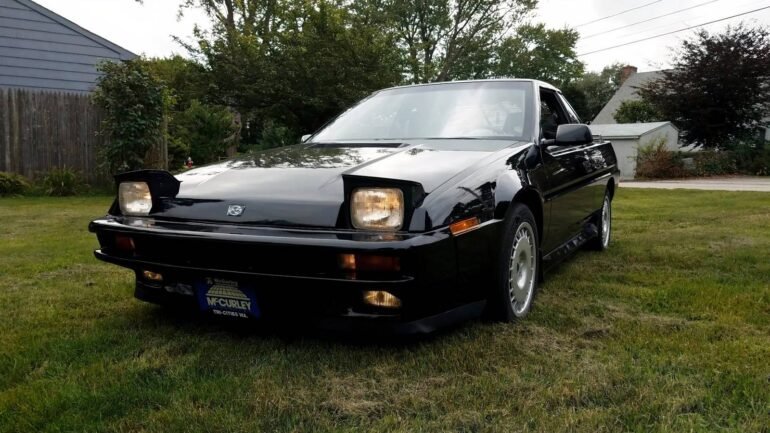
The Subaru XT looked like it was designed by someone who thought the Saab 900 was too conventional. With its wedge-like body, aircraft-inspired cockpit, and adjustable air suspension, the XT was one of the strangest cars sold in America during the 1980s—and one of the most fascinating. It was Subaru at its most eccentric, years before the brand became synonymous with sensible all-wheel-drive wagons.

The XT wasn’t just weird for weirdness’s sake. Subaru used the model as a showcase for its growing technological prowess. Full-time all-wheel drive, pneumatic suspension, and a flat-six engine in the XT6 made it one of the more advanced cars in the segment. Drivers sat in a fighter-jet-style cockpit complete with unique control stalks and a futuristic instrument cluster. It wasn’t a sports car in the traditional sense, but it had a personality unmatched in its class.
Ultimately, the XT was too strange for mainstream buyers and too mild to capture the hearts of performance fans. But it paved the way for Subaru’s future experimentation and laid the groundwork for the brand’s quirky identity. The XT didn’t sell well—but it defined Subaru’s design courage.
Period Rivals:
- Honda Prelude
- Toyota Celica
- Mazda MX-6
Chevrolet Celebrity (1982–1990)
Original MSRP: $8,588

The Chevrolet Celebrity is one of the most successful cars that almost no one remembers. Built on GM’s front-drive A-body platform, the Celebrity was a family-car workhorse that sold by the hundreds of thousands, often to people who wanted something unremarkable, dependable, and vaguely modern in a decade shaped by rapidly changing expectations. It wasn’t sexy, but it was exactly what middle America needed at the time. Today, it’s a ghost—a car that was everywhere, yet somehow left no trace.

The Celebrity represented GM’s attempt to bring efficiency, downsizing, and modern front-wheel-drive engineering to the mainstream. It did so effectively enough to flood American streets with Celebrities of every spec: wagons, sedans, Eurosport packages, even the occasional high-trim model with digital instrumentation that felt like a sci-fi novelty. It projected competence, if not character, and that identity defined GM’s approach to volume sales throughout the decade.
What makes the Celebrity important is the simple fact that it became a reliable fixture in a turbulent era. As fuel prices fluctuated and customers demanded better economy, the A-body cars kept General Motors afloat. They may not be remembered today—but the Celebrity absolutely defined middle-class motoring in the 1980s.
Period Rivals:
- Ford LTD
- Dodge 600
- Buick Century

The 10 Most Collectible American Cars Of The ’80s
Were there any great cars from the 1980s? Here are ten cars that are the most collectible for their power, presence, and pure joy on any road or track
Mazda 626 Turbo (1986–1987)
Original MSRP: $8,730

Mazda’s 626 Turbo is one of those cars that enthusiasts praise once they learn about it—mostly because so few people remember it existed. In the mid-’80s, Mazda was quietly building some of the most engaging front-drive cars in the world. The 626 Turbo took the company’s growing engineering confidence and paired it with a turbocharged engine that delivered surprising speed for a sensible-looking sedan.

The 626 Turbo was a wolf in business attire. It looked like something an accountant would buy, but its forced-induction four-cylinder produced lively acceleration and punchy midrange torque. Mazda’s hallmark steering feel and chassis balance made it far more capable than its unassuming exterior suggested. It wasn’t a sports sedan so much as a family car that happened to enjoy spirited driving.
Although overshadowed by the more famous RX-7, the 626 Turbo helped cement Mazda’s identity as a company that built cars with heart. It didn’t survive in the public imagination, but its influence is felt in every fun-to-drive Mazda sedan that followed.
Period Rivals:
- Honda Accord LX-i
- Toyota Camry LE
- Nissan Stanza XE
AMC Eagle Wagon (1980–1988)
Original MSRP: $7,549

The AMC Eagle Wagon is one of those cars that makes far more sense looking backward than it ever did in the moment. In the early ’80s, the idea of blending station-wagon practicality with full-time four-wheel drive and mild off-road capability was unheard of. Today, that’s literally the definition of a crossover. AMC was just 25 years too early. The Eagle Wagon was both an oddball and a visionary, a trailblazer dressed in wood paneling.

AMC took its aging Concord wagon, raised the suspension, added a viscous center coupling, and created what might be the first modern crossover utility vehicle. It was rugged enough for skiers and rural families but comfortable enough for everyday suburban errands. In an era when SUVs were still truck-based and fairly crude, the Eagle’s blend of refinement and capability was quietly revolutionary.
Although AMC didn’t live long enough to see the market shift in its favor, the Eagle Wagon remains proof that the company was full of good ideas—it just lacked the resources to bring them to maturity. Today, the Eagle is forgotten by the masses but worshipped by a small cult of enthusiasts who recognize just how far ahead of the curve it really was.
Period Rivals:
- Subaru GL Wagon
- Jeep Cherokee XJ
- Toyota Tercel 4WD Wagon
Dodge Daytona Turbo Z (1984–1993)
Original MSRP: $11,000

The Dodge Daytona Turbo Z was Chrysler’s most enthusiastic attempt to redefine American performance for the front-wheel-drive era. Turbocharged, wedge-shaped, and dripping with ’80s zing, the Turbo Z delivered the kind of punch that drivers didn’t expect from a compact Chrysler product. It blended performance and nostalgia in one neon-accented package.

Under the hood, the Daytona Turbo Z offered up to 174 horsepower in later models—serious thrust for the time. Coupled with energetic handling and available Carroll Shelby–tuned variants, the Daytona became an accessible performance icon for budget-minded enthusiasts. It wasn’t perfect, but it was undeniably fun, and in the ’80s, fun was currency.
The Daytona Turbo Z may be little more than a trivia question today, but it helped shift American performance away from pure displacement and toward turbo technology. It proved that small engines and forced induction could provide big thrills. In that sense, the Daytona was a sign of things to come.
Period Rivals:
- Ford Mustang GT
- Chevrolet Camaro Z28
- Pontiac Firebird Formula

10 American Cars From The 1990s That Are Modern Classics
Cars are added each year to the list of new classics, look away now if you were born in the ’90s – these 1990s American cars are now modern classics.
Nissan Pulsar NX (1987–1990)
Original MSRP: $11,059

The Nissan Pulsar NX was a car designed for people who wanted everything—literally. Its modular rear-end system let buyers swap between a traditional hatch, a wagon-like Sportback, or an open-air configuration. The result was a shape-shifting compact coupe that doubled as an engineering experiment and tripled as a toy. The ’80s loved big ideas, and the Pulsar might’ve been one of the decade’s most charmingly impractical ones, especially in its radical Sportback version.

Beneath the quirky body panels was a genuinely enjoyable car. Light, rev-happy, and eager, the Pulsar carried Nissan’s growing reputation for sporty handling and clever engineering. The SE and NX models provided affordable performance that didn’t rely on brute force. It was the kind of car that encouraged taking the long way home, not because you needed to, but because you wanted to rotate the hatch configuration just one more time.
Why did it fade? Simple: the modular system was expensive, confusing for dealers, and outside the mainstream appetite. But today, as the car world embraces customization and clever packaging, the Pulsar NX feels oddly modern. It may be forgotten, but it remains one of Nissan’s most inventive swings.
Period Rivals:
- Honda CRX
- Toyota Corolla FX-16
- Mazda 323 GTX
Isuzu Impulse (1983–1992)
Original MSRP: $11,297

The Isuzu Impulse—designed by the legendary Giorgetto Giugiaro—is one of the great forgotten gems of the 1980s. With Italian styling, Japanese reliability, and eventually turbocharged power, the Impulse was a stylish outsider in a competitive field of compact sport coupes. It never grabbed headlines, but it offered a blend of design and engineering that deserved much more attention than it got.

The second half of the decade brought turbo power and even Lotus-tuned suspension, transforming the Impulse into a genuinely capable enthusiast’s car. Those upgrades never translated into significant sales, but they gave the Impulse a cult following among drivers who appreciated its clean lines and surprisingly sharp handling. It was a sophisticated machine wrapped in an understated package.
Isuzu left the passenger-car market long ago, and the Impulse vanished with it, making the model feel more obscure today than ever. But for those who remember, the Impulse was a bold swing from a company unafraid to experiment—and it helped bring stylish, affordable performance to the masses.
Period Rivals:
- Volkswagen Scirocco
- Toyota Corolla GT-S
- Nissan 200SX
Mitsubishi Starion / Chrysler Conquest (1983–1989)
Original MSRP: $14,559

The Mitsubishi Starion—marketed as the Chrysler Conquest in the U.S.—was one of the decade’s great styling statements. Its widebody versions represent some of the most aggressive factory fender flares ever stamped into metal. Combined with rear-wheel drive and turbocharged power, the Starion was a proper sports car hiding in plain sight.

The Starion was among the first Japanese performance cars to embrace the turbocharged future. It offered electronic fuel injection, advanced suspension tuning, and a driving experience that felt exotic compared to most American options at the time. It was fast, sleek, and engineered to challenge the established players in the growing import-performance segment.
Its lack of mainstream recognition today is mostly a story of timing. The 3000GT stole much of Mitsubishi’s sports-car spotlight in the ’90s, leaving the Starion to fade quietly into obscurity. But for those who know, the Starion remains one of the key performance machines that set the stage for the Japanese sports-car dominance that followed.
Period Rivals:
- Nissan 300ZX Turbo
- Mazda RX-7 Turbo
- Toyota Supra Mk II

10 Used Performance Bargains That Are Still Overlooked In 2025
Get them while they’re still cheap – the market is still to catch on to these sports cars, grand tourers, and coupes that offer speed and style.
Oldsmobile Toronado Trofeo (1987–1992)
Original MSRP: $22,428

The Oldsmobile Toronado Trofeo stands out as one of the most ambitious American cars of the ’80s, even if most people have never heard of it. Marketed as a luxury-tech showcase, the Trofeo introduced advanced electronics—including one of the earliest touchscreen interfaces—years before such features became industry standards. It was bold, futuristic, and very Oldsmobile in its willingness to experiment.

With its front-wheel-drive chassis, V6 power, and driver-focused cockpit, the Trofeo aimed to blend American comfort with European-inspired handling. The available “Visual Information Center” touchscreen was a generation ahead of its time, offering climate controls, trip functions, and vehicle data in a layout that might pass for early-2000s tech. The car drove well, looked sharp, and carried itself with quiet confidence.
But the Trofeo was ultimately too innovative for its own good. Buyers weren’t ready for touchscreen controls, and Oldsmobile lacked the premium cachet needed to sell its high-tech vision. As a result, the Trofeo faded into obscurity—but its ideas lived on in nearly every modern luxury car interface. It didn’t just define the ’80s. It predicted the 2000s.
Period Rivals:
- Buick Riviera
- Ford Thunderbird Turbo Coupe
- Chrysler New Yorker
Sources: CarGurus, Car And Driver, J.D. Power