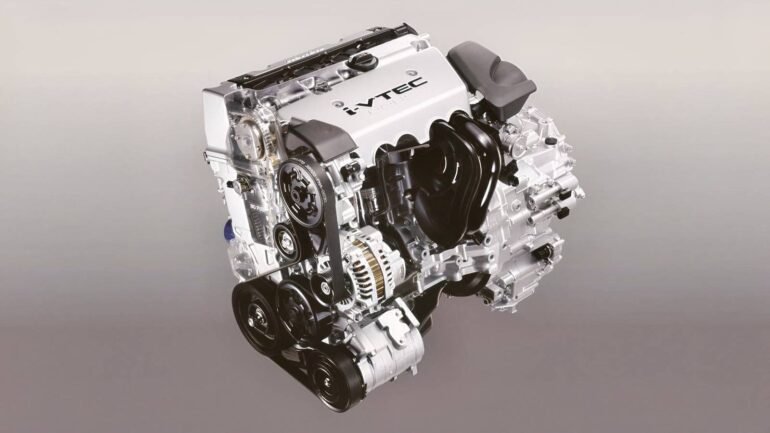
If you spend enough time in the import-performance world, you eventually learn there are two kinds of Honda engines: the ones people like, and the ones worshiped. And among the pantheon, few powerplants enjoy the kind of reverence the Honda K24 engine commands. It’s the rare four-cylinder that checks every box—strong, endlessly tunable, reliable to the point of stubbornness, and flexible enough to live happily in everything from family crossovers to track-weapon Civics.
But what makes the K24 so legendary? Why has it become the go-to swap for everyone from weekend tinkerers to world-class builders? This complete Honda K24 engine guide breaks down the history, the tuning potential, the engineering brilliance, and the culture surrounding it that turned a humble 2.4-liter into an icon.

The 10 Quickest Honda Civics Ever Built
The Honda Civic is one of the best-selling commuter cars in automotive history, but it also has a wild side.
A Bigger, Better Evolution Of Honda Four-Cylinder Performance

Honda didn’t create the K24 to be a tuner hero. It created it to be a workhorse—a torquey upgrade to the smaller K20 engine that arrived at the dawn of the 2000s. Yet in typical Honda fashion, the company accidentally engineered something far more potent.
Where earlier Honda engines like the beloved B-Series made their names on freaky-high revs and light-switch VTEC engagement, the Honda K24 engine introduced something fresh: torque. According to MotorTrend, thanks to its longer 99 mm stroke and taller deck height, the K24 delivered midrange punch that earlier Honda engines simply couldn’t match. For everyday drivers, that meant easy acceleration. For tuners? It meant a torque-rich foundation that could support massive power without worry.
The result was an engine family that balanced everything Honda was already good at—precision, durability, efficiency—but added the one element it always lacked: displacement. Suddenly, Honda had a four-cylinder that could not only scream at high rpm, but muscle its way through the lower revs, too. That combination would shape two decades of tuning culture.
Which Honda Models Used The K24 Engine?

Part of what makes the K24 legendary is how widespread it became. Over its 23-year lifespan, the engine appeared in everything from commuter sedans to sporty rippers. If you’re hunting for a donor engine or just tracking down the right variant, these are the major U.S.-market applications:
- K24A1: 2002–2009 Honda CR-V
- K24A2: 2004–2008 Acura TSX
- K24A4: 2003–2005 Honda Accord, 2003–2008 Odyssey, 2003–2006 Element
- K24A8: 2006–2007 Accord, 2007–2011 Element
- K24W (Earth Dreams): 2013–2017 Accord, 2015–2019 CR-V
- K24V7: 2016–present Acura ILX
- K24W7: 2015–2020 Acura TLX
- K24Y2: 2012–2015 Honda Crosstour
- K24Z1: 2007–2009 CR-V
- K24Z2/Z3: 2008–2012 Accord + 2009–2014 Acura TSX
- K24Z4/Z6/Z7: 2008–2014 CR-V & 2012–2015 Civic Si / ILX
This wide presence is part of why the Honda K24 engine dominates the aftermarket. There are simply more of them, in more cars, at more price points—and that availability drives both experimentation and innovation.
Honda K24 Engine Performance: Stock Horsepower And Torque

In stock form, the K24 was never meant to run with turbocharged muscle or high-revving European exotics. Yet Honda quietly pushed the envelope over the years. The most powerful factory configuration topped out at 206 horsepower and 182 lb-ft of torque in the 2015–2020 Acura TLX (K24W7). Right behind it is the 205-horsepower K24Z7 used in the 2014–2015 Civic Si—an engine many enthusiasts still consider one of Honda’s last great naturally aspirated four-cylinders.
Earlier versions like the K24A2 in the Acura TSX also hit 205 hp, but with slightly lower torque. Meanwhile, the mid-2000s Accord and CR-V variants delivered more modest figures, often prioritizing efficiency and smoothness over outright power. Even at its peak, the Honda K24 engine wasn’t winning dyno charts. What it delivered instead—broad torque, reliability, and a stout bottom end—was far more useful for the builders who would eventually unlock its hidden potential.

Can The Honda K24 Handle A Turbo? Absolutely.

Ask any Honda tuner what makes the K24 special, and you’ll get a one-word answer: headroom. The K24’s architecture is strangely tolerant of boost. Even on stock internals, many builders routinely see 400–500 horsepower with a well-sorted turbo setup. That kind of output from a factory 2.4-liter is almost absurd. Still, it speaks to the engine’s engineering: thick cylinder walls, robust rotating assembly, and a head design that flows exceptionally well.
The K24 Can Clear 400 Horsepower With Boost Alone

Once you cross the 500-horsepower line, you’re in built-engine territory—but the block can take it. At that point, you’re upgrading pistons, rods, valvetrain, and likely the transmission. You’re also managing heat, fueling, and traction. But when everything’s dialed in, a boosted K24 becomes a humble, devastatingly effective supercar slayer.
This is partly why the K24 has become the standard swap engine for track builds, drift cars, restomod projects, and even exotic chassis conversions. The formula is simple: find a K24, bolt on a turbo, reinforce what needs reinforcing, and enjoy supercar performance on a fraction of the budget.
K24 vs. K20: What’s The Difference?

The K24 and K20 are siblings, but they play very different roles. The K20 is lighter, more rev-happy, built for high-rpm thrills. The K24 is torquey and more flexible. Here’s a little breakdown:
Honda K20 engine:
- 2.0 liters
- Shorter stroke (86mm)
- Shorter deck height
- Higher redline
- Ideal for high-rev NA builds
Honda K24 engine:
- 2.4 liters
- Longer 99 mm stroke
- Taller deck height
- More torque
- Better for turbo setups or street builds
Both engines are legendary in their own right, but the Honda K24 engine ultimately wins the battle for versatility. With more displacement and stronger real-world performance, the K24 has become the preferred foundation for modern builds.
K-Series vs. B-Series: The Great Honda Engine Debate

Ask ten Honda fans whether the K-Series or B-Series is better, and you might start a small skirmish in the AutoZone Parking lot. But from a strictly technical standpoint, the K-Series—and especially the K24—represents a major leap forward.
Here’s why:
- More displacement → more torque, easier tuning
- Modern head design → better flow
- Roller rockers → less friction, higher efficiency
- Stronger architecture → more boost-friendly
The B-Series still has an unmatched, vintage charm—especially the high-revving B16 and B18—but the K24 simply gives builders more to work with. It’s an evolution, not a replacement.
How Much Does A Honda K24 Engine Cost?
This is where the Honda K24 becomes almost unfair. A used, complete K24 often costs around $1,000–$1,300, depending on mileage and variant. Compare that to virtually any modern performance crate engine, and the value becomes painfully obvious.
If you need a long-block capable of handling serious boost, prices climb—often $8,000 to $12,000. A fully race-prepped K24 built for four-digit horsepower numbers can approach $20,000.
For swaps, the total project cost varies wildly, so much so that listing the prices might not even be terribly helpful, but we will provide some numbers to at least get potential builders an idea.
- Basic swap: $2,000–$4,000
- Street performance build: $6,000–$10,000
- Track or turbo build: $10,000–$20,000+
Are There Common Honda K24 Engine Problems?

Honda engines are famously reliable, but even the K24 has a few weak spots worth noting:
- Front crankshaft seal leaks
- Top-end ticking from cam or valvetrain wear
- Engine vibration from mounts or imbalance
Most of these issues trace back to age, deferred maintenance, or neglect at the end of an enthusiast’s feet. With regular oil changes and proper care, a K24 can easily sail past 200,000 miles without drama—and in many cases, far beyond. This is still Honda we’re talking about here.
VTEC vs. i-VTEC: What’s the Difference?

You talk performance Hondas without a quick tip of the hat to the patron god of four-cylinders, Lord VTEC. VTEC is the classic two-profile cam system that helped define Honda performance. i-VTEC takes things further by adding continuously variable cam phasing.
The key advantage of i-VTEC is flexibility. Instead of waiting for a fixed rpm to activate the high-lift cam profile, the ECU can adjust timing based on throttle input, load, and driving conditions. This makes for better torque, smoother power delivery, and improved fuel economy. With respect to this article, most K24s use i-VTEC, which is one of the reasons they work so well in both daily drivers and performance builds.
Why The Honda K24 Engine Deserves Its Legendary Status

The Honda K24 engine didn’t earn its reputation through hype. It earned it through performance, durability, and a kind of blue-collar adaptability that’s rare in modern engines. It’s big enough to make torque, strong enough to handle boost, simple enough to maintain, and cheap enough to play with.
In the right hands, a K24 can do most anything you’d care to do in a small sedan: a reliable commuter, a track brute, a daily-driven turbo monster, or the heart of a wildly creative swap. Few engines in modern automotive history have that kind of range. That’s why this Honda K24 engine guide exists. And that’s why, decades from now, when enthusiasts talk about the golden age of Honda engines, the K24 will be standing right there at the top.