Supercars are not generally known for their small engines; we have big-displacement models like the 8.0-liter-equipped Bugatti Chiron, the 8.4-liter V-16-flaunting Tourbillon, and the 7.3-liter V-12-boasting Pagani Zonda. European supercars are likely the first to be thought of when you think of big engines and exclusivity, but we have turned out some very impressive, rare exotics that take the displacement battle to the supercar stalwarts.
The American sports car with the biggest engine is certain model years of the Dodge Viper, and while they possess a lot of qualities that make them supercars, they are not quite exclusive enough to take the title of the American supercar with the biggest engine. This goes to a lesser-known model created by Falcon, a short-lived and now-defunct American brand that turned out one heck of an American beast.
The Little-Known Falcon F7 Is Pure American Supercar Exclusivity And A Huge Engine

Hitting the supercar scene as a prototype in 2010, the Falcon F7 is an exceptionally rare, powerful, and pure American supercar. It was built in very limited numbers, and for the most part, has been forgotten by the mainly Euro-centric fans of rare exotics. Alongside all its supercar credentials, the real heart of this snarling beast is a massive 7.0-liter V-8 borrowed from another American legend, making it the American supercar with the largest displacement engine ever created.
The 7.0-Liter LS7 Under The F7’s Hood

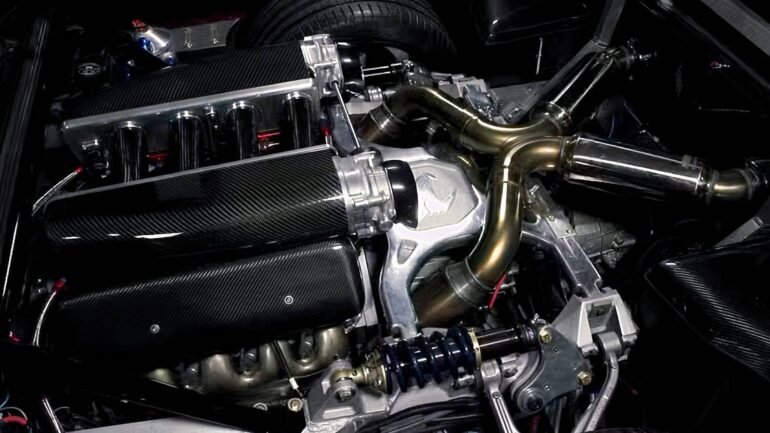
The Falcon F7 is equipped with a 7.0-liter LS7 V-8 pinched from the Chevy Corvette Z06 — a legend in its own right. However, Falcon tweaked GM’s famously ready-for-power V and created a true monster. At ‘base’ level, the Falcon F7’s engine is naturally aspirated and boasts a forged aluminum block with high-flow LS7 heads, large intake and exhaust ports, and LS7-typical aggressive cam profiles. That means very high-revving and a snappy nature.

The NA LS7 was not the only flavor, though, and Falcon also turned out a model or two with a far more aggressive mill under the hood: a bi-turbocharged variant. Working alongside Lingenfelter Performance Engineering, Falcon adapted the LS7 for intense forced induction. The layout retains the LS7’s configuration, but was beefed up with an intercooler, an upgraded carbon-fiber intake manifold, oversized throttle bodies (90 mm standard, like the Z06’s engine, but can be modified up to 102 mm), and, most importantly for forced induction lovers, two turbos built by Lingenfelter Performance Engineering.
At the naturally-aspirated level, the LS7 can redline at around 7,000 rpm; with the turbos, that number reportedly goes up to a claimed 11,000 rpm. It doesn’t get more American than that: big engine, high-revving, and aggressive.
Falcon F7 Performance Specifications

As standard under the hood of the Falcon F7, the LS7 V-8 is no meek mill; it kicks out a very healthy 620 horsepower and 585 pound-feet of torque, and can get you to 60 mph in as little as 3.3 seconds. However, if you want over 1,000 horsepower and sub-three-second dash times, the bi-turbocharged F7 is the way to go.
|
Spec |
Falcon F7 (Turbo) |
|---|---|
|
Engine |
7.0-Liter Bi-Turbocharged V-8 |
|
Horsepower |
1,100 Horsepower |
|
0–60 MPH |
2.7 Seconds |
|
Top Speed |
200 MPH + |
To put this kind of power and speed into perspective, the Lamborghini Aventador Roadster can hit 60 mph in 2.9 seconds, the Pagani Roadster R hits 60 mph in around 2.6 seconds, and the legendary Ford GT can make the dash in around three seconds. The Falcon F7 was built as a true supercar slayer.
Forget The Nannies, The F7 Is Old-School Supercar Fun

Built in tiny numbers between 2012 (official first MY) and the mid-2010s, the Falcon F7 was hand-assembled in Holly, Michigan (near the spiritual homeland of the auto industry in the U.S.A.: Detroit), by Jeff Lemke’s Falcon Motorsports. This boutique shop wanted to build a brutal, analog answer to European supercar dominance, and we’d say that they did in some style.

You don’t get much in the way of driving aids, and you don’t get much in the way of comfort, but that’s why it is great. It channels exactly what supercars were initially made for: speed, engaging guts, and to stand out. It is old-school raw brute force in the most American supercar fashion possible.
The Falcon F7 Is Everything You Could Ask For In An American Supercar, But It Has Been Forgotten

Each F7 boasts an alluringly chiseled, jet-fighter-inspired demeanor and rides on a bespoke aluminum, carbon-fiber, and Kevlar monocoque chassis. Carbon-fiber body panels and a removable targa top strike a balance between über lightweight (weighing in at around 2,800 pounds) and fun to drive in the sun, and a six-speed manual transmission provides proper on-road engagement.

The chassis is designed for track-like torsional rigidity; the suspension is race-minded, with Penske coil-over pushrod geometry, giving it a very firm and precise feel, and the LS7 is mid-mounted to help even out weight distribution. Everything is designed to give you the most hands-on feedback possible; the transmission is an old-school gated six-speed mated to a heavy-duty dual-disc clutch; there are no paddle shifters or torque-vectoring gimmicks, just a mechanical linkage that calls for clean shifts and rewards them with intense feedback.

Braking hardware is courtesy of oversized 15.5-inch front and 15-inch rear carbon ceramic Brembo brakes, which can bring you from 60 to nought in less than 100 feet, and the chassis packaging is designed to complement the purist character (if you ignore the turbos): short shift throws, mechanical diff feel, and an all-round setup that will make you forget about the electronic aids in other similarly-aged supercars.
You Need To Learn How To Drive It, But It’s Worth The Practice

Driving an F7 sounds unbelievably fun, but it is not a car we think you can just jump in and spank it. The gated manual and heavy V8 will need smooth clutch work and heel-toe skills; stall it, and we can make a good guess that you will feel every mechanical consequence. The steering and suspension give clear feedback, so when you get used to it, you will get to know it, but the lack of modern electronic softening can mean that blips in steering are punished more than in other, more modern supercars.

The intense power from the bi-turbocharged LS7 V8 also needs respect; there have been reports of boost lag and abrupt torque delivery, which means you need to be careful on the throttle out of corners (think a far more powerful version of the ‘Widowmaker’ Porsche 930 Turbo). This unapologetically American, track-DNA-laced supercar is totally road-legal and one of the rarest American-made supercars ever created, but it is no commuter – just another reason to want one.

Owning A Falcon F7 Today

If the American supercar that many a gearhead hasn’t heard of sounds appealing, we’re with you on that. However, we mentioned that only very limited numbers were ever built. To be precise, only seven Falcon F7s were ever made, making it not only the American supercar with the largest engine ever created, but also the rarest mid-engined American supercar ever made.
It wasn’t Falcon Motorsports’ intention to only make seven F7s; they wanted to make at least 25 models, but it wasn’t to be, and by the end of their days in 2021, the small numbers stayed small. The last Falcon F7 was rolled out, and the company sold it for just under $700,000. It is no doubt a shame that Falcon folded, but the Falcon F7 should be remembered as a supercar that honored the old-school guts and pure brute force that are so overlooked in the modern market.
Surprisingly Low Auction Prices, But Near-Impossible To Find

You may be surprised to hear that, despite its rarity, unbelievably powerful engine, Ferrari-munching sprint times, and true on-road purity, the highest price that a Falcon F7 has been sold for at auction is $198,000. Four of the seven available models have been listed for sale in the last 10 years, and only three of them have sold. Auction results for the Falcon F7 are as follows:
- 2012 Falcon F7. Sold for $198,000 in 2015.
- 2014 Falcon F7. Sold for $181,000 in 2025.
- 2012 Falcon F7. Sold for $148,500 in 2017.
- 2014 Falcon F7. Listed for sale for $122,000 in 2021, but did not sell.
With only seven made, the Falcon F7 is rarer than the 1957 Jaguar XKSS, the Alfa Romeo 33 Stradale, and the Ferrari F40 LM, and equals the total number of W Motors Lykan HyperSport models ever turned out. It is shamefully forgotten about outside the in-the-know supercar world, but we aren’t surprised; the production numbers are small, the Falcon Motorsport brand doesn’t have the sway of other supercar makers, the whole operation was unfortunately relatively small considering Falcon’s ambitions, and at the time, they were up against a huge number of European supercars that were laying waste to the scene.
Other American Supercars With Massive Engines
The Falcon F7 may boast the biggest engine to ever power an American supercar, but it is not alone in the world of big-displacement engines pumping out glorious amounts of power. Some American brands still honor ‘no replacement for displacement’ and have turned out some absolute monsters over the years. Below are other American supercars with massive engines. We have included the Dodge Viper because we know it can be argued, courtesy of its gargantuan engine, power, and performance credentials, that it is an American supercar, not just a sports car.
|
Spec |
2013–2017 Dodge Viper |
Hennessey Venom F5 |
SSC Ultimate Aero TT |
|---|---|---|---|
|
Engine |
8.4-Liter V10 |
6.6-Liter Bi-Turbocharged ‘Fury’ V8 |
6.3-Liter Bi-Turbocharged V8 |
|
Horsepower |
645 Horsepower |
1,817 Horsepower |
1,300 Horsepower |
|
Torque |
560 LB-FT |
1,193 LB-FT |
1,100 LB-FT |
|
0–60 MPH |
3.5 Seconds |
2.5 Seconds |
2.8 Seconds |
|
Top Speed |
206 MPH |
300 MPH + |
256 MPH |
Sources: Falcon Motorsports and Classic.com.