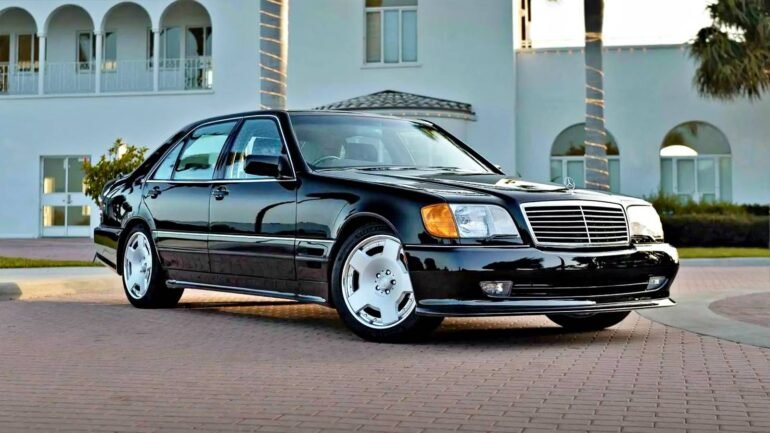
When Mercedes-Benz launched its new S-Class, the W140, in 1991, it became an instant monument to engineering excess, with no boundaries, no budget constraints, and nobody who said: “Okay, I think that is enough”, until a decade after they started designing it. The result was more than a very large luxury saloon. The W140 was a statement to BMW, Lexus, and the other upstarts who wanted to move onto the same level as Mercedes. The W140 became known as the most over-engineered Mercedes-Benz ever built. Some tried to mock it as a folly, but most people who love cars considered it a legend.
The Mercedes-Benz W140 was launched in 1991, and production ended in 1998, which meant its development took three years longer than its production run lasted. In total, Mercedes-Benz sold 406,710 W140 sedans and 26,022 coupes. The W140 also marked a turning point for Mercedes, since it was the last car made under the philosophy of building the best car in the world, no matter what the cost. The W140’s engineering was so over the top that this car still commands attention after all these years.
A New Vision: The Ambition Driving The W140

Mercedes-Benz began developing the W140 in 1981, at a time when the company stood alone at the top of automotive engineering excellence, but was starting to feel the pressure. Jaguar was faltering, but BMW was on the up. Although Lexus was only officially launched in 1989, there were rumors of a new threat from the east. Audi was flexing its tech muscles, and it would move into the luxury market in that decade. It had to redefine both luxury and technology for the whole industry. The engineers were given the mandate of no compromise and the money to achieve this.
Ten Years In The Making

The W140 took 10 years to design, although the first half of that was spent developing, testing, and rejecting different prototypes. The final design was accepted in 1987, but faced numerous delays as features were added, refined, rejected, and re-engineered again. The program had the nickname “The Cathedral” because it was so complicated and expensive.

Another delay was when BMW launched the new 7 Series, its first post-war V-12 car. Mercedes-Benz had to design a new V12 engine and enlarge the engine bay of the car to accommodate the bigger engine.
Size Mattered

Initial prototypes were rejected because they were too small and had to be made longer, wider, and given more of a presence. The final W140 was huge, even by today’s standards. The 600 SEL — long wheelbase — is 205.2 inches long, 74.3 inches wide, and 57.7 inches tall. The curb weight was just under 5,000 pounds.

Not only was this car large, but everything about it was on the same scale. The pillars were thick, and the doors looked like bank vaults. But the W140 was not only big and imposing, but it was also serenely quiet, and even the massive door closed with a subdued ‘whump’. This was the power car of the ’90s, driven by heads of state, corporate CEOs, and anyone who needed to project personal power.

Mercedes S-Class Turns 50 Years: The Benchmark Of Luxury Sedans
A staple of Luxury motoring; here’s taking a look at how the flagship German sedan has evolved over the past five decades
Engineering Without Limits: Technologies That Made The W140 A Legend

The Mercedes-Benz W140 S-Class is called the last full production car built by engineers, not accountants. Engineers had a free hand and the budget to build and add features as they wished. Many of these showed the way cars would be built in the future, while some were wild for the sake of being wild, and would probably not be used in production cars again.
Super Quiet Experience

The feature that attracted a lot of attention then and even now is the double-glazed windows. These were added for unmatched sound insulation, but this has not really caught on because of the extra weight and cost. The car was made even more soundproof by adding thick underbody shielding, heavy insulation, and rubber isolation mounts.

The doors and trunk were engineered to soft-close themselves. Instead of requiring effort, vacuum actuators would gently pull them shut. The very thick door seals, which added to the soundproofing, also made the doors difficult to open. So the door handles got a pneumatic system that lifted the handles when pulled, making it a bit easier. The W140 also featured a central hydraulic system to power everything from the wing mirrors to the trunk lid.
Advanced HVAC System

Air-conditioning in luxury cars was pretty standard in the early ’90s, but Mercedes-Benz took it to a different level. Their engineering on this one aspect of the W140 was so extensive that it led to dozens of patents on new components. The HVAC introduced automatic multi-zone controls, sensors for sun, humidity, and cabin temperature. This system was so good, it could keep the temperature inside constant, no matter the conditions outside. This system is so complex that repairing it today would cost more than buying a used W140.

Another outstanding feat of engineering is the 6.0-liter V12 engine used in the top-line S600. The M120 engine produced 390 horsepower and was considered one of the smoothest and most durable V12 engines ever built. The engine was so over-engineered that tuners could boost power up to 700 horsepower without modifying any internals.

A History Of The Mercedes-Benz S-Class Coupe And Convertible And Why They’re Iconic
Mercedes-Benz discontinued its flagship grand tourer coupe and convertible, but that still doesn’t keep us from missing them.
A Technological Powerhouse That Influenced An Entire Industry

Imitation is the sincerest form of flattery. While many argued at its launch that the engineering of the W140 was excessive and over the top, and many still do, much of the engineering first used in this car can be found in luxury and even mass-market cars today. Silence and isolation became a luxury hallmark and are commonly featured by brands like Audi, BMW, Lexus, and others. While double-glazed windows are rare, the same effect is now achieved by laminated acoustic windows. The idea of a luxury car being super quiet was not new, but it became mainstream with the W140.
Luxury And Safety

The soft-close door system, then seen as revolutionary, is now common on premium vehicles. Mercedes-Benz set the standard for how a luxury car door should feel and sound when it was closed. Power convenience features like remote opening boot or electrically adjustable wing mirrors have moved beyond the luxury market and are now mass-market standards.

Many of the electronic safety systems pioneered by the W140 have become so common, they are rarely even mentioned individually in car reviews. Some of the technologies are the electronic stability program, brake assist, which kicked in during emergency braking, front and side airbags, and seatbelt pre-tensioners. These features became industry standards that continue to save thousands of lives.
The Flagship As A Statement

The Mercedes-Benz W140 created the philosophy that the flagship model was not just a bigger or more powerful version of the other cars in the range, but would serve as a technology showcase for the model and even the brand. The W140 came in nine gas versions and one diesel. Engines ranged from the 3.2-liter inline six, through the V8s, to the mighty V12 found in the S600. Everything in the S600 was one or more levels above the lower trims.

The S-Class still serves this role in the Merc lineup today, but other marques like Audi, Lexus, and BMW also follow the same practice. With BMW, for example, any vehicle with the number seven in it means top of the range.

10 Used Luxury Cars That Outshine Their Modern Rivals
Many enthusiasts argue that older luxury cars, built with more robust materials and engineering philosophies, offer a superior driving experience.
Why The W140 Stands As the Last Great “No-Limits” Mercedes

With the W140, Mercedes-Benz reached the limits of ‘no-limits’. The car was way too ambitious. The search for perfection caused huge delays in the development time, and development costs soared out of control. The cost of production, with all the new technology and focus on extreme precision, skyrocketed. The price of a new S-Class shocked even the most affluent buyers. Mercedes could not sustain these excessive levels of engineering and remain profitable. It is notable that the next generation S-Class, the W220, was notably more cost-efficient, with a shift to lighter materials and normal levels of luxury. This shift only served to raise the legendary status of the W140.
Built By Engineers

Front three quarter shot of the 1991 Mercedes-Benz S-Class
The W140 was an automotive deviant, a car built by engineers on the premise of ‘no-compromise’. There was no input from accounting, and nobody knows if marketing even knew it existed. That the car was eventually launched and sold so well is a testament to pure engineering excellence.
End Of An Era

The Mercedes-Benz W140 is an idea rather than a car. It represents that one moment when an entire company stopped thinking and started creating, engineering without compromise. It will remain as the most over-engineered Mercedes ever made. The W140 was peak engineering, a one-off, and will not be repeated.
Sources: Mercedes-Benz, Bring a Trailer