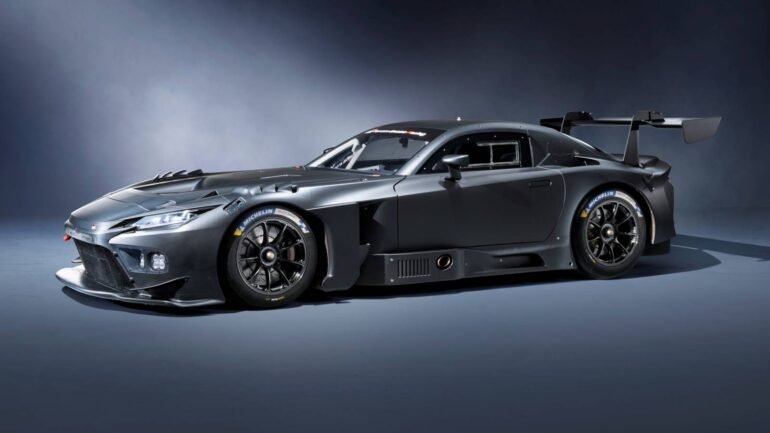
Toyota doesn’t do wild very often. That’s precisely why this matters. For a brand built on dependability, efficiency, and common sense, moments of excess stand out like lightning strikes. When Toyota chooses to ignore convention and indulge its performance instincts, the results tend to be unforgettable.
The Lexus LFA proved that more than a decade ago. Now, with the GT Hypercar Concept, Toyota appears to be flirting with that same dangerous territory again — and the performance world is better for it. This is the boldest, most unapologetic concept Toyota has unveiled since the LFA, and it sends a message that goes far beyond design theatrics.
A Concept That Feels Like A Warning Shot
The GT Concept Doesn’t Ease You In; It Hits Hard

Low, wide, and visibly aggressive, it looks nothing like a traditional Toyota. The proportions are extreme. The surfaces are sharp. The stance is pure race car. This isn’t a design exercise meant to test public reaction — it’s a statement piece meant to stop conversations. Toyota has built fast cars before. Toyota has built exciting cars recently. But it hasn’t built something this confrontational in years. In fact, the GT Concept feels deliberately disruptive. It ignores the polite performance formula that dominates today’s market, where speed is filtered through luxury, screens, and safety nets. Instead, it presents a performance as something raw, purposeful, and slightly intimidating — a philosophy that feels increasingly rare. Much like the Lexus LFA once did, the GT Concept doesn’t try to be liked. It tries to be respected.
Why The Lexus LFA Comparison Is Inevitable

The Lexus LFA wasn’t successful because of sales numbers or spec-sheet dominance. It was successful because it was unreasonable. A naturally aspirated V10 developed by Yamaha; carbon-fiber construction created entirely in-house; a ten-year development cycle for a car Toyota never expected to profit from. The LFA existed to prove a point — and it succeeded.

It redefined Lexus. It reshaped Toyota’s performance credibility. And it left an emotional legacy that still resonates today. The GT Concept feels cut from that same cloth. Like the LFA, it ignores market logic. Like the LFA, it prioritizes engineering purity over cost control. And like the LFA, it feels like something Toyota wanted to build for itself, not something it was forced to build by trends or regulations. That mindset is rare — especially in today’s performance landscape, where risk aversion often replaces ambition.
Motorsport First, Road Car Second

One glance at the GT Concept tells you exactly where its inspiration comes from. This is not a GR Supra taken to extremes. It’s a hypercar silhouette rooted in endurance racing. The long nose, deep aero channels, ultra-wide track, and tightly packaged rear are all hallmarks of modern prototype racers. There’s clear visual DNA from Toyota’s GR010 Le Mans Hypercar — a machine that has dominated endurance racing in recent years. Everything about the GT looks functional. Nothing appears decorative. The aero elements look designed to manage airflow at extreme speeds, not simply fill space. The bodywork looks shaped by engineering rather than styling trends. That’s what separates this concept from most modern show cars. It doesn’t feel like fantasy — it feels like a racecar that’s been toned down just enough to imagine outside a pit lane.
This Isn’t a GR Car — And That’s the Point

Toyota’s Gazoo Racing division has earned its credibility. The GR Yaris, GR Corolla, and GR Supra have reintroduced Toyota to enthusiasts who once wrote the brand off as purely sensible. But those cars still live in the real world. The GT Concept doesn’t. It sits above GR — not as a future trim level or limited edition, but as a philosophical extension of Toyota’s performance ambitions. A car that doesn’t need to be practical, attainable, or even logical. A car that exists to elevate everything beneath it. That’s the same role the Lexus LFA played within the Lexus lineup. And it’s a role Toyota itself hasn’t attempted to fill in over a decade.

Toyota hasn’t confirmed what powers the GT Concept, but whatever ends up beneath that dramatic bodywork will define its legacy. A Le Mans-inspired hybrid system would be the most logical solution. Toyota already possesses the technology, and it would align perfectly with the car’s motorsport-focused design. High-output combustion paired with electric torque would deliver the immediacy expected of a modern hypercar. A hydrogen combustion engine would be the most daring move. Toyota has invested heavily in proving hydrogen can preserve the sound, vibration, and engagement of internal combustion. A flagship hypercar would be the ultimate platform to demonstrate that belief. A full EV remains possible, but it feels least aligned with the GT’s character.
How The GT Stacks Up Against Modern Hypercars

The LFA was unforgettable largely because it appealed to the senses. Silence and software-driven performance were never part of that equation. If Toyota wants the GT to truly follow in the LFA’s footsteps, emotion will matter just as much as output figures. Placed in today’s performance landscape, the GT Concept occupies an interesting space. Many modern hypercars rely heavily on luxury, digital interfaces, and brand prestige. Others chase headline numbers through electrification alone.

The GT feels different. It looks leaner. More focused. Less indulgent. It feels closer in philosophy to race-derived machines than lifestyle exotics. That approach aligns closely with Toyota’s motorsport roots and suggests the GT isn’t meant to out-flash its rivals, but out-engineer them. If built, it wouldn’t need to be the fastest hypercar in the world. It would need to be the most authentic — exactly what made the LFA so revered.
Why This Concept Matters Right Now

The GT Concept arrives at a critical moment for performance cars. Internal combustion is under pressure. Electrification is accelerating. Many manufacturers are downsizing their enthusiast offerings or abandoning halo projects entirely. Risk is being replaced by caution. Toyota is doing the opposite. By unveiling something this extreme, Toyota is reminding enthusiasts that it still values passion, motorsport, and emotional engagement. It’s proving that efficiency and excitement don’t have to be mutually exclusive — and that performance doesn’t have to be diluted to survive. That message carries real weight, especially coming from the world’s largest automaker. Even if the GT Concept never reaches production, its influence will be felt. Concepts like this shape design language, guide engineering priorities, and set internal ambition. The Lexus LFA did exactly that, and its impact can still be traced through Lexus and Toyota performance models today.
A Halo Car in Everything but Name

The GT Concept has that same potential. It raises expectations. It lifts the ceiling. It changes the conversation. And that is precisely what a true halo car is supposed to do. This might be Toyota’s Most Exciting Idea in Years. The Toyota GT Hypercar Concept is wild, excessive, and unapologetic — and that’s why it matters. It recalls a time when Toyota wasn’t afraid to take risks. When it built cars like the Lexus LFA, simply because it could. When passion outweighed predictability. Whether the GT ever reaches production is almost beside the point. Its existence alone proves Toyota hasn’t lost its edge — it’s simply been waiting for the right moment to show it again. And if this really is the wildest thing Toyota has done since the Lexus LFA, then the next chapter of Toyota performance might be far more exciting than anyone expected.
Sources: Lexus, Toyota