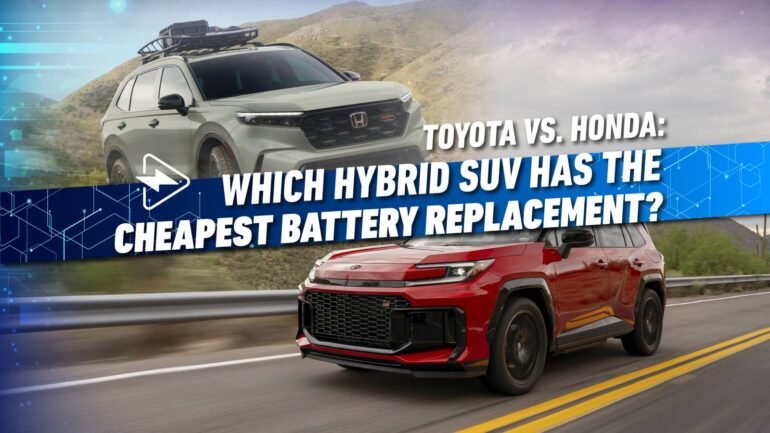
Toyota and Honda are currently leading the hybrid race in the U.S., which shouldn’t come as a surprise to anyone, considering they are the first brands to bring these types of vehicles to the market with the first-generation Insight and Prius. What started out as a niche and relatively more expensive proposition has now evolved into mainstream options that American car owners flock towards for their appealing fuel-saving returns and attractive overall affordability.
-


- Base Trim Engine
-
2.5L Inline 4 Hybrid
- Base Trim Transmission
-
CVT
- Base Trim Drivetrain
-
Front-Wheel Drive
- Base Trim Horsepower
-
226 hp
- Make
-
Toyota
- Model
-
RAV4
-


- Base Trim Engine
-
2L I4 Hybrid
- Base Trim Transmission
-
CVT
- Base Trim Drivetrain
-
Front-Wheel Drive
- Base Trim Horsepower
-
145 HP @6100 RPM
- Base Trim Torque
-
138 lb.-ft. @ 4500 RPM
- Base Trim Fuel Economy (city/highway/combined)
-
43/36/40 MPG
When it comes to 2026 year models, it’s undeniable that the Toyota RAV4 and Honda CR-V are destined to be two of the most popular options. Both of these midsize SUVs tackle the segment with an effective balance of practicality and versatility, without compromising on performance and efficiency. Both of these models will need their battery packs replaced after about 15 to 20 years of use, and this will likely be the most expensive repair that you will have to execute throughout your entire ownership experience. The big question is, which model is going to cost you more between the two options.
Toyota’s Varying Costs For The RAV4 Battery

According to Toyota, you can expect to pay anywhere between $3,000 and $8,000 to have a new 0.9-kWh Nickel-Metal Hydride battery pack installed in your RAV4. If you opt for a refurbished pack, this lowers the price to anywhere between $1,500 and $3,500, but these will be slightly less reliable and suffer from a shorter lifespan.
All RAV4 models come standard with the brand’s class-leading 10-year or 150,000-mile battery warranty, which covers all manufacturer-related faults and defects. Toyota benefits from a fairly comprehensive online parts catalog, but it does not list a replacement HEV battery pack part, so there’s no exact figure for us to reference.
Toyota’s Dependable HEV System

Bear in mind that if you purchase a new Toyota RAV4 and maintain it to the manufacturer’s specification, you’re unlikely to encounter any battery-related faults within the first 10 to 15 years. At this point, there’s a very strong chance that Toyota’s replacement battery packs will be substantially more affordable than what they are today.
Although Toyota isn’t deeply invested in full electrification, it still heavily invests in electromobility, with the goal of making the technology more reliable, efficient, and affordable. Based on this, there’s a strong likelihood that you’ll be paying a bit less than the above-quoted figures when the time comes to have the HEV system’s battery pack replaced.
What Happens When The Battery Starts To Fail

Several symptoms will start to present themselves when your RAV4’s hybrid battery reaches the end of its lifespan. This will negatively affect its performance and efficiency. The first thing you’re sure to notice is a noticeable and significant fuel economy drop, as the hybrid system heavily relies on this part to alleviate consumption from the ICE system. When this occurs, you’ll also be subject to inconsistent or reduced acceleration due to the diminished power output from the hybrid battery.

2026 Toyota RAV4 Interior And Exterior Picture Gallery
The 2026 Toyota RAV4 debuts with bold new styling across Core, Rugged, and Sport designs, and offers only electrified powertrains.
The CR-V Hybrid’s Competitively Priced Replacement Battery

Honda’s online parts catalog for the CR-V Hybrid indicates that a new HEV battery pack module costs $3,222.17 before taxes and discounts, but this includes all auxiliary components that you wouldn’t typically need unless your housing sustains damage due to a collision or manufacturer fault. Select Honda dealership websites indicate that you can expect to pay around $2,000 for a new hybrid battery in the best-case scenario, which we think is a bit of a conservative figure. CR-V owner forum users have indicated that older Honda CR-V Hybrid battery replacements typically cost around $1,900 for parts and excluding labor via an independent workshop, which sounds reasonably accurate.
Parts are likely to take up the bulk of the cost, with battery replacement labor estimated to be around $500 and $800, depending on whether you take your vehicle to a Honda-accredited service center or an independent workshop. Replacing the battery pack on an HEV is a much easier task than a battery module replacement for an EV, but it does require some level of stripping, as the large pack is typically located beneath the rear bench.
Honda’s Outstanding Warranty Coverage

Honda includes its standard three-year or 36,000-mile limited warranty and five-year or 60,000-mile powertrain warranty with every CR-V Hybrid sale. You also get a five-year corrosion warranty over an unlimited mile range. If you have a replacement part fitted, the manufacturer covers this for one year. Accessories get a three-year or 46,000-mile warranty.
All hybrid systems are covered for a comparatively short three years or 36,000 miles, but the battery pack gets the market-standard eight years and 100,000-mile coverage. For peace of mind while on the road, you also get a 36-month or 36,000-mile roadside warranty in the package. There are also in-house extended warranty packages that vary in years and miles, if you plan on keeping the car for longer.

2026 Honda CR-V Trailsport Debuts With Improved Off-Road Ability
It comes with rugged Continental CrossContact ATR all-terrain tires.
The Toyota RAV4’s Reliability And Ownership Costs

According to Edmunds, you can expect to spend $45,506 over the course of five years and 60,000 miles on the base Toyota RAV4 LE. $5,672 accounts for maintenance, $887 for repairs, $11,709 for depreciation, and $9,464 for fuel. J.D. Power’s valuation of the RAV4 Hybrid, which consists of a reasonably impressive 80/100 quality and reliability rating, resulting in an 80/100 overall score. iSeeCars backs this with an 8.7/10 reliability score, citing that it will benefit from a 14.4-year lifespan and cover 173,295 miles without any reliability issues.
According to CarEdge’s depreciation calculator, the Toyota RAV4 Hybrid retains more value than most HEV SUVs in the U.S. thanks to its strong brand reputation, high consumer demand, and proven long-term reliability. Toyota has built a reputation for producing durable vehicles with low maintenance costs, which translates to higher resale values. The RAV4 Hybrid benefits from Toyota’s strong presence in the hybrid market, where it is recognized as a leader due to its early adoption of hybrid technology and consistent refinement of its models.
The CR-V Hybrid’s Equally Impressive Reputation

The Honda CR-V Hybrid benefits from good overall mechanical reliability, predominantly thanks to the dependable nature of its L-Series ICE unit, but the direct-drive system also omits a lot of possible mechanical faults. J.D. Power issues the entire range with an 83/100 consumer-verified overall score, consisting of 83/100 for quality and reliability, 79/100 for the driving experience, 86/100 for resale, and 83/100 for dealership experience.
iSeeCars issues the Honda CR-V with an 8.7/10 overall score, including 8.2/10 for reliability, 8.8/10 for retained value, and 9.0/10 for safety. The publication indicates that this model will cover 13.8 years or 169,293 miles without experiencing any noteworthy mechanical issues, together with a 30.2-percent probability of hitting 200,000 miles.

Honda CR-V vs. Toyota RAV4: Which SUV Is The Smarter Buy In 2025?
Choosing between the 2025 Toyota RAV4 and the 2025 Honda CR-V really comes down to what you value most.
The 2026 RAV4’s Highly Competitive Pricing

Toyota kicks the 2026 RAV4 range off with the LE, starting at $31,900. Following this is the $34,700 SE, all-wheel drive exclusive $39,900 Woodland, $36,100 XLE Premium, and the $41,300 XSE and $43,400 Limited, both of which are also all-wheel drive only. The PHEV range only consists of the SE and the XSE, priced at $44,815 and $48,685, respectively. Opting for the all-wheel drive system will see all relevant models becoming $1,400 more expensive.
The 2026 CR-V Hybrid’s More Premium Approach

The CR-V Hybrid range starts at $35,630 for a base Sport derivative in front-wheel drive guise. The $38,880 Trailsport Hybrid is a configuration that is based on the entry-level model, but with a more adventurous aesthetic. The Sport-L is essentially a more premium extension of the base model, increasing the price to $38,725. The Sport Touring sits at the very top of the range with a $42,250 starting price before options. You also need to be mindful of Honda’s $1,350 destination and handling fee, which applies to all CR-V Hybrid models.
Sources: iSeeCars, J.D. Power, and Edmunds