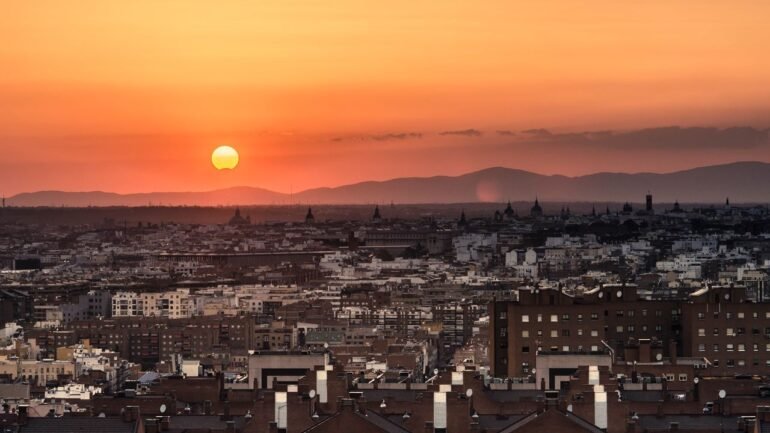
For travelers just booking their August eclipse trips now, cities like Valencia, Bilbao, and Zaragoza may be your best option. Accustomed to managing high-season crowds, the hubs promise modern infrastructure, open restaurants, and more hotel options. The Basque Country’s culinary reputation means places like San Sebastián filled early, but nearby alternatives like Vitoria still have scattered availability.

Central Spain
For those prioritizing pristine skies and natural beauty over comfort, Central Spain’s rural autonomous communities—including Castilla y León and Castilla-La Mancha—offer a different proposition entirely.
Sergio Carmona, an IT consultant, lives in Castilla y León in Soria, the country’s least densely populated province. Despite only having 10 permanent residents and 0.04 inhabitants per square mile, he says his 10-person village has already received tens of thousands of accommodation requests. Official hotels in Soria’s capital are all fully booked, leaving private home rentals on Facebook Marketplace or rural campsites as the only remaining options.
“Soria has a special natural charm,” Carmona says, noting the region’s well-preserved rural walking and hiking paths and spectacular night skies—exactly what serious eclipse chasers seek. However, the town’s locals are “a bit scared” by the volume of requests they’re fielding, he notes. His village, like many in the path, has virtually no infrastructure—few shops, limited restaurant service and rural roads that may be shared with harvest tractors in mid-August.
“Tourists have to understand where they’re coming,” Carmona says. “This isn’t a theme park. Come prepared like you’re going to camp in the mountains. Bring your things and pick up your trash afterward.”
Know before you go
A few practical considerations: ISO 12312-2 certified eclipse glasses are required for safe viewing—regular sunglasses won’t cut it. Totality lasts only 75 to 90 seconds, depending on your location, so make sure you’re in the right place at the right time. And be advised that weather can always play spoiler; August is Spain’s second-sunniest month, but clouds can roll in anywhere.
For island watchers, Ellis’s boat rental advice bears repeating—book now if you haven’t already. For rural viewers, pack camping-level supplies: Food, water, trash bags. Don’t assume services will be available. And if you still haven’t booked accommodations: “Get started yesterday,” in the words of Ellis.
But if you do miss out, fret not: Two more total solar eclipses will pass through Spain on August 2, 2027, and January 26, 2028.