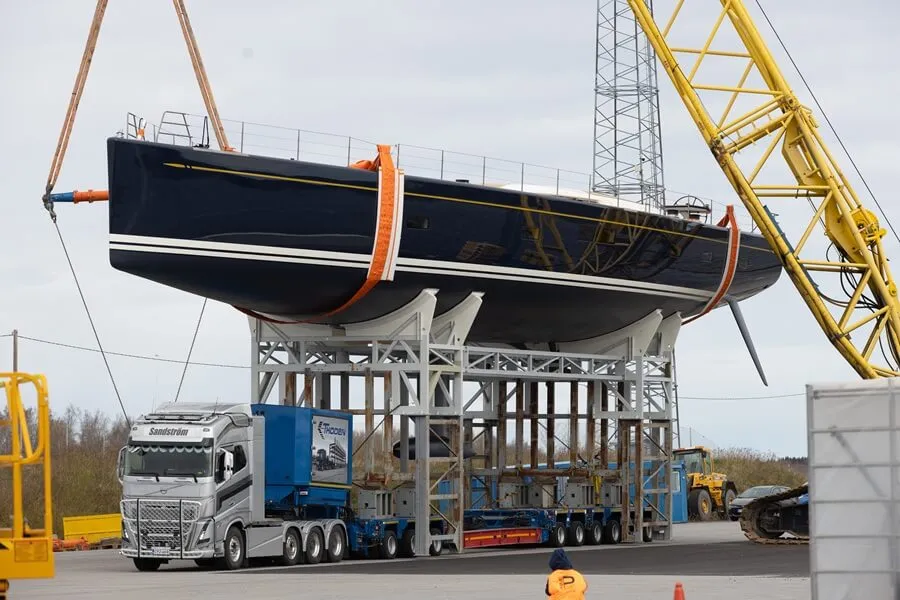
This far north in Finland, the morning air is laden with cold, even in May. The weather is unpredictable, especially in the Gulf of Bothnia where the town of Jakobstad (Pietarsaari in Finnish) sits on a latitude of 63° 40’N. On this particular morning, a team of shipyard workers sit anxiously studying the movement of the thin clouds that hover above the bay, wondering if the conditions will be right for their slated mission.
“For sure, the weather is an important factor on a day like this,” says Kim Sundkvist, Project Manager at Nautor Swan, one of the world’s premier sailing boat builders and certainly the most famous one in the upper latitudes. From Jakobstad, you could reach the Arctic Circle (66° 34’N) by lunchtime if you started driving early in the morning.
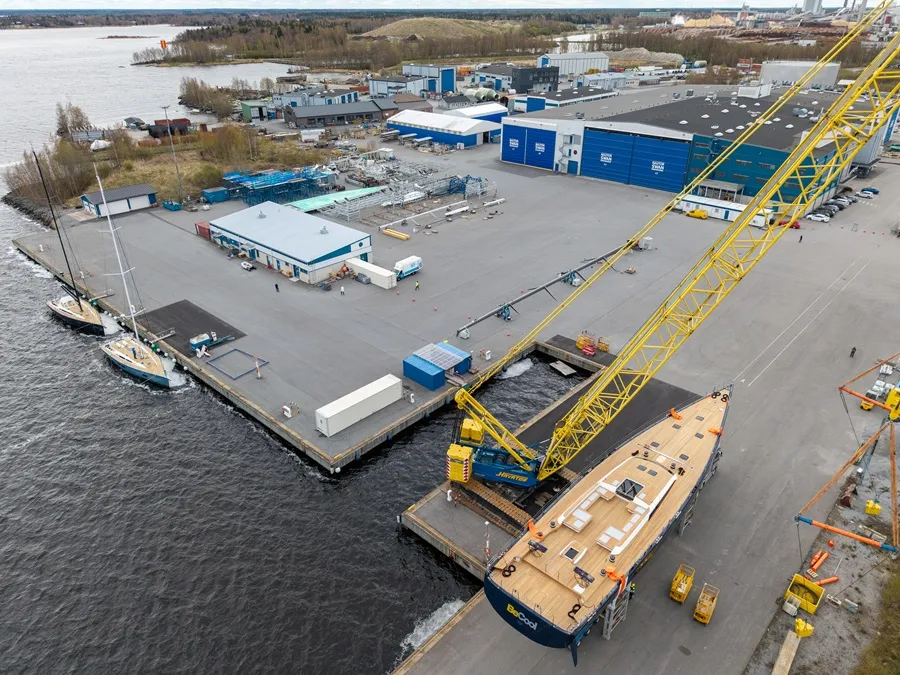
“We can’t have too much wind, which was actually the case two days ago,” he notes, as the shipyard prepares its second attempt to launch the first Swan 128, named BeCool.
The massive crane, one of Havator’s biggest, can lift 600 tonnes and needs to be booked months in advance as it’s one of the only models in the Nordic region that can handle such a job.
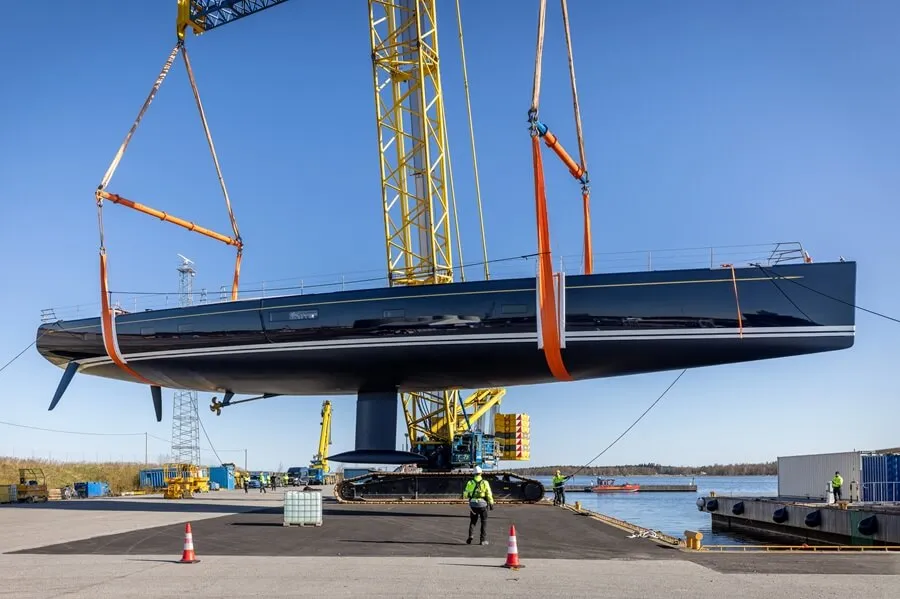
The different parts of the lattice boom crawler crane had arrived on multiple lorries and been assembled onsite in preparation for the job of taking the 128ft-long hull from its cradle, hoisting it into the morning sky, over concrete and into the sea.
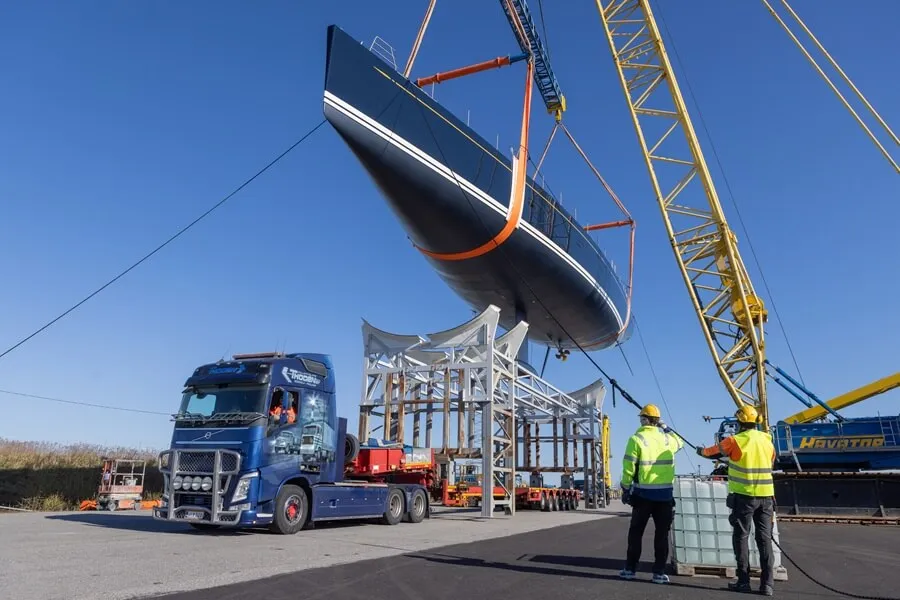
“One thing that gets the adrenaline going is when the boat is lifted off the build cradle,” he says. “We make a lot of calculations, so the slings are well positioned on the crane and it’s well balanced. However, it’s still exciting to see whether we got our calculations right!”
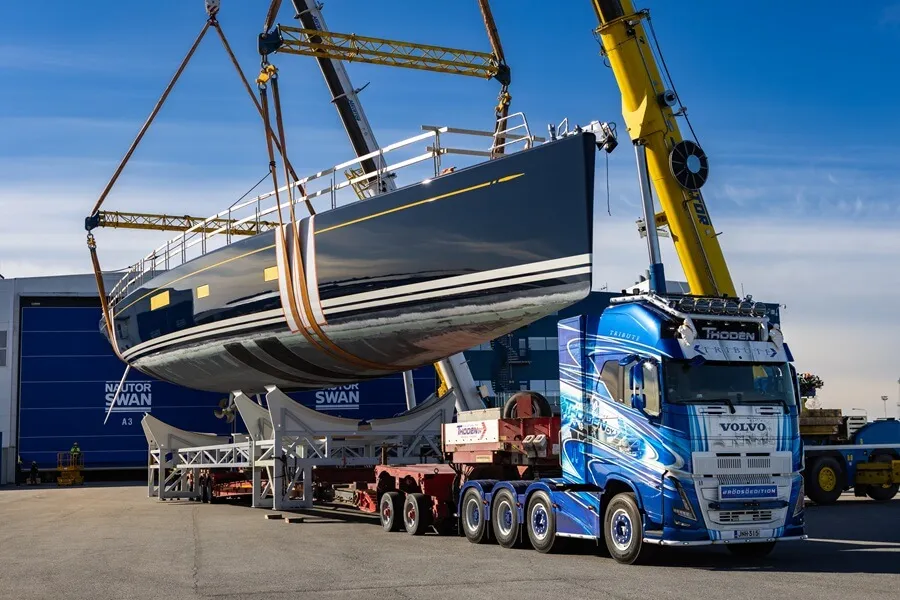
The slings are placed in their appointed position. The crane operator — having raised the massive lattice boom — awaits the crew on the deck to fasten the lifting brace. The final check is done: heads nod, walkie talkies give the signal. It’s time and the lifting of the 39 metre hull begins.
DESIGN, PLUG AND MOULD (2022-23)
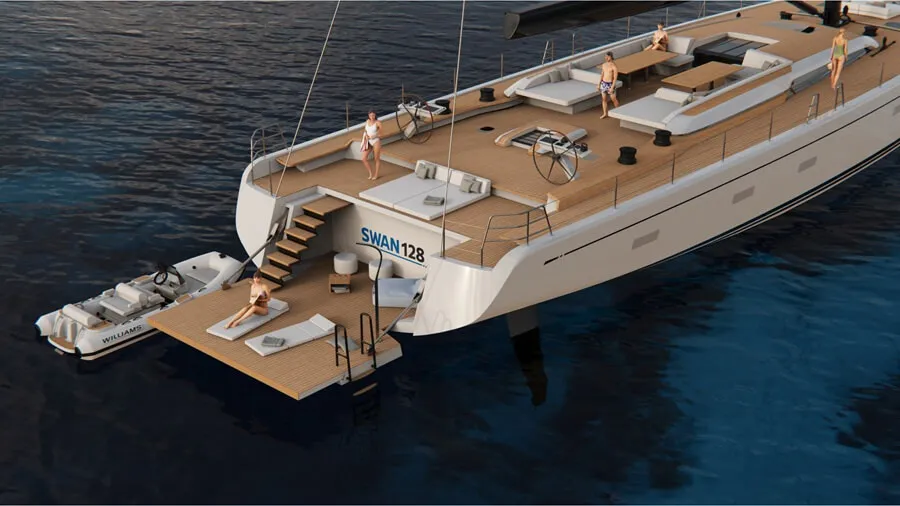
Launch day was among the latter landmarks in the build story of the first Swan 128. The model features naval architecture by veteran Germàn Frers — who has designed for Swan since 1981 — while Lucio Micheletti handled deck and coachroof styling, with Misa Poggi designing the interiors.
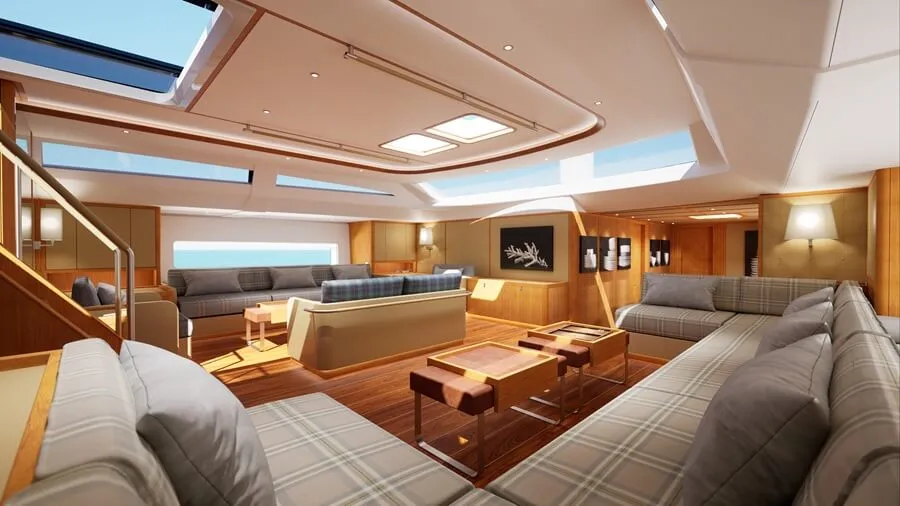
To tell a fuller story of what goes into building a Swan 128, we look back at the design and build process, which in this case stemmed from a Swan 98 owner looking for a bigger yacht. “This owner was very much involved in the design process, mainly on the general arrangements and the exterior,” Sundkvist says. “He had input on how he would like to see the boat.”
The design process went through what Sundkvist describes as a ‘couple of loops’, as a hull was designed and provisional interior layouts drawn, before additions such as the requirement of a laundry room added 4 feet to the original 124-foot hull.
As it was the first model of an all-carbon yacht, a mould was required. In fact, Nautor Swan is one of the few shipyards in the world able to build a full-carbon mould of this size. (In contrast, no mould was needed for the aluminium hull built in the Netherlands for Swan’s upcoming Alloy 44, which is being finished in Italy and scheduled to debut in 2028.)
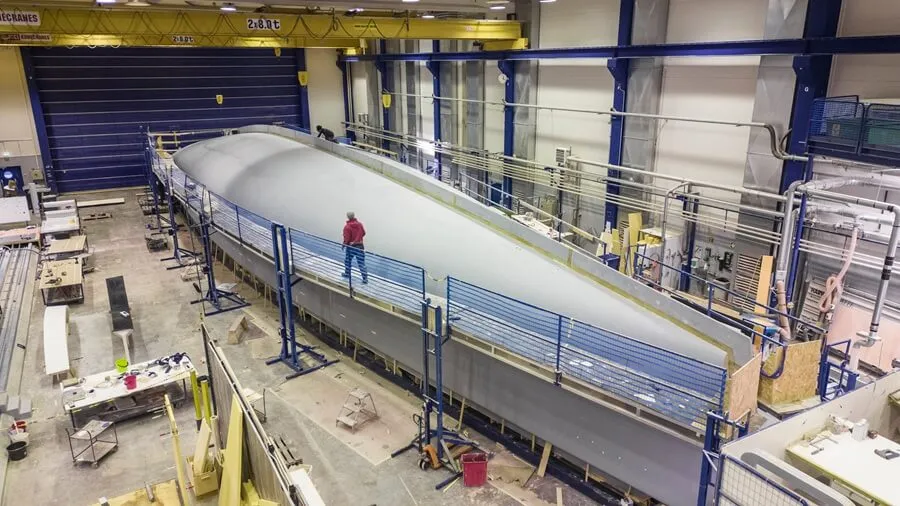
In June 2022, half a year since initial discussions and designs began, Nautor Swan began producing the largely wooden plug for the Swan 128 mould at its plug-and-mould facility in the small village of Kållby, about a 15-minute drive southeast of the shipyard’s main Boatbuilding Technology Center (BTC) in Jakobstad.
As the base shape for the mould, the plug is built upside-down or ‘bottom up’ and is eventually sanded and laminated to become vacuum tight. The full-carbon mould was then created by laying up and infusing a monolithic full carbon laminate over the plug.
The plug-and-mould process continued through January 2023, when the still-upside-down plug and mould, as well as external supports, were transported by road to the BTC at the end of the month.
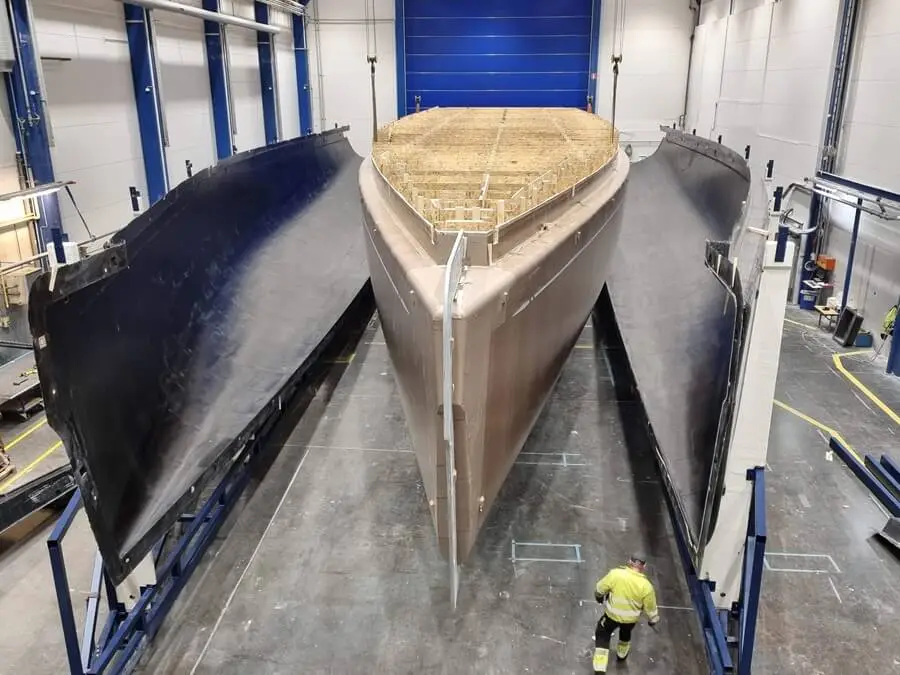
In their new home in Jakobstad, the plug-and-mould structure was rotated 180 degrees until it was the ‘right way up’, before the mould was then separated from the plug in two halves on February 8, 2023. (Prepared for hull one, the mould was also used later for the second Swan 128, which is scheduled to launch in May 2026.)
HULL AND DECK (2023)
Like all Maxi Swans, the Swan 128 is built in full carbon and requires multiple steps, starting with lamination of the hull shell. Both hull and deck manufacturing is based on Sprint© with carbon prepreg fabrics and epoxy resin in a sandwich featuring Corecell core. All materials are engineered and produced by Gurit.
The hull and deck manufacturing process includes a two-stage post-curing process in a digitally controlled oven for about 20 hours, with a characteristic temperature curve up to 90°C, then a final structural assembly post-cure.
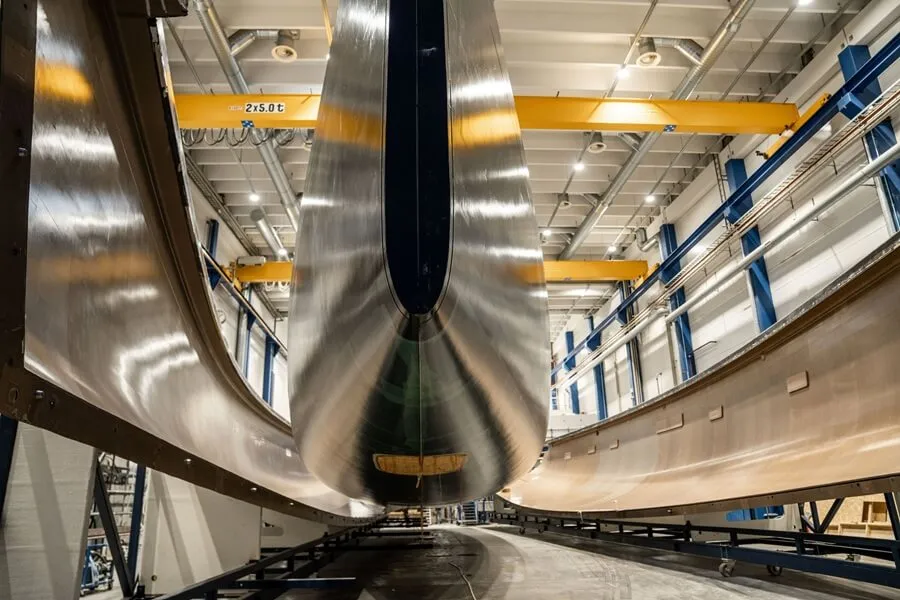
With the cured hull still in the mould, Swan installed carbon bulkheads, girders, keel floors, topside stringers and other parts of the internal skeleton. Once the hull structure was effectively self-supporting, it was ‘de-moulded’ in August 2023, with the mould halves removed, like they were earlier from the wooden plug.
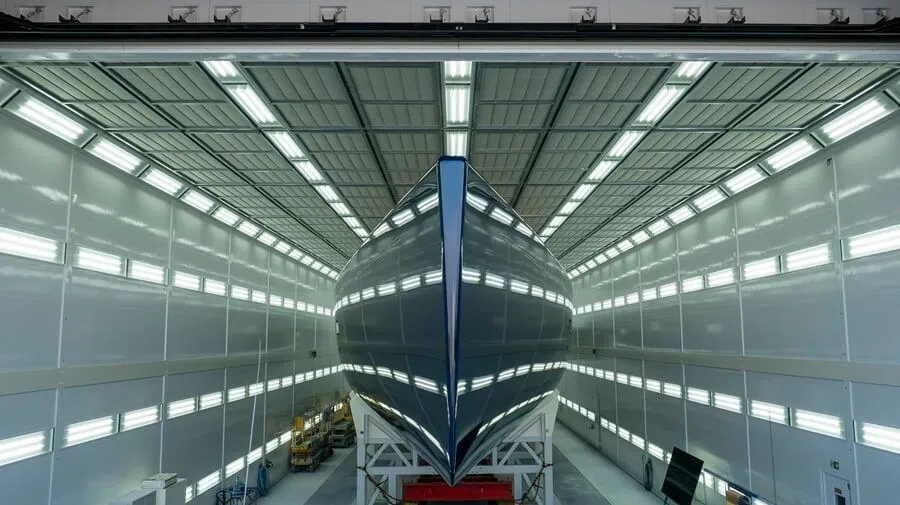
In November 2023, the fully faired, pinkish hull was transported by lorry to the paint shed, where it received what Sundkvist describes as the blue ‘show coat’, which allowed imperfections to be viewed and corrected before the final paint job about 10 months later.
OUTFITTING (2024)
In early 2024, Nautor Swan began outfitting the hull, focusing initially on tanks, batteries, piping and cabling. In February, the carbon deck was carefully lowered onto the hull for ‘dry fitting’, before being lifted off and moved back beside the hull, where teams continued to work on it.
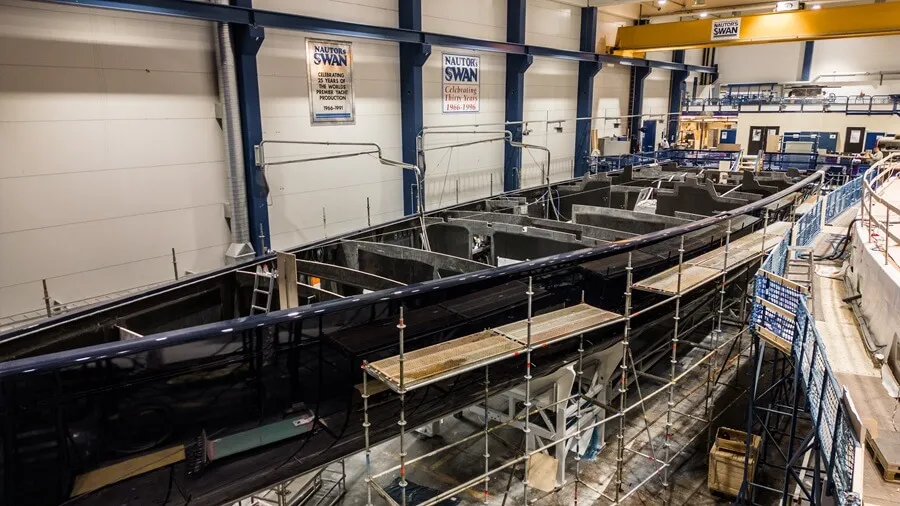
By March, the team had started installing furniture and joinery in the hull, with Nautor Swan having started preparing all woodwork onsite from mid-2023.
Starting from the ends of the hull — to give more time for teams to work on the engine room below the saloon — the installation of all wooden components took about six months. This period of the build is about efficiency and coordination, as many teams are working inside and outside the boat at the same time.
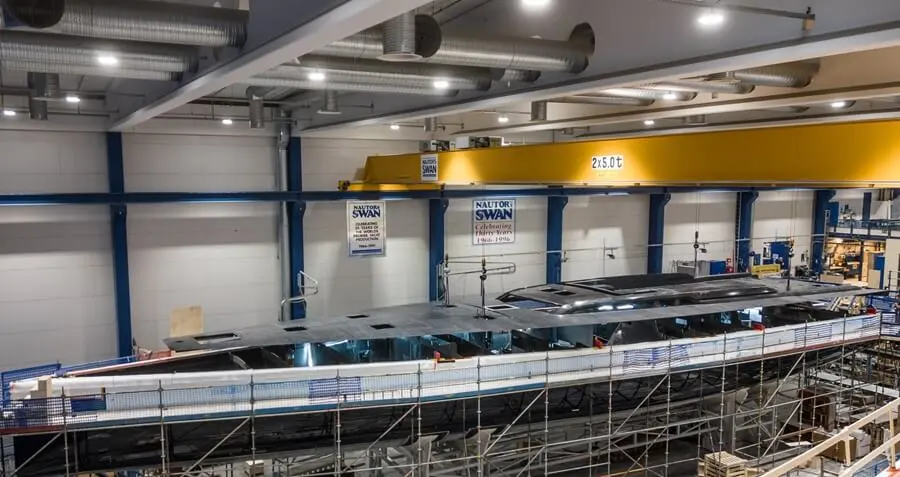
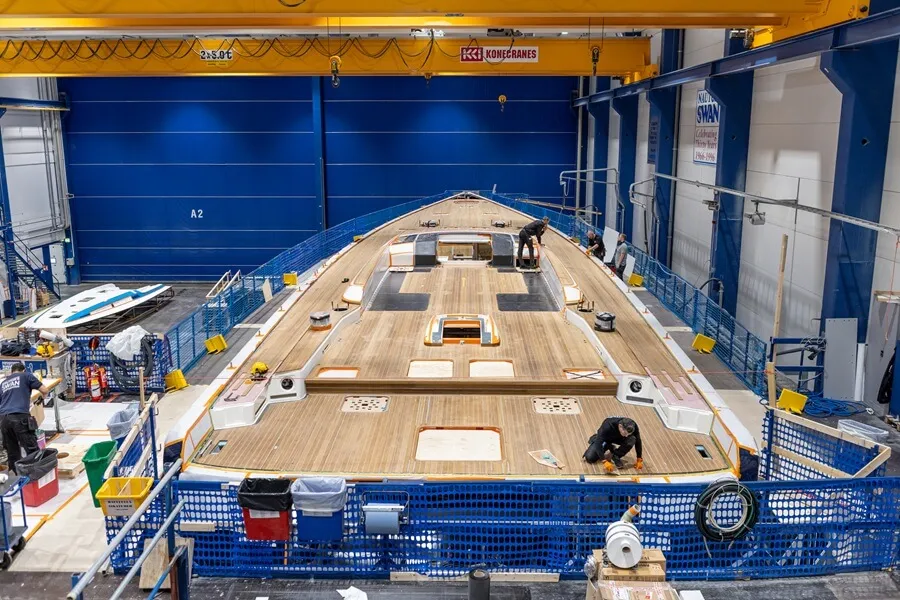
In parallel, Nautor Swan was working on completing much of the deck and coachroof structure, which was being assembled beside the hull. Work included laying it with teak, installing winches and sail handling systems, and painting.
There was also a lot happening outside Finland, with North Sails responsible for the yacht’s sails including a 444-square-metre main sail, 369-square-metre fore triangle, a 402-square-metre jib and a 1,180-square-metre asymmetric spinnaker.
Southern Spars was busy producing the 57-metre mast tube in New Zealand and the 18 metre furling boom in Spain, both in preparation for shipping to Finland, while the Future Fibres rigging, including AEROsix laterals and ECsix fore and aft stays, was being produced in Sri Lanka.
The enormous mast was eventually transported from New Zealand to Belgium as deck cargo on a ‘fruit ship’, Sundkvist explains, before it was reloaded onto another ship to the Jakobstad port, close to the Nautor Swan facility.
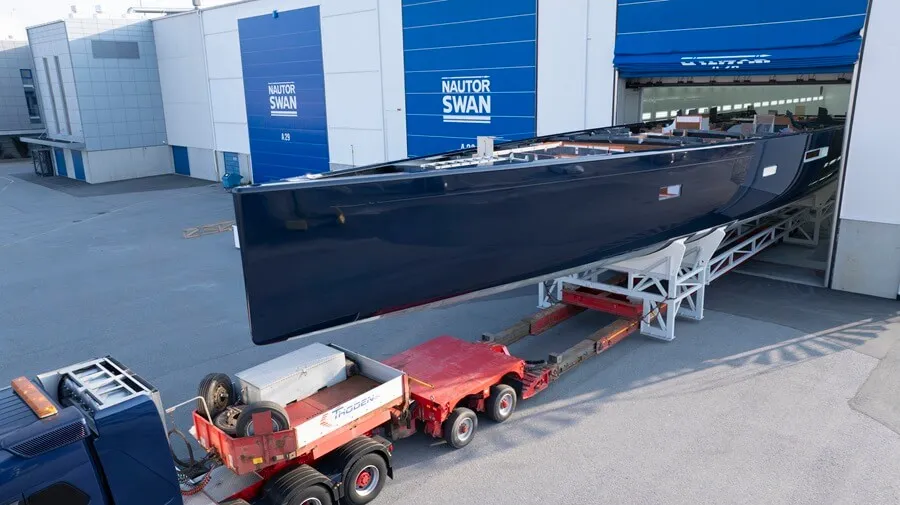
Back in Jakobstad, the Swan 128’s sanded-down hull was moved in September 2024 to the paint shed, where it was sprayed with its final base coat and a clear coat on top before returning to its shed.
On October 11, the almost-complete deck was fitted and glued to the hull, a milestone for the project, with the subsequent period referred to as ‘after deck’.
AFTER DECK (2025)
In the final months ahead of the launch, work continued inside and outside the boat, with power systems tested in the first quarter of 2025.
To prepare for installation of the keel, the hull was then moved outside in April 2025 to be lifted by two cranes onto a much-higher support structure and returned to its shed on the same day.
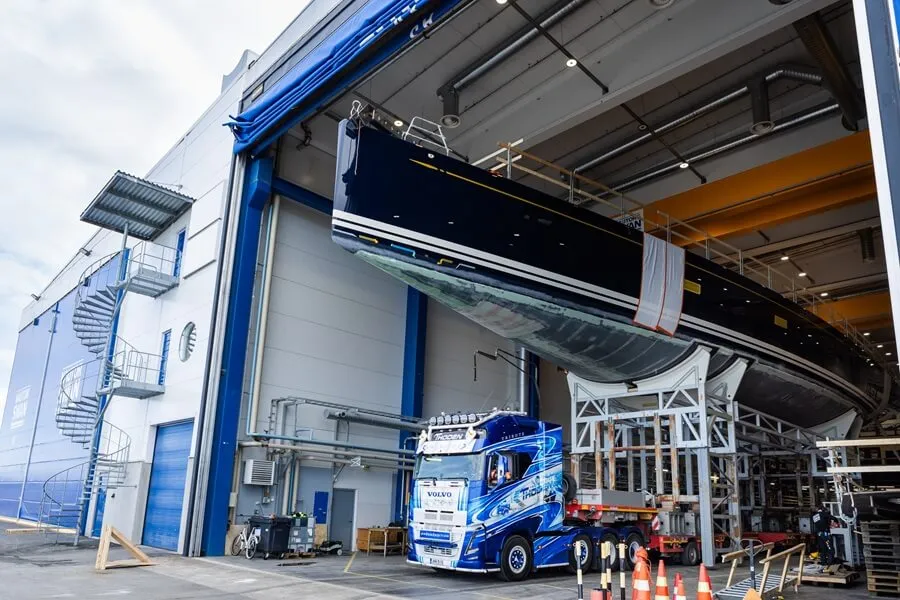
After all, the enormous telescopic keel on the Swan 128 gives the boat a draft ranging from 4.4 metres up to 6.7 metres when down — that’s 22 feet below the water.
“The draft is quite impressive,” smiles Sundkvist, who explains that the keel is the biggest built by its supplier to date. The weight of the ballast – telescopic keel, lead bulb and fins — totals almost 35 tonnes.
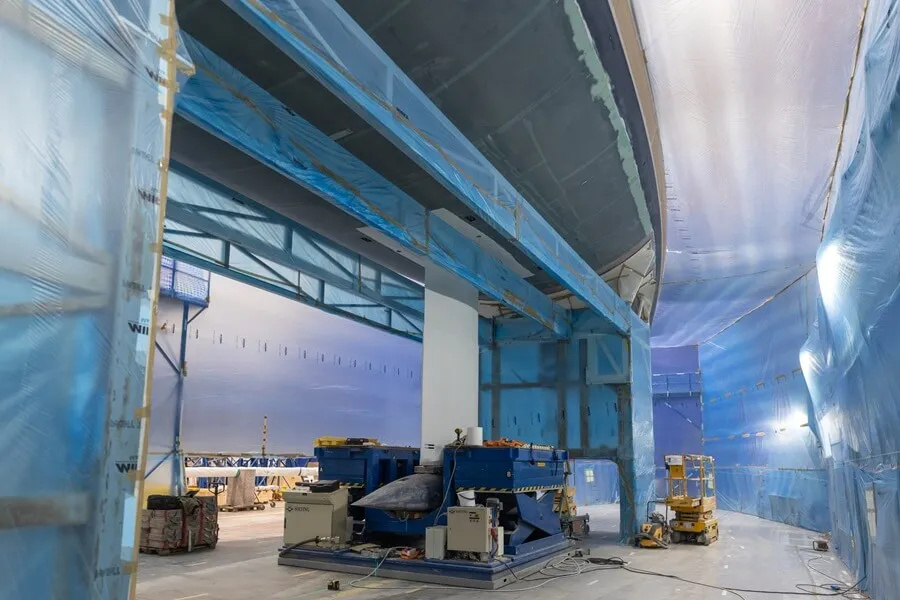
As well as the keel, the garage door was also installed, showcasing the BeCool movie typeface emblazoned in gold and silver. Antifouling work followed, while the shipyard fine-tuned all systems and components ahead of the scheduled launch date in May.
With one attempted launch already scuppered by bad weather, everyone involved was hoping for the best. “I think everybody put it in their evening prayers,” Sundkvist notes with a chuckle.
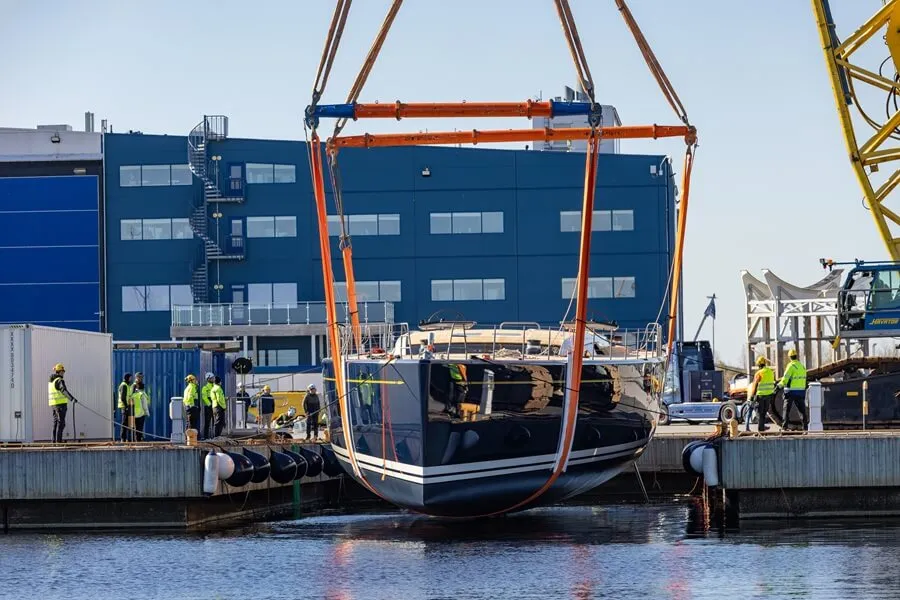
On May 16, 2025, all went smoothly, as the crane lifted the Swan 128 on two sets of orange slings before turning 180 degrees and lowering the hull into Nautor Swan’s specially designed water ‘pit’.
Days later, the high modulus mast tube was stepped, which was another major, weather-permitting operation, albeit one requiring a slightly lighter but almost-as-tall Havator crane.
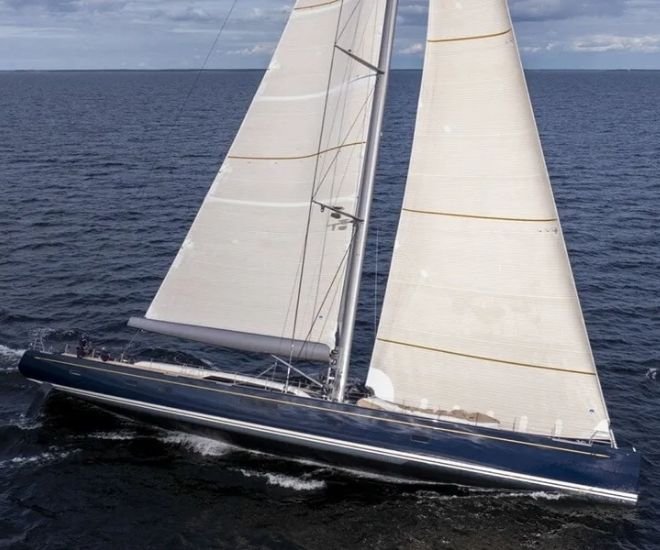
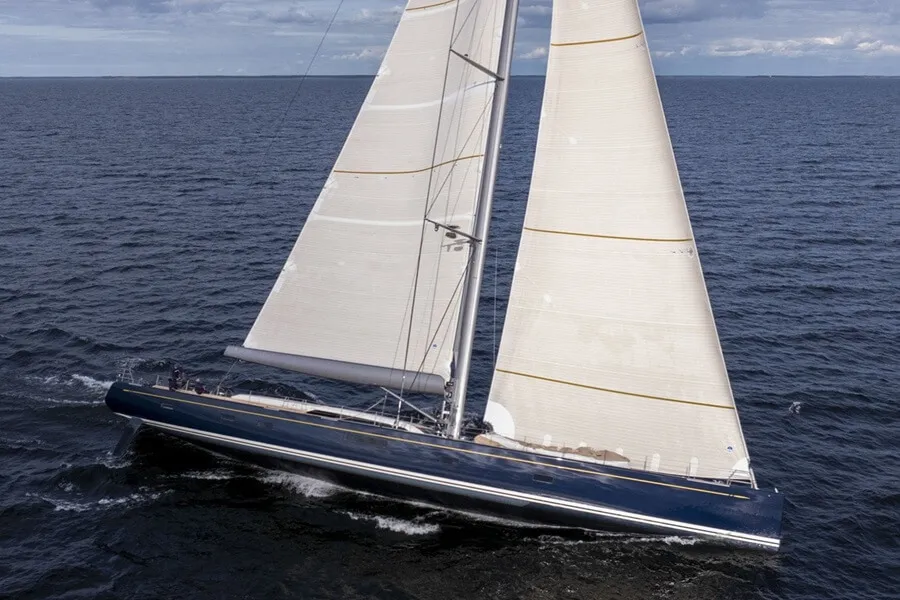
An impressive sight, the mast towers an impressive 57 metres above the design waterline. Add in the nearly 3-metre lightning spike (and burgee pole) and the Swan 128’s air draft is close to 60 metres, making the yacht more than 50 percent taller than it is long. And that’s just above the water.
With the boom and rigging also fitted, engine trials then took place in the Gulf of Bothnia, before the team awaited a calm day for the sails to be fitted offshore, which allows the boat plenty of room to manoeuvre during what can be a lengthy process the first time. Once everything was set, BeCool’s extensive sea trials period commenced, and the first photos of the boat sailing were taken and shared around the world.
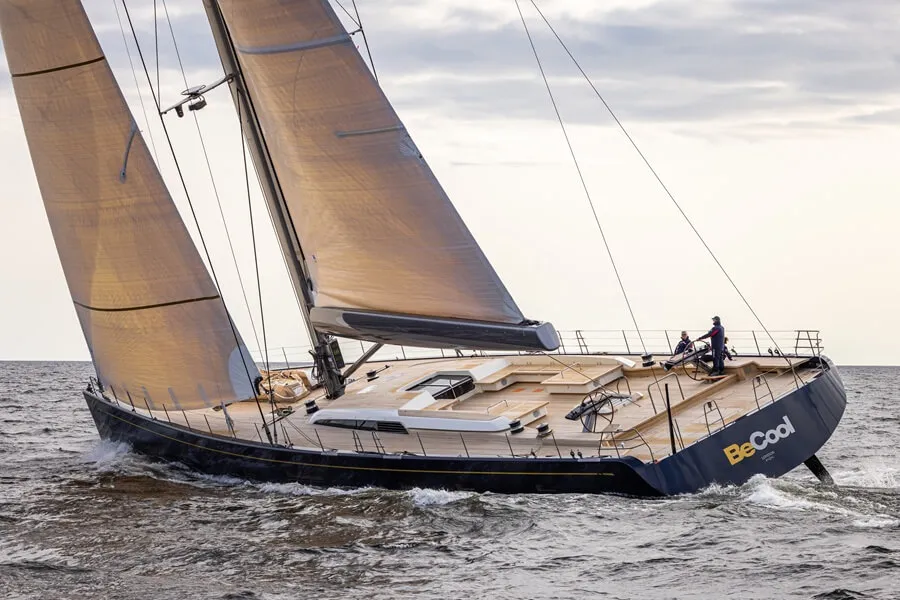
After relocating to Costa Smeralda in Sardinia, BeCool was well used by her active owner over the summer before the first Swan 128 headed north for its world premiere at the 34th Monaco Yacht Show in late September. Sundkvist, for one, was delighted to see BeCool in such a spectacular setting. “It’s not every day you get to visit Monaco,” he smiles, as he recalls the yacht’s global debut. “It was my third time to the show, and it was nice to see the boat in her element.”
After Monaco, BeCool headed west along France’s south coast to participate in Les Voiles de Saint-Tropez. This year, her schedule includes an Atlantic crossing to the Caribbean, where she’s signed up for the St Barths Bucket Regatta (March 12 to 15), before returning to Europe for the summer.
In September, Porto Cervo — the beating heart of Costa Smeralda — hosts both the Maxi Yacht Rolex Cup and Rolex Swan Cup, with the latter gearing up to be a momentous edition with Nautor Swan celebrating its 60th anniversary this year.
Before then, the shipyard’s activities include preparing for the launch and delivery of the second Swan 128, which features the same hull, deck, mast and boom designs used for BeCool, but with hybrid propulsion and a slightly amended sail plan. Let’s all pray for good weather.
Words: Sam Coleman & John Higginson; Photos: Nautor Swan
This article was first seen on YACHT STYLE
For more on the latest in luxury yachting reads, click here.