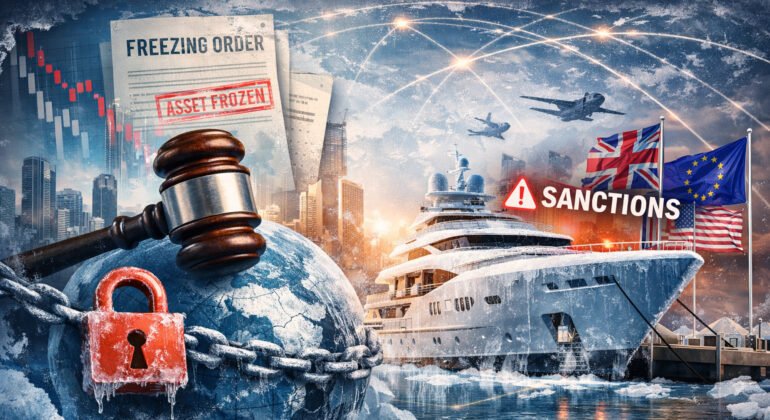
Yacht deals run on instant monetary transfers, layered entities, and cross‑border deals. This makes asset protection feel both urgent and fragile. Generally speaking, courts have responded with powerful tools now often called worldwide asset freezing orders. They’re designed to stop money before it disappears. They’re also on the rise. This growing tension between speed and due process drives a necessary debate about fairness, jurisdiction, and comity among courts. We examine the details, in light of a marked increase in worldwide asset freezing orders impacting yachts and the rest of maritime, in this episode of The Yacht Law Podcast.
The history matters. Late-Cold-War economics, Russia’s wild privatization, and an anti‑corruption crusade shaped the legal and political climate that turned targeted freezes into a global norm. Considering wires settle in minutes, courts fear that by the time a claimant wins on merits, assets will disappear. Yachts and superyachts are especially of concern, since they, unlike some other assets, can literally move with a moment’s notice.
Although efforts began in English courts, they spread across common-law jurisdictions and into international practice through comity. The legal test tends to center on a good arguable case, a real risk of dissipation, and proportionality so the order isn’t unduly oppressive. These orders aim to preserve the status quo, not decide the dispute, yet their bite is real. In fact, banks, yacht brokers, and intermediaries who receive notice risk contempt if they help move frozen assets. That pressure reshapes behavior far beyond the courtroom. As a result, yacht deals that would have closed on routine diligence alone end up chilled.
Sanctions actions have added a public‑law layer that supercharges freezing. After the Magnitsky Act and the 2022 invasion of Ukraine, the United States, United Kingdom, and European Union expanded lists that instantly bar transactions and lock assets. Sanctions can and do result from other issues, too, not pertaining to the invasion. Regardless, they all come from executive authority and can apply with little warning. Compliance teams now check multiple lists, and mismatches between jurisdictions complicate cross‑border trades. A party not under sanctions in one bloc still can be off limits in another. This leaves counterparties to decide whether to walk away, restructure terms, or seek declaratory comfort from local courts. The legal exposure extends to service providers who “facilitate” transfers after notice.
High‑value movable assets bring problems into sharp focus. A nightmare case unfolds when a buyer closes on a yacht, invests in crew and maintenance, and later learns a foreign court froze the seller’s assets mid‑deal. If the order is recognized locally, the boat can be seized as an unlawfully dissipated asset. The buyer could try to chase reimbursement, but encounter a web of shell entities. Even absent sanctions, disputed liens or fraudulent yacht titles can produce hard choices for courts and lenders.
In turn, the proverbial KYC tools raise hard questions about due process. Pre‑judgment takings—like that of the superyacht Phi, which we discuss—run against the grain of constitutional norms. But, maritime exceptions exist because vessels can vanish over the horizon. Courts balance harms by requiring prompt post‑seizure hearings and tailoring the size and scope of freezes. Still, the combination of ex parte orders and global ripple effects can trap innocent third parties. In the case of a pending yacht sale, lawyers lay out the would-be buyer’s choices: honor the freeze, seek a local ruling that refuses recognition, or pause deals until clarity emerges. None are painless, although all seek to reduce risk.
Thankfully, a possible global treaty could bring consistency to recognition standards and defenses. Until then, practical due diligence is the best way forward. It won’t eliminate risk, because courts can still freeze assets, but it does turn a binary gamble into managed exposure.
Listen to the podcast episode above, or listen and subscribe for free on Apple Podcasts, Spotify, Amazon Music, or your favorite service. Use the link below.
The Yacht Law Podcast theyachtlawpodcast.buzzsprout.com