The Origins of TRUNK Hotels
For our founder, Yoshitaka Nojiri, hotels have always held a certain magic. From family celebrations to memorable meals, they were places where ordinary moments became extraordinary—both familiar and uniquely memorable.
When Nojiri-san founded his first company, Take & Give Needs—now Japan’s leading wedding business—he also consulted for hotels within the bridal department. It was during this time that the idea of creating his own hotel began to take shape. However, that dream was briefly set aside with the onset of the global financial crisis.
Between 2008 and 2012, while planning to expand his business beyond Japan, he spent long stretches living in luxury hotels in Shanghai and Hong Kong. Working on hotel-related projects while actually living in them offered him rare insight—allowing him to experience hotels simultaneously as a guest, an operator, and a businessman.
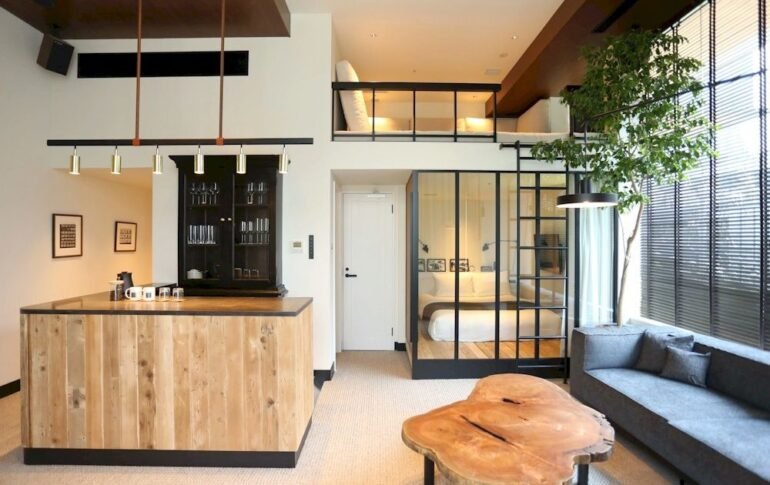
By 2013, Nojiri-san reignited his vision, traveling extensively to study distinctive boutique hotels around the world. Inspired by their individuality and sense of place, he felt Japan was ready for a new kind of hospitality experience. This vision came to life in 2017 with the opening of TRUNK(HOTEL) CAT STREET, a lifestyle-focused boutique hotel in the heart of Shibuya, where contemporary design meets a vibrant, community-driven atmosphere. In 2019, TRUNK(HOUSE) opened in Kagurazaka as an intimate, one-suite hotel, offering a private, highly personalized stay that emphasizes exclusivity and meticulous attention to detail. The portfolio grew further in 2023 with TRUNK(HOTEL) YOYOGI PARK, overlooking the lush greenery of Yoyogi Park, where modern Japanese sensibilities harmonize with Scandinavian design to create a calm, understated atmosphere, complete with a rooftop temperature-controlled pool.
What Makes TRUNK Different
TRUNK stands out in Japan’s hospitality scene through its distinctive creative and brand strategy, carving a path that is uniquely our own. While large corporations and international brands continue to shape much of the hotel market, as an independent, homegrown brand, we have the freedom to explore ideas and initiatives that bigger players often cannot.
Take our approach to service, for instance. Many hotels in Japan strictly follow manuals and standard procedures, but at TRUNK, we empower our team members to respond intuitively—assessing each guest’s needs and making thoughtful decisions in the moment. Similarly, when launching new locations, our strength lies in maintaining a cohesive vision from start to finish, seamlessly integrating concept, design, and service to create experiences that feel both authentic and meticulously crafted.
Also, whilst our core concept is and should be the same in every hotel, we see every TRUNK hotel as its own independent creation. As hotel owners ourselves, we understand the importance of being actively involved. With TRUNK, we aim to listen to owners—their wishes, insights, and perspectives on how a TRUNK hotel can make a difference in their market. After all, they are the experts in their own territory.
Why Going Global Now
Our first TRUNK hotel opened almost 10 years ago, and we now have three properties in Tokyo and a fourth one coming. Furthermore, we have a TRUNK hotel scheduled to open in Sapporo in 2027 with over 100 rooms. This is the first time we have had such a large hotel and a hotel which is in a city far away from Tokyo. With that in mind we realized that now is the time to go beyond our borders.
Another motivating factor was that we have many loyal international guests who told us that they would love to have a TRUNK hotel in their city, such as Seoul, Shanghai, London or New York. And we think they are right.
However, our selection process is exceptionally careful. We focus on places that offer both cultural richness and significant market potential, specifically prioritizing cities where the TRUNK brand can genuinely thrive and contribute in a meaningful way. Our mission isn’t simply to build high-quality hotels—we aim to be a presence that thoughtfully integrates with each city while reinterpreting existing contexts and creating new value.
Currently we see a lot of independent hotel companies being bought by large players. We certainly can see the economic reasons for these transactions, but we also hear from the guest and development community that they would like to keep having smaller independent hotel companies as a choice. Companies which try to make a difference with each property. Companies who focus on the guest as an individual and not just at numbers. Hotels which make the guest feel special and align with the locale that they are in.
Developers will continue to work with the big players of course but many also want to have iconic projects which make a name for themselves. We strongly feel that TRUNK has a role to play here. We are a small and dedicated player with our founder’s involvement to ensure that our original vision stays alive. This consistency is often lost when smaller brands get too big too fast or when they are bought up by a large global player where distribution is more important than focus on service and quality.
Moreover, Japan is one of the most sought-after travel destinations, and through TRUNK hotels in cities outside of Japan, we can showcase that there is more to Japanese culture than sushi and sake. And don’t get me wrong, I love both.
Where Do We Want to Be
Our expansion plans stretch from Asia (close to home) through Europe and the Middle East to the US—roughly in this order. TRUNK Hotels naturally thrive in cosmopolitan cities and selected resort locations such as Seoul, Jeju Island, Shanghai, Singapore, Bali, Bangkok, and Ko Samui—but also in cities like Dubai or Doha. On the European stage, we can certainly play a role in the larger cities, but I also envision a resort in Tuscany, for example. All major cities are challenging and highly competitive, which is why New York and London remain the ultimate long-term goals.
We see a TRUNK hotel, in part, as a destination amplifier or destination builder. The beauty is that, as Nojiri-san believes, we don’t follow a strict manual; rather, we express each location individually through our hotels and concept.
We also recognize that we must learn not only how to grow, but how to grow thoughtfully. As such, we are now working on giving the company and our teams a global posture. In simpler terms: from inward-facing (Japan) to outward-looking (global).
What are the Key Must-Have’s When Growing Global
As I mentioned, we must shift our focus from “within Japan” to “outside of Japan”. With that, we are looking to modernize our guest-facing digital platforms, including website design and guest journey flow. This involves making booking easier, adopting modern communication methods, and implementing data collection points that help us better understand our guests and how we can serve them more effectively. It also means improving the operations of individual hotels to maximize the value of each asset for its owner.
Hospitality is about people. Not only the people who stay with us but also the young passionate individuals who work with us. Here, we must make sure our people journey is clearly defined and understood so that our employees understand why it would be great to work at TRUNK. I feel it is important for a company to give more to its employees than just a paycheck or mandatory trainings. How can we impact their lives positively so that they can become better versions of themselves. If they grow, we grow.
But we cannot forget, of course, that it is also a business. Striking the right balance—competing at the top of our game to satisfy customers, being the desired operator for owners, and the preferred employer for young talent—is a key motivator for us. A small, localized company operates in a certain way. We surely don’t want to lose our core ethos, which is what makes TRUNK special, but we have to get to version 2.0 if we want to be a small but serious global player.
What is Important to Remember When a Company is in a Growing Phase
It is vital not to forget the roots of the company and its philosophy. I believe truly great hotels are those where the overall design and experiential planning are consistently excellent across all levels. Everything, from the story, concept, and floor plan to the spatial design, interior and exterior decor, guest services, and products must be cohesive with a clear vision and consistent tone and manner. That’s an absolute requirement. Therefore, we must continue always to see each hotel as its own independent creation.
Instead of chasing superficial trends, a remarkable hotel embodies unique values rooted in its brand philosophy and aesthetic. It remains unaffected by changing times, enduring for years as something truly timeless. Such hotels naturally attract and retain guests. The ability to maintain consistent quality over time, I believe, is a strength held only by hotels that have genuinely established their unique style and treat each element individually—just as every guest should be cared for individually.
Reprinted from the Hotel Business Review with permission from www.HotelExecutive.com.