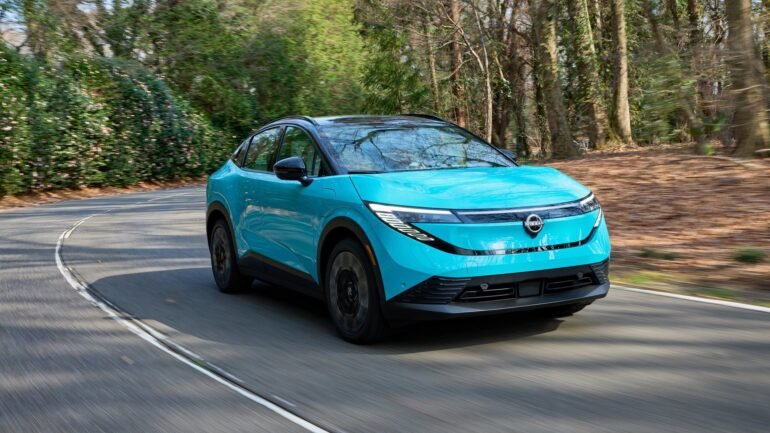
Nissan needs the new-generation Leaf to change its financial trajectory. As the Japanese automaker continues to grapple with its financial woes, the need for competitive vehicles while taking care of its balance sheet when it comes to new vehicle research and development (R&D) is more important than ever. Thankfully, Nissan’s efforts with the new Leaf electric vehicle seem to have paid off, at least on paper.


- Base Trim Engine
-
Electric
- Base Trim Transmission
-
Single-speed Automatic
- Base Trim Drivetrain
-
Front-Wheel Drive
- Base Trim Horsepower
-
174 hp
- Base Trim Torque
-
254 lb-ft
That’s because today, Nissan has revealed everything you need to know about the 2026 Leaf. Reinvented as a small crossover, Nissan hopes that more buyers will be attracted to its style, but more importantly, competitive on-paper specifications, and, thankfully, affordable pricing.
To give you the most up-to-date and accurate information possible, the data used to compile this article was sourced from various manufacturers and other authoritative sources, including Rho Motion.
Nissan Is Looking To Turn A New Leaf

The 2026 Nissan Leaf has been reinvented from the ground up, but while the platform underneath may still not be as sophisticated as those from non-legacy electric vehicle (EV) brands, the new Leaf is interesting enough to turn a new leaf (pun intended) to secure the future of this pioneering electric Nissan.
A Sub-$30,000 Price Helps Pique Interest

At a time when vehicle prices keep climbing, no thanks to tariffs, of course, the fact that you can buy an EV today for under $30,000 is already remarkable, to begin with. The made-in-Japan Leaf will start at $29,990, thus making it the cheapest EV in the United States today. This price tag applies to the base S+, while the mid-range SV+ retails for $34,230, and the range-topping Platinum+ retails for $38,990. But wait, things can even be more affordable if you’re willing to wait a bit longer. That’s because the shorter-range S trim’s pricing still has to be announced, as it’s coming at a later date.
More Than 300 Miles Of Range

300 miles seems to be the magic number for an EV to be worth considering in North America, and with that, the 2026 Nissan Leaf has an EPA-estimated range of up to 303 miles. Yes, up to, and that’s because, as you’re probably noticing as a trend in the EV realm, it’s often the base version, which often has the smallest and thus lightest wheels, that has the most range. In this case, the base S+, which has 18-inch wheels with hubcaps, has 303 miles. Going for the mid-spec SV+ with its 18-inch alloy wheels reduces the range to 288 miles, while the range-topping Platinum+ and its 19-inch alloy wheels suffer the biggest range penalty at 259 miles.
2026 Nissan Leaf Performance Specs
|
S+ |
SV+ |
Platinum+ |
|
|
Powertrain |
(Front) Single permanent magnet synchronous motor |
||
|
Transmission |
Single-Speed Automatic |
||
|
Horsepower |
214 hp |
||
|
Torque |
261 lb-ft |
||
|
Drivetrain Layout |
FWD |
||
|
Battery |
75 kWh |
||
|
Range (EPA) |
303 miles |
288 miles |
259 miles |
|
Combined Energy Efficiency (EPA) |
121 |
114 |
103 |
|
Max AC Charging |
7.2 kW |
||
|
Max DC Charging |
150 kW (10-80% in 35 minutes) |
||
|
0-60 MPH |
N/A |
||
|
Top Speed |
N/A |
||
|
Base Price |
$29,990 |
$34,230 |
$38,990 |
Being the plus (+) variant of the 2026 Nissan Leaf, the 303-mile maximum range is thanks to its 75-kWh lithium-ion battery and front-wheel-drive (FWD) electric motor that’s good for 214 horsepower and 261 pound-feet of torque. The battery can be topped up at up to 7.2 kW in AC, while DC fast charging is up to 150 kW, with the latter being good for a 10 to 80 percent charge in just 35 minutes. The Leaf also comes with vehicle-to-load (V2L), basically turning this vehicle into an external power source. Oh, and it natively comes with the NACS port as well.
What You Can Expect Design-Wise

The 2026 Nissan Leaf has been reinvented as a crossover, giving it a fresh personality versus its previous hatchback styling that didn’t evoke any emotions. However, manage your expectations of the Leaf, because what you see in the brochures is the range-topping Platinum+. Go for the lower variants, and their designs drastically change.
Manage Your Expectations According To Desired Trim

That’s because, while the lower variants still look relatively sleek, changes in their design for cost-reduction purposes somewhat alter the look of the Leaf. Let’s start with what’s common to all three variants. LED exterior lighting comes as standard, and so are flush door handles that automatically pop out when unlocking the car. From there, the S+ comes with 18-inch wheels, which, to its credit, have a modern and geometric hubcap design that entirely masks those steel wheels.
Going up the trim ladder gives you 18-inch alloy wheels and integrated LED turn signals. Finally, the range-topping Platinum+ is the model you see in brochures and ads, and its standard features include:
- 19-inch wheels
- A motion-activated powered tailgate
- Signature exterior LED lighting
- Full-width light bar at the front
Modern, Tech-Filled Interior

On the upside, there is a greater consistency with the Leaf’s interior across all three variants. You get a minimalist, horizontal dash whose material and build quality vary depending on which variant you’re choosing. Two large displays are framed in a single glass piece, which, for the base S+, contains two 12.3-inch screens that are running an older generation of Nissan’s software (basically what you see in the Ariya). Opting for the SV+ and higher trims gives you the newer and larger 14.3-inch screens (which form the Monolith Display motif), along with two wireless charging pads, and a total of four USB-C fast charging ports.
The Platinum+ adds the benefit of multicolor ambient LED lighting, a Bose Personal Plus 10-speaker audio system, and a Dimming Panoramic Roof, which features Polymer Dispersed Liquid Crystal technology to adjust the opacity of each zone of the Leaf’s glass roof. It is also this variant that has the richer interior color schemes, though Nissan has not yet provided any photos of what the interior of the lower-spec variants looks like.
A Hot Model Couldn’t Come Soon Enough

As new vehicle prices climb even higher than they already are in 2025, mostly due to today’s political and economic climate, the 2026 Nissan Leaf’s arrival couldn’t come soon enough. Will it help turn the tide for Nissan, or even help EV sales maintain their momentum amidst challenging market circumstances?
Finally, A Compelling, Affordable EV

EV sales across the globe are outpacing the United States. According to Rho Motion, global EV sales as of July 2025 surpassed 10.7 million units, which is a robust 27 percent increase year-to-date. Unsurprisingly, China leads the way with 6.5 million units, a 29 percent growth from last year. Europe is also surging ahead with 2.3 million units or a 30 percent growth. The rest of the world had 900,000 EVs sold, or a whopping 42 percent growth. North America, on the other hand, saw one million EV sales during the first seven months of 2025, which is a mere two percent gain from last year. Rho Motion also expects a slight uptick in EV sales in the United States ahead of the removal of the $7,500 federal tax credit by September, followed by a likely small sales decline.
The timing of the 2026 Nissan Leaf’s arrival couldn’t come soon enough. Since it’s made in Japan, the Leaf doesn’t even qualify for the tax incentives anyway. Thus, its sub-$30,000 base price is already an achievement of its own. The Leaf is set to be joined by upcoming affordable EV trucks from Ford and even the Jeff Bezos-backed Slate Auto, as well as the revival of the highly affordable Chevrolet Bolt EV. Times are interesting for those looking for an affordable EV.
But, They Need Hybrids To Be Relevant

Unfortunately, EVs can only do so much to help change Nissan’s fortunes. For the brand to appeal to a broad audience, it desperately needs hybrids, too. That’s because hybrids in recent years, and even in 2025, continue to be the fastest-growing electrified vehicle type in terms of sales. Americans who are reluctant to go the pure EV route are choosing the high fuel efficiency benefits and improved refinement of a hybrid, not to mention the lack of a motoring lifestyle change to experience the benefits of a hybrid.
But how good is Nissan’s hybrid system in the first place? Is it well-suited for American drivers? To find out, we sampled a Nissan Kicks e-Power to find out how the system performs, and whether it’s fit for North American driving habits.