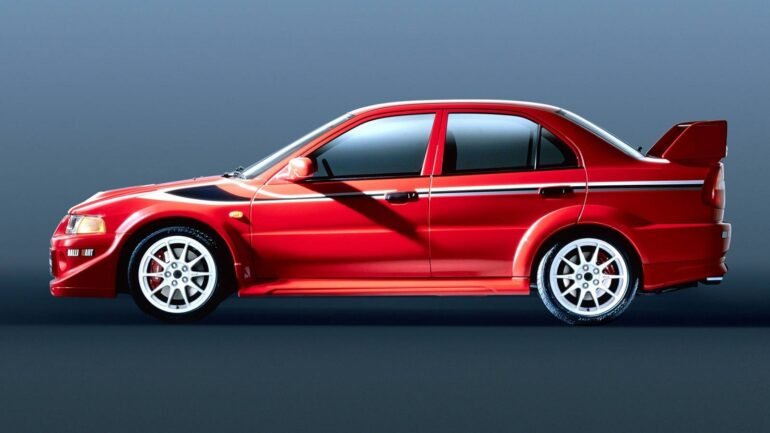
When we talk about rally legends, the Mitsubishi Lancer Evolution is one of the first cars to come to mind. Together with the Subaru Impreza STI, the two Japanese rally rockets were responsible for one of the most epic automotive rivalries we have ever seen. They say competition is the driving force in the automotive industry, and there’s no better way to evolve a performance car than motorsports. Both Mitsubishi and Subaru evolved their four-door performance sedans over the years, but the culmination of their rivalry was reached in 1999 when the Lancer Evolution VI came out.


- Base Trim Engine
-
2.0L Turbo Inline-4 Gas
- Base Trim Transmission
-
5-Speed Manual
- Base Trim Drivetrain
-
All-Wheel Drive
- Base Trim Horsepower
-
291 hp
- Base Trim Torque
-
300 lb-ft @ 4000 rpm
- Fuel Economy
-
17/23 MPG
- Make
-
Mitsubishi
- Model
-
Lancer
- Engine
-
2.0L Turbo Inline-4 Gas
Like all other Lancer EVO generations before it, the sixth generation was never sold in the U.S. market, but in 2024, this Japanese pocket rocket turned 25 years old, and this means you can finally import it and get yourself a piece of Japanese rally heritage with one of the most powerful inline-four engines ever built.
- The First Lancer EVO to end Subaru’s rally domination.
- The Last truly lightweight Lancer Evolution.
- The Lancer Evolution VI is one of the most sought-after EVOs.
- Since Jan 2024, early EVO VI variants have become legal for U.S. import.
There is a lot of specialized literature surrounding the Mitsubishi Lancer Evolution VI, and we gathered extensive data from official manufacturer websites as well as various specialized outlets to give you all relevant information on the Lancer Evolution VI, and why it’s the best Lancer EVO ever made.
The First Lancer EVO To Break Subaru’s Winning Streak

The Lancer Evolution, as we know i,t may have been retired for good, but over the years, the model proved it truly lives up to its name. The simple reason is that over the years, Mitsubishi’s rally car has constantly evolved. The EVO I started it all in 1993, and the EVO II and III were essentially evolutions of that car, adding various refinements to the formula. In fact, the EVO II and EVO III featured a different chassis code compared to the previous two generations. The same philosophy of evolution has been applied to the EVO IV through VI, the EVO IV being the first Lancer EVO to be completely redesigned. Like before, the EVO V and VI were evolutions of the EVO IV, adding a bit more power, stability, better cooling, and tweaks to the already impressive all-wheel-drive system.

Interestingly enough, Mitsubishi started rallying in 1967, which is four years before Subaru embarked on its quest to dominate the rally scene. Despite that, Subaru dominated the rally scene for the most part. The Lancer EVOs were great, but it was in 1999 when Mitsubishi finally managed to break Subaru’s winning streak in rallying. The Lancer Evolution VI finished what the EVO IV started, and it did so with Finnish racing driver, Tommi Mäkinen, behind the wheel. This car and driver combination allowed Mitsubishi and its EVO to win four consecutive WRC wins, between 1996 and 1999. This high point of Mitsubishi’s rally prowess was later commemorated with one of the most collectible Lancer Evolutions ever made.
When Can I Import A Mitsubishi Lancer Evolution VI?

Mitsubishi’s rally-bred sedan follows in the footsteps of another JDM icon, the Skyline R34 GT-R, which became legal for import a couple of years back. The Lancer Evolution VI was introduced in January 1999 and was produced until August 2001. At the time of writing this, you can import all EVO VI examples produced no later than September 2000. According to U.S. laws, it is not the car, but the VIN number that needs to be 25 years old in order for a car to be legally imported.

If you want to import a Lancer EVO VI with a VIN number from August 2001, you’ll have to wait until August 2026 to legally import it. There are still ways to import a car that’s never been sold in the U.S. market, and that’s less than 25 years old, but only under special conditions. The “show and display” clause may apply to rarer models like the EVO VI Tommi Mäkinen edition, but you can only drive it 2,500 miles a year until the car turns 25.
The Tommi Mäkinen Edition Is The Most Collectible Lancer Evolution
All Evolution VI is a blast to drive, but the Tommi Mäkinen Edition (TME) is considered the ultimate. The driver-centric sedan became even sharper thanks to a lightweight turbine wheel and a lowered suspension, compared to the standard EVO VI. Even in this limited-edition Evolution VI, Mitsubishi offered two trims, an RS trim with shorter gearing and a more “generously” equipped GSR. We are using quotes because while the GSR trim comes with all the optional extras, no EVO VI can truly be called a luxury car.
The Evolution VI TME also scored a more aggressive front bumper, exclusive to the limited-edition model. One thing that remained a constant right until the Lancer Evolution’s unceremonious retirement is its economic roots. According to Sports Car Market, a total of 4,092 Mitsubishi Lancer Evolution VI TMEs were built, despite the most commonly quoted figure being 2,500 (which is what the original homologation requirement for the EVO was).
What Makes The Lancer Evolution VI So Capable?
The Group B Connection

Just like the legendary Ferrari F40, the Mitsubishi Lancer Evolution roots can be traced back to a Group B rally car that was developed too late to see any racing. The Group B car in question was a heavily modified, all-wheel-drive Mitsubishi Starion. Its go-fast, Group B bits were, eventually, grafted onto the Group A Mitsubishi Galant, which in turn “donated” the hardware to the smaller, lighter Lancer thus spanning the EVO I. While far from the latest and most sophisticated generation, the Evolution VI is considered the ultimate, um… evolution of the Lancer.
The Evolution VI Is What Evolution V Should Have Been

The Mitsubishi EVO VI featured the same CP9A platform as its predecessor, the EVO V, which was 70 mm (2.8 inches) wider than the EVO IV and thus no longer considered “compact” according to the Japanese dimensions regulation. The EVO VI improvements over the EVO V revolved, mainly, around cooling and reliability. Unlike the Tommi Mäkinen Edition EVO VI, the RS trim does not come with Active Yaw Control.
This is, essentially, Mitsubishi’s version of what we nowadays know as torque-vectoring. It works through an array of sensors (steering, throttle position, and others) to determine how power should be distributed between all four wheels. This feature was actually introduced on the EVO IV, in 1996. The only feature the Evolution VI was lacking was the central, locking differential, which was added to the heavier, Lancer EVO VII.
The Last EVO To Offer A No-Nonsense, Bare-bones Version Of The Car

It’s always great when a manufacturer gives you the opportunity to spec a car with all the go-fast bits, but none of the “fluff”, and the Lancer Evolution VI is the last JDM icon to allow you to do that. The RS (rally sport) version is a bare-bone variant of the EVO VI. Earlier generations with the RS trim even scored steel wheels.
Brembo brakes, electric windows, shorter gear rations, Recaro bucket seats, and 17-inch Enkei alloy wheels were all optional extras on the RS trim. The Lancer Evolution VI is considered the last lightweight EVO. In base form, it tips the scales at just 2,778 pounds (1,260 kg) while a fully-loaded EVO VI weighs 2,998 pounds (1,360 kg).
The EVO VI Packed One Of The Most Tunable Inline-Four Engines

While we can talk tomes about the Lancer Evolution’s incredible chassis or rally-bred all-wheel-drive system, it is the engine that, often, steals the show. That’s because under the hood of almost all Lancer EVOs is the very familiar 4G63T engine. This 2.0-liter, turbocharged inline-four is so capable, that Mitsubishi used it in all Lancer EVO generations except the last, tenth-generation.
The 4G63T is part of the old guard of JDM engines and, like the car it was most prominently featured in, it underwent improvements along the way. More power, better cooling, and increased reliability were all part of the plan to make the little four-banger one of the greatest JDM engines of all time. In the EVO VI, the engine seemingly complies with the Japanese Gentlemen’s agreement, but like other JDM icons, the EVO VI hides a bit of reserve.
Mitsubishi Lancer Evolution VI Performance Specs
|
Engine |
2.0-liter turbocharged inline-4 |
|
Transmission |
5-speed manual |
|
Power |
276 hp (claimed) |
|
Torque |
273 lb-ft |
|
Driveline |
Front engine, AWD |
|
0-60 MPH |
5.0-4.3 seconds (depending on gear ratios) |
The most powerful factory version of a 4G63T-equipped EVO is the Evolution IX MR FQ360, with 366 horsepower and 363 pound-feet (492 Nm), there are plenty of built 4G63Ts out there that reliably push well over 1,000 horsepower. Another impressive characteristic of Mitsubishi’s four-banger, aside from the ability to take massive amounts of boost, is the ability to rev to over 11,000 RPM (with the right parts).