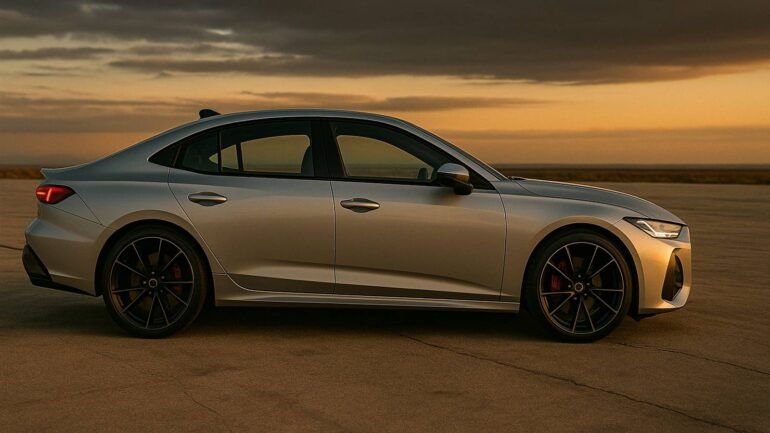
When you hear “sports sedan”, what is the first car that comes to mind? It might, rightfully so, be a BMW M3, Mercedes-AMG E63, or an Audi RS4 (aka Team Germany). If you prefer a Japanese flavor, the Lexus IS and Nissan Q60 also have their place. Yet, what if you asked the same question to someone who has never seen or driven a car before? That someone is ChatGPT, and recently, we have been asking the AI bot what it thinks about automotive design.
This time around, we have pressured the leading AI chatbot to render another unique concept car out of thin air, using the prompt to create a “great looking sports sedan” completely from its own design. What crazy amalgamation did it conjure up from the ether this time? Stick around as we go through each detail one by one.
ChatGPT’s Perfect Sports Sedan Is An Audi

As you can clearly see, ChatGPT has a clear German bias, and at first glance, it resembles the new 2025 Audi S5 Sportback. Yet, let’s take a closer look to see just exactly where AI is drawing inspiration from to create this novel concept car. This time around, ChatGPT provided us with an explanation of how it came to certain conclusions about its final design. Let’s start with the most obvious and distinct styling cue, the front fascia.
The Audi-Like Front End Design

Straight from Audi’s design studio comes this front-end look, which ChatGPT states resembles the modern Audi S5/S7 Sportback styling. The distinct, sleek headlights with thin LED signatures are definitely Audi, although the German brand has been becoming more liberal with the look of its headlights over the last couple of years.
According to ChatGPT, the black honeycomb grille has echoes of Japanese designs, such as the iconic Lexus spindle grille or Acura’s modern grill design found on the Acura Integra and other models. However, because the side intake styling and overall bumper design are so Audi, it really resembles the honeycomb style still found on many modern Audi Sport models.
The Less Obvious Rear End Design

Although many modern cars are now integrating the singular long and thin taillight design that extends from end to end connecting the rear, ChatGPT kept it a bit old school with two individual taillight housings (and we like it). Once too many automakers follow the same styling, it doesn’t look distinct anymore, and this is certainly becoming the case with the singular long taillight theme in our current design landscape.

ChatGPT says that it took inspiration from the Alfa Romeo Quadrifoglio and the Kia Stinger, but the taillights look more like the Audi RS3 or the BMW 8-Series. We can see how the overall shape of the rear end looks more like an Alfa Romeo Giulia, but the dual-exhaust setup and rear diffuser design are relatively simple and would fit on almost any modern sporty vehicle.
The Overall Design Of ChatGPT’s Sports Sedan

All things considered, we think this render looks pretty good. The “coupe-style” roofline is supposed to be like the Mercedes-AMG GT 4-Door Coupe or BMW 8-Series Gran Coupe. You can clearly see a BMW M3 Sedan in the side profile as well. A nice choice with the AMG-style wheels as well. Not bad for a quick render, if you ask us.

For the sake of comparison, we put the same prompt into Adobe’s generate image software powered by Firefly Image 3, and the result was subpar to say the least. The main gripe was that Adobe’s software rendered three distinct, crazy-looking hypercars (none of which were sedans). Look at what ChatGPT gave us in comparison: our sports sedan is gliding through the snow! If it wasn’t obvious enough, ChatGPT 1, Adobe, 0.
ChatGPT Even Gave Us An Interior

While the interior is the weak point of the render, we are glad we got an interior image at all. Most of the interior details are relatively generic, and the small infotainment screen and lifeless analog instrument cluster are dead giveaways. The only recognizable interior feature is the metal bottom detail on the steering wheel, which is 100 percent from an Audi. It goes without saying, but this render is nowhere near as cutting-edge or distinct as the interiors found in many luxury sport sedan automakers like Mercedes-Benz and BMW models.
Giving An Overall Score To ChatGPT’s Render

If you had to give this sports sedan render a total score, what do you think would be fair? As far as its overall design, we think an 8/10 is solid. Let’s not forget that Adobe’s software couldn’t even understand what a sedan was. That just goes to show that ChatGPT is clearly several steps ahead of the rest of the competition. Yet, ChatGPT couldn’t have created this image without inspiration from pre-existing sources. Let’s take a look back at some of the greatest sports sedans that have left a historic impression on automotive design.
Legends Of Sports Sedan Design

Although most of our attention has been dominated by German sports sedans, at one point, the most important sports sedan was Italian. The Alfa Romeo 1900 is a legend from the 1950s that was one of the earliest definitions of a true sports sedan. This humble-looking compact Italian was revolutionary in more ways than one.
The First Uni-Body Vehicle Ever Produced

At the time, Alfa Romeo was seeing an unprecedented level of success in racing, securing the first two Formula 1 World Championships. Despite their love for racing, the Italian automaker retired from the top level of motorsport to shift all its energy to focusing on producing a new car. That new car would be the Alfa Romeo 1900, the first unibody vehicle ever built on a full-scale assembly line. With its front bench seat, the diminutive sedan was able to seat six and was promoted by the now iconic slogan, “The family car that wins races.”
Ford Vs. Ferrari

American automakers would take this same concept to establish the “Win on Sunday, sell on Monday” slogan used in association with success in NASCAR racing and the corresponding success in auto sales in the 1950s. This concept would reach its peak with the story of Ford vs. Ferrari, where Ford would prove that a company known for economical sedans could take the crown from the established champions of racing in their own backyard. Nowadays, super sedans like the 2025 Cadillac CT5-V Blackwing continue this connection between motorsports and fast production vehicles.
The First “Super Saloon”

Muscle Cars Vs. Sports Sedans

Although the muscle car era was already in full effect by the time Mercedes debuted the 1968 Mercedes-Benz 300 SEL 6.3, it was a different kind of beast from its American counterparts. While muscle cars of the 1960s were all about fitting big engines into small sedans, not too many of them focused on the handling aspect that defined their driving dynamics.
Then, to top it off, of all the most desirable classic muscle cars, none of them are sedans. Thus, Mercedes knew if they wanted to build the complete package of what a four-door sports sedan could be, they would have to create something completely novel. With the 6.3-liter M100 V-8 engine pulled from the flagship 600 Series limo, we’d get the first taste of what a true sports sedan would look like.
The First “Sleeper” Build

The 1968 Mercedes-Benz 300 SEL 6.3 would be a muscle car, luxury car, and sports car all in one. At its debut, this Mercedes sedan was one of the fastest four-door cars in production. Yet, where it excelled was in its overall capability, enhanced by features such as widened tires, air suspension, four-wheel disc brakes, and power steering.
With a 6.6-second 0-to-60 MPH time, the 300 SEL 6.3 still provides a respectable pace even today. Yet, where the 300 SEL 6.3 was outstanding was in high-speed cruising, where one of its famous selling points was the ability to maintain comfort for five occupants at speeds above 120 MPH.

This garnered the nickname “The Intercontinental Express”. Yet, unlike muscle cars of its era, the 300 SEL 6.3 had a playful and light steering that was communicative and responsive. It was this 60s Mercedes that would set the blueprint for a lineage of future great sports sedans, such as the Mercedes W212 E63 AMG. So, next time you see a crazy 700-horsepower sedan like the BMW M5 on the road, remember that a little Alfa Romeo did it first!