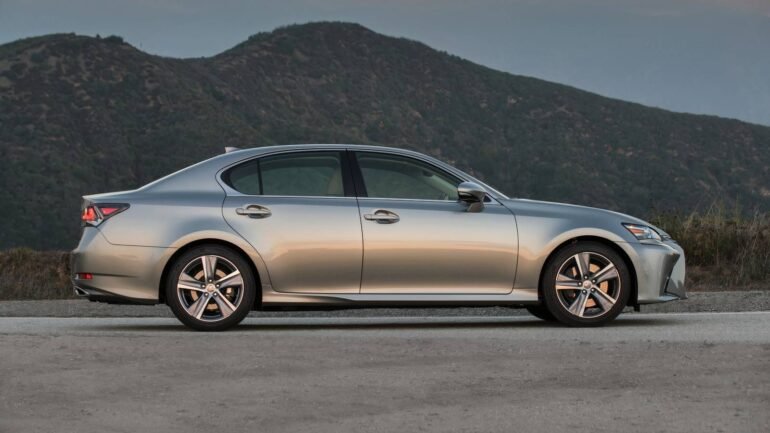
Through the 2010s, hybrid technology found an unlikely home in the luxury segment, primarily sedans (which were the de rigueur American market to be in at the time). Starting as an efficiency ploy to make compact cars ultra-efficient, hybrid powertrains quickly snaked their tendrils into automakers’ premium lineups to make luxury markets’ engines more efficient, while preserving the traditions of refinement and comfort and showcasing the innovation that luxury buyers slavered over.


- Base Trim Engine
-
3.5L V6 Hybrid
- Base Trim Transmission
-
Continuously Variable Automatic (CVT)
- Base Trim Drivetrain
-
Rear-Wheel Drive
- Base Trim Horsepower
-
338 hp
- Base Trim Torque
-
257 lb-ft @ 4500 rpm
- Fuel Economy
-
29/34 MPG
- Make
-
Lexus
- Model
-
GS Hybrid
- Segment
-
Midsize Luxury Sedan
Unlike mass-market hybrids that often sacrificed excitement and aesthetics, mid-size luxury hybrids of this era were crafted with the same attention to style, detail, and elegance as their non-electrified counterparts. Sleek bodywork, plush interiors, and the quiet authority of a well-insulated cabin meant they carried themselves as true luxury cars first, and hybrids second. And few did it as well as this luxury sedan that straddled the line between compact efficiency and flagship grandeur.
To give you the most up-to-date and accurate information possible, the data used to compile this article was sourced from various manufacturers and other authoritative sources, including Kelley Blue Book, Edmunds, and the EPA.
The 2018 Lexus GS 450h Is A Forgotten Luxury Hybrid Noted For Its Performance
Modern Good Looks Convey Sporty Manners

The Lexus GS Hybrid stood out as one of the few Japanese luxury sedans that could hold its own against Europe’s most celebrated sports sedans. It paired sharp, athletic styling with a drivetrain that blended a smooth V-6 engine and electric performance enhancements, offering strong acceleration alongside impressive efficiency. Unlike many hybrids during its era, it wasn’t marketed solely as a fuel saver, but as a true performance contender, delivering a balance of power, refinement, and handling.
And, of course, the Lexus GS 450h carried the brand’s hallmark reliability and meticulous craftsmanship, with a cabin that mixed modern technology with traditional luxury appointments. Positioned as a mid-level luxury car (which skewed closer to the full-size LS and the mid-size ES), it offered buyers a credible alternative to established German marques, proving that hybrid technology could coexist with sharp design, rewarding dynamics, and the prestige expected of a premium sports sedan.
The 2018 Lexus GS 450h Is An Affordable Sports Sedan

The 2018 Lexus GS 450h wasn’t a wallflower. It carried a design that ensured it never faded into the background of the crowded midsize luxury dance. Lexus’s bold signature spindle grille dominated the front fascia, from which flowed crisp body lines that ran cleanly along the sides to a short rear deck that conveyed the athleticism of a performance coupe, but without the quickly fading roofline that impinged on rear-seat headroom. It combined to make the car look fast, even while it was standing still.
The long-wheelbase conveyed solidity, the width commanded presence, and the sleek fenders emphasized agility. At a time when just about every mainstream and luxury automaker offered a hybrid sedan, the Lexus GS 450h stood apart by pairing striking design with the promise of performance and efficiency. It wasn’t just a cookie-cutter hybrid with looks that prioritized function over form; it was a statement piece that proved a hybrid could deliver style and substance.
How The 2018 Lexus GS 450h Compares To Today’s Mid-Size Luxury Sedans

The 2018 Lexus GS 450h came from an era when true mid-size luxury hybrids were still a rarity, and though the market exploded in the mid-2010s, the mid-size luxury segment remains largely unrepresented today, outside of Lexus’s own lineup. The European sports sedans that represented the GS Hybrid’s main competition have largely shifted to mild-hybrid systems that prioritize power over incremental efficiency gains, and the broader hybrid luxury market has moved towards crossovers — a more lucrative segment.
Lexus GS And ES Hybrid Sedan Spec Comparison
|
2018 GS 450h |
2025 ES 300h |
|
|
Original MSRP |
$64,660–$69,705 |
$44,835–$51,130 |
|
Fair Purchase Price |
$34,621–$37,271 |
Not applicable |
|
Powertrain |
3.5-liter V-6 + 1 motor |
2.5-liter inline-4 + 2 motors |
|
Transmission |
Continuously variable |
Continuously variable |
|
Power |
338 hp |
215 hp |
|
Torque |
257 lb-ft |
163 lb-ft |
|
Driveline |
Rear-wheel drive |
Front-wheel drive |
|
Range |
539 miles |
581 miles |
|
Efficiency City |
29 mpg |
43 mpg |
|
Efficiency Highway |
34 mpg |
44 mpg |
|
Efficiency Combined |
31 mpg |
44 mpg |
|
Overall Length |
192.1 inches |
195.9 inches |
|
Wheelbase |
112.2 inches |
113 inches |
|
Width |
72.4 inches |
73.4 inches |
|
Height |
57.3 inches |
56.9 inches |
The 2018 Lexus GS 450h In Performance, Efficiency, And Presentation

The Lexus GS 450h remains a standout at the upper end of the midsize luxury sedan segment, having been removed from the Lexus line-up in 2020 and never replaced. The 2018 model was rated especially high in quality and reliability, offering a package that blended presence, refinement, and forward-thinking technology. With its bold design and balanced proportions, the Lexus GS 450h carried the kind of style that set it apart from more conservative rivals from Germany.
Under the hood, the hybrid V-6 powertrain V6 delivers strong acceleration alongside impressive fuel economy for a sedan of its size and intent. Inside, the 2018 Lexus GS 450h emphasizes comfort and craftsmanship, with premium materials and the typically Lexus-quiet, composed cabin that makes the RWD sports sedan an ideal companion for long-distance cruising, as well as for daily use. The GS Hybrid embodies the brand’s commitment to efficiency without compromise.
Hybridization Enhanced Power And Efficiency In The Lexus 3.5-Liter V-6

With the electrification of Lexus’s 3.5-liter V-6, the 2018 GS 450h set itself apart from its GS 350 sibling by delivering more power and noticeably better efficiency. The GS 350 provided the base with solid performance, and the 450h pushed acceleration without sacrificing the engine’s inherent smoothness. Both shared the same comfortable 99-cubic-foot cabin, but the 450h gave up over five cubic feet of trunk volume to house the hybrid battery (13.2 cubic feet vs. the 350’s 18.4).
2018 Lexus GS Hybrid And Non-Hybrid Performance Specs
|
2018 Lexus GS |
450h |
350 |
|
Original MSRP |
$64,660–$69,705 |
$53,285–$54,340 |
|
Fair Purchase Price |
$34,621–$37,271 |
$25,834–$26,661 |
|
Powertrain |
3.5-liter V-6 + 1 motor |
3.5-liter V-6 |
|
Transmission |
Continuously variable |
6-speed automatic |
|
Power |
338 hp |
311 hp |
|
Torque |
257 lb-ft |
280 lb-ft |
|
Driveline |
Rear-wheel drive |
Rear- or all-wheel drive |
|
Range |
539 miles |
383–400 miles |
|
Efficiency City |
29 mpg |
19–20 mpg |
|
Efficiency Highway |
34 mpg |
26–28 mpg |
|
Efficiency Combined |
31 mpg |
22–23 mpg |
The 2018 Lexus GS 450h Was The Middle Ground Between The ES 300h And LS 500h

In 2018, Lexus’s hybrid sedan lineup offered three distinct flavors—the efficient ES 300h, the performance-oriented GS 450h, and the flagship LS 500h. The GS 450h occupied the sweet spot, falling in between the two on efficiency, while matching the ES on comfort and the LS on performance. The ES 300h was, and is, the volume seller, the LS 500h carried, and continues to carry, the luxury torch, and the GS 450h? It’s nearly as desirable as the LS 500h, as evident in today’s KBB fair pricing.
Lexus Hybrid Sedan Specs Comparison
|
GS 450h |
ES 300h |
LS 500h |
|
|
Original MSRP |
$64,660–$69,705 |
$45,460 |
$80,535 |
|
Fair Purchase Price |
$34,621–$37,271 |
$23,289 |
$36,262 |
|
Powertrain |
3.5-liter V-6 + 1 motor |
2.5-liter inline-4 + 1 motor |
3.5-liter V-6 + 2 motors |
|
Transmission |
Continuously variable |
Continuously variable |
Continuously variable + 4-speed automatic |
|
Power |
338 hp |
215 hp |
354 hp |
|
Torque |
257 lb-ft |
163 lb-ft |
257 lb-ft |
|
Driveline |
Rear-wheel drive |
Front-wheel drive |
Rear- or all-wheel drive |
|
Fuel Tank |
17.4 gallons |
17.2 gallons |
22.2 gallons |
|
Range |
539 miles |
688 miles |
577–622 miles |
|
Efficiency City |
29 mpg |
40 mpg |
23–25 mpg |
|
Efficiency Highway |
34 mpg |
39 mpg |
31–33 mpg |
|
Efficiency Combined |
31 mpg |
40 mpg |
26–28 mpg |
|
Overall Length |
192.1 inches |
193.3 inches |
206.1 inches |
|
Wheelbase |
112.2 inches |
111 inches |
123 inches |
|
Width |
72.4 inches |
71.7 inches |
74.8 inches |
|
Height |
57.3 inches |
57.1 inches |
57.5 inches |
Other Notable, Oft Overlooked Mid-Size Luxury Hybrids

As the 2010s wound down, the midsize hybrid luxury sedan market began to fade, caught between waning buyer interest in traditional sedans and the surge of crossovers. Once seen as the pinnacle of elegance and efficiency, hybrid sedans like the Honda Clarity and Kia Optima struggled (and failed) to stay relevant as consumer demand shifted toward SUVs and crossovers, like the Toyota Venza. Luxury brands followed the market, channeling hybrid technology into taller, more versatile models.
Early 2020s Hybrid Vehicle Specs Comparison
|
2022 Toyota Venza |
2021 Honda Clarity PHEV |
2020 Kia Optima PHEV |
|
|
Original MSRP |
$34,455–$41,945 |
$35,415–$37,615 |
$37,150 |
|
Fair Purchase Price |
$26,526–$30,604 |
$25,497–$27,419 |
$18,435 |
|
Powertrain |
2.5-liter inline-4 + 3 motors |
1.5-liter inline-4 + 1 motor + 17-kWh battery |
2.0-liter inline-4 + 1 motor + 10-kWh battery |
|
Transmission |
Continuously variable |
Continuously variable |
6-speed automatic |
|
Power |
219 hp |
212 hp |
202 hp |
|
Torque |
163 lb-ft |
232 lb-ft |
276 lb-ft |
|
Driveline |
All-wheel drive |
Front-wheel drive |
Rear- or all-wheel drive |
|
Overall Range |
566 miles |
340 miles (48 electric) |
630 miles (28 electric) |
|
Efficiency City |
40 mpg |
44 mpg |
38 mpg |
|
Efficiency Highway |
37 mpg |
40 mpg |
44 mpg |
|
Efficiency Combined |
39 mpg |
42 mpg (110 MPGe) |
41 mpg (101 MPGe) |
The Last-Gen Toyota Venza Is Often Overlooked By Buyers Who Picture Its Predecessor

The Toyota Venza returned to the Toyota lineup in 2021 after a five-year absence, as the first of Toyota’s move to hybrid-only models. Replaced in 2025 by the Toyota Crown Signia, it is often overlooked, mostly because buyers think of the clumpy model that went away in 2015. The most loved of the model run, the 2022 Toyota Venza quietly delivers a compelling mix of style, efficiency, and comfort in a sleeker coupe-like crossover that offers a refined, upscale interior.
The Honda Clarity PHEV Is Overlooked By Buyers Who Think Clarity Is Just An EV

The 2021 Honda Clarity PHEV was a unique entry in the midsize hybrid space, offering a plug-in hybrid powertrain that delivered about 47 miles of electric-only range, which was superior to most rivals at the time. It provided the elegance of a sedan with the efficiency of an EV for daily around-town driving, but was mostly overlooked due to consumer perceptions. The Honda Clarity made its name as a fuel-cell hydrogen car and came to the mass market as an EV, so buyers looking for an ICE hybrid don’t pay much attention.
The Kia Optima Was Beloved, But Not Many Buyers Know It Offered A PHEV

Before it was replaced in the brand’s lineup, the mid-sized Kia Optima sedan made quite an impression as an ICE and hybrid model, with its blend of style, performance, and efficiency. However, not many buyers know it was also a PHEV for that extra boost of efficiency at the lower end, and offered the ability to complete shorter commutes without using much gasoline. However, the market was transitioning toward crossovers, and the Optima PHEV is today mostly passed over for Kia Sportage or Sorento PHEVs.
The Lexus GS 450h Is Overlooked Despite Its Looks, Presentation, And Performance

The 2018 Lexus GS 450h embodies everything a midsize luxury hybrid should be—understated elegance, impressive efficiency, and performance that rivaled European sport sedans of its time. It proved that hybrid technology could be more than an economy play; it could enhance power delivery, ride quality, and refinement without compromising style or craftsmanship. Yet, like many sedans of its era, the Lexus GS hybrid slipped into the background, even within its own brand, as the market shifted.
The same fate befell capable hybrid models of the time, such as the 2021 Honda Clarity PHEV, the 2020 Kia Optima PHEV, and even the 2022 Toyota Venza. Each offers efficiency, comfort, and a thoughtful balance of hybrid technology and performance, but buyers continue to gravitate toward compact crossovers and SUVs, drawn by their everyday usability and versatility. That trend automatically disqualifies hybrids through misconceptions of stereotyped models.

Looking back at the Lexus GS 450h and its contemporaries, it’s clear these forgotten midsize luxury hybrids still “look the business,” reminding us of a pivotal stage when automakers experimented with blending hybrid efficiency and premium performance. In many ways, they set the groundwork for today’s luxury hybrids and luxury EVs, proving that flash often blinds buyers to hybrid efficiency.