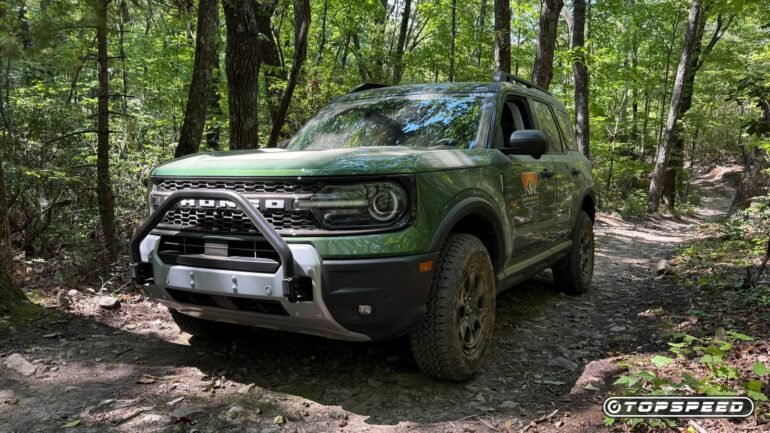
In a world where conformity and profits reign supreme, anything that steps beyond the edges of the pack is an act of open rebellion that should be supported at all costs. OK, so if you can all forgive the theatrics, we are talking about manual transmissions, the obsolete heart-warmer of the automotive world. Specifically, we are gathered here today to discuss the Ford Bronco’s manual transmission.
The Ford Bronco’s manual transmission feels like a cheat code or something. It’s a handshake in the digital age — the last bastion of control for people who still enjoy the actual doing of driving. While most automakers sacrificed their stick shifts to the lords of profit, Ford had the brass to offer one in its reborn off-roader. The best part is, the Bronco’s three-pedal transmission isn’t a gimmick — it’s the real deal: technically, a seven-speed Getrag unit, but more accurately, it’s a six-speed with a granny gear designed for the trails.
That makes the Ford Bronco one of the few vehicles in 2025 where you can still choose your own gears. It’s not faster, easier, or more efficient. But it is so much more fun — and that’s precisely why it’s worth saving.
A Brief Reminder Of What We’ve Lost

To understand why the Bronco’s manual transmission matters, you have to zoom out. The manual gearbox was once the default choice. It was how you learned to drive, how you felt the car. Then came automatics that were smoother, faster, more expensive, and more fuel-efficient. What was once a fancy optional extra became the norm. Manual cars, once known as “standard” shift, are now the exception, a rarity, even collectible. Today, less than two percent of vehicles sold in the U.S. have a manual transmission. That’s extinction-level territory.
When Ford relaunched the Bronco in 2020, nobody expected it to join that endangered species list. In fact, most of us assumed it would be a big dumb plastic thing that just had Bronco written on it. Instead, Ford gave enthusiasts what they’d been begging for: a manual option on a mainstream 4×4 Ford. It was an old-school nod packaged inside one of the most talked-about new vehicles of the decade.
The Bronco’s Manual Transmission, Explained
Let’s get technical for a second. The Bronco’s manual is a seven-speed Getrag MTI550, and it’s paired exclusively with the 2.3-liter EcoBoost turbocharged four-cylinder. That’s 300 horsepower and 325 lb-ft of torque on premium fuel — plenty of grunt to make a stick shift fun again.
The gearbox features six traditional forward gears plus one ultra-low crawler gear (marked “C” on the shift pattern). This crawler gear has a ratio of 6.588:1, which, combined with the Bronco’s transfer case and axle gearing, delivers a final crawl ratio north of 90:1 depending on configuration. That’s deep enough to let you inch down a boulder field with your foot off the throttle.
In normal driving, the gearbox feels tight and mechanical. Throws are a bit long, but honestly, why wouldn’t they be? It’s a truck, after all. Despite the long throw, the clutch take-up is predictable, and the gates are easy to find and well-defined. There’s an old-school satisfaction in the way it clicks from third to fourth, with just enough clunk to remind you something mechanical is happening.
The Crawler Gear: Manual’s Secret Weapon
The “C” gear is where things get interesting. It’s basically a built-in low range for extreme off-roading. Think of it as a granny gear, designed for slow, precise crawling over rocks, logs, or deep mud. However, this doesn’t mean that the Bronco doesn’t have 4L, which it does. This “C” gear is just a super-low gear that makes off-road descents more controllable. In an era where everything off-road is controlled by software — hill-descent control, terrain modes, automatic diff locks — the Bronco’s crawler gear gives the driver a tangible sense of control. You can literally idle your way down a steep trail, feathering the clutch like a pro, feeling every inch of terrain through your fingertips and boots.
There’s nothing artificial about it. It’s analog torque management — just you, the clutch pedal, and gravity. And in an ironic twist, it’s also safer. The crawler gear’s low ratio gives finer throttle control than most automatics can manage, reducing the risk of lurching or slipping when things get tricky. It’s proof that “old tech” still has merit, especially when the going gets tough.
Who It’s For (Hint: It’s Not Everyone)

Let’s be clear — the manual Bronco isn’t for everyone. You can’t get it with the larger 2.7-liter V6. You can’t get it with the Sasquatch package (unless you count the recent limited compatibility in off-road trims). It’s a niche within a niche. Ford basically demands that you forgo the fancier trims if you want it in standard shift. But if you are rightly minded, Ford thought that might be part of its appeal, and it was right.
This isn’t about 0–60 times or convenience. It’s about connection — the feeling of actually driving each mile. Every shift requires intention, and every stall teaches humility. You’re part of the process.
Why The Manual Is Disappearing

Let’s be honest: automatics won the war. They’re quicker, smoother, and now, thanks to electric motors and hybrids, transmissions, in general, are increasingly irrelevant. You can forget about making the argument for manuals; EVs don’t even need transmissions in the traditional sense.
The Bronco’s manual exists because Ford still recognizes something that sales data can’t quantify: joy. There’s a visceral connection between a driver and a clutch pedal that no paddle shifter can replicate.
Modern automatics may shift faster than any human, but they’ll never make you grin like when you nail a downshift into a hairpin turn or time a perfect launch out of a muddy rut. They’ll never give a young driver the pride of accomplishment when they finally hit their first hill start.
How It Changes The Bronco

Drive a manual Bronco, and you realize it transforms the entire vehicle’s character. It’s not just a drivetrain choice; it changes the rhythm of the experience.
With the automatic, the Bronco feels competent, refined, and powerful. With the manual, it feels like a car that a younger you would have dreamed of owning.
Every input — throttle, clutch, shifter — requires a series of micro decisions. It’s inherently more engaging, more physical. You find yourself scanning the trail ahead differently, thinking about gear selection and momentum. It’s real driving.
It’s slower, yes. But none of us are Lewis Hamilton and shouldn’t be fooled by nanosecond-faster shifts that couldn’t matter less to your commute to your office job. In the case of SUVs, slow is better. The Bronco with a stick turns every drive into a rare experience by today’s standards.
The Last Stand For Stick Shifts

By keeping the manual alive, Ford did more than give enthusiasts a toy — it made a statement. It said: “Driving still matters.” And that’s no small thing in a market obsessed with autonomy and touchscreens.
The Bronco’s manual option joins a shrinking list of vehicles still offering three pedals: the Mazda MX-5 Miata, the Toyota GR86, the Porsche 911, and a few sporty Hondas. But unlike those cars, the Bronco isn’t about lap times — it’s about landscapes.
It’s one of the last manual 4x4s you can buy new, and possibly the only one that balances real off-road capability with modern comfort and safety.
Why It’s Worth Saving

Saving the manual isn’t about nostalgia — it’s about preserving a skill and a sensation. It’s about choosing fun over specs, joy over profits. There’s something simple and good about honing the mechanical empathy required to drive a manual transmission with some grace.
In an era of self-driving cars and one-pedal EVs, the manual Bronco reminds us that driving can still be an experience, not just another task. It’s a tactile, imperfect, deeply satisfying act — and it deserves to survive.
TopSpeed’s Take

The Ford Bronco’s manual transmission is just like every other manual transmission that ever was; it’s not perfect, it will annoy you in traffic, and it’s not for everyone. But it represents something bigger to us — it’s a symbol of resistance to an industry that’s too eager to automate everything for a population that has largely given up on the doing of things, and would rather have the tech flavor of the day do them for us. It’s proof that some of us still want to drive — not just get somewhere.
So if you get the chance, grab that shifter, feel the clutch bite, and row through the gears of the last great manual SUV on the market. Because once it’s gone, we’ll never get it back.