An easy way to start an all-out war between old-school muscle car guys is by asking what the best-looking muscle car from “the golden era” (1964-1970) is. Depending on whether you are more of a Pontiac GTO or a Plymouth Road Runner kind of guy, your answer will surely vary. Yet, what if we took all the brand loyalty and emotional subjectivity out of it and just asked an unbiased, semi-intelligent smart robot instead? This is exactly what we did, and it is safe to say we were impressed by the results.
This is because when you ask ChatGPT to design a classic muscle car from scratch using its near-infinite brain, it’s something like opening Pandora’s box. Most of the time, you get a carbon copy of a pre-existing model with some AI-added eccentricity. Yet, on this occasion, we were intrigued that the chatbot formed a bespoke creation. Let’s break down the AI’s design process and see if the hype (and bias) is real or not.
To give you the most up-to-date and accurate information possible, the data used to compile this article was sourced from various manufacturers and other authoritative sources.
The Best-Looking ’60s Muscle Car (According To AI)

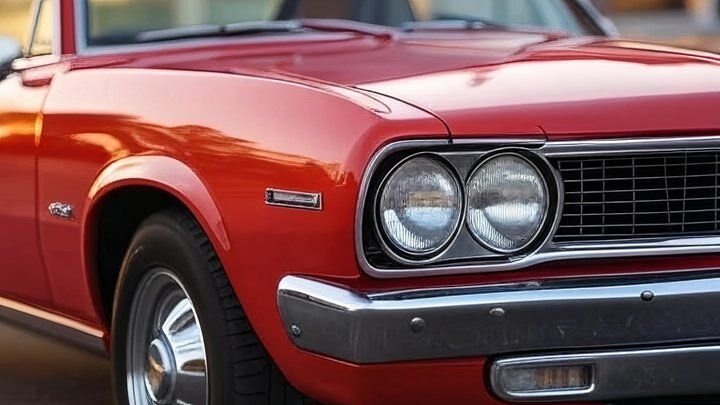
Yes, what you see before you is a muscle car of ChatGPT’s (semi-original) design, dubbed the “Crimson Tempest”. At first glance, what is the first design element that stands out? Although the name has “Tempest” in it, the design doesn’t resemble that of the Pontiac Tempest. We’d say it is clear that the overall shape and silhouette are that of a 1967 Chevrolet Camaro. The design of the front fender, doors, glass, and roof is 100 percent a 1967 Camaro, so it is the headlights, hood, and front valence that make this AI-designed creation stand out.
Chevrolet’s Style Steals ChatGPT’s Heart

The quad circular headlights of the ChatGPT creation follow the equilateral shape and design of the Chevrolet Impala and Chevrolet Chevelle, whereas the 1967 Camaro’s secondary headlights were always smaller instead of equal in size. The hood is also a particular design, which seems to most closely resemble the shape of the ram air-style drag racing hood found on the ultra-rare 1969 Chevrolet Camaro ZL1.
Throw that together with the generic five-spoke “American Racing” vintage wheels, and you have an interesting amalgamation of a 1960s muscle car created from a variety of similar-era Chevrolet products. This then begs the question: Did Chevy create the best-looking muscle car design of all time, or is ChatGPT simply biased in favor of this specific design?
The Alternate Angles And The Interior

If we focus on the rear quarter view of the Crimson Tempest, we confirm that the 1967 Chevrolet Camaro is the blueprint for the leading AI’s idea of what the best-looking muscle car looks like. From the shape of the rear glass with the chrome trim down to the signature high kick rear spoiler and rectangular taillights, this is a 1967 Camaro to a tee.
Interior Aspects Drive Home The Chevy’s Influence

The interior also looks like a 1967-68 Camaro except for the third large gauge on the instrument cluster, as the original Chevy only came with two. Everything else seems to be in order, including the shape of the transmission tunnel, along with the chrome shifter and the iconic white shift knob.
Chevy’s Muscle Car Design And The Influence Of The 1960s

So, have we decided that the first-generation Chevrolet Camaro was the best-looking muscle car of the 1960s because ChatGPT said so? Not so fast, because there are many other icons of the era that also deserve recognition for their gorgeous styling. Although many of Chevy’s most recognizable models, like the Chevelle and Impala, shared the circular quad headlight design motif, this particular design was not exclusive to GM products.
The first-generation Chevy Camaro was not the first muscle car to offer this iconic design, and this fascia layout would become a signature of the muscle car era. Yet, the first vehicle that carried this quad circular headlight design and popularized the concept of a “muscle car” was the 1964 Pontiac GTO.
The Standout Leaders Of Muscle Car Design

Back in the 1960s, most new models saw significant styling updates on a year-to-year basis, and the Pontiac GTO was no different. Despite all the constant changes throughout the years, the 1969 Pontiac GTO hardtop coupe is arguably the most attractive year of the original muscle car. Some prefer the 1970 “Judge” GTO, but for us, the front grill design where the headlights were integrated in 1969 looks a bit more unique and characteristic.
The Best-Selling 1960s Muscle Car

If good looks is a popularity contest, the Chevrolet Chevelle is the outright winner because a record 2,671,900 Chevy Chevelle and/or Malibu units were sold in four years from 1964 to 1970. In that final year of 1970, the Chevrolet Chevelle, the hottest muscle car of the era, also saw the aesthetic peak of its exterior design.
The 1970 Chevrolet Chevelle SS 454 Hardtop Sport Coupe features a timeless “coke bottle” silhouette that sees a different interpretation of the quad circular headlight design, with each headlight receiving its own housing. After 1970, the Chevelle would lose the characteristic quad circular headlight design, and by the start of the third generation in 1973, the hottest muscle car of its era had lost just about all of its once glorious sex appeal.
The Ford Mustang And Co. Would Like A Word

ChatGPT decided to give all the muscle car brownie points to the Chevrolet Camaro and its siblings, but no conversation about good-looking classic muscle cars is complete without mentioning the Camaro’s proverbial rival, the Ford Mustang. It was in response to the Mustang that the Chevy Camaro was created, and the Mustang’s impact extended beyond just the muscle car market.
The first-generation Mustang created the pony car market out of thin air thanks to clever engineering solutions such as parts sharing between existing models that allowed the Mustang to achieve an affordable price point compared to its rivals. Yet, no part of the Mustang was a bigger selling point to the developing “youth” market than its sleek two-door fastback styling that looked too good to be true.
The Mustang Paved Its Own Lane

At first glance, the first-generation Mustang has the appeal of a European grand touring car, and this is a big reason why the swooping design of the fastback body style quickly became the most popular of the available options. The Mustang became an icon of design with distinctive performance-based models like the “sportsroof” 1965 Shelby Mustang with its distinctive rear window louvers, and the 1969 Boss 429 model that flexed the biggest hood scoop of its era in an attempt to hide the NASCAR V-8 engine under the hood.
The Time When Muscle Cars Were Skyrocketing In Popularity

Steve McQueen solidified the popularity of the 1968 Ford Mustang GT with his adventures in the streets of San Francisco in the 1968 film Bullitt. Yet, it is the iconic car chase scene from this movie that also introduced another legend of its era, the 1968 Dodge Charger R/T.
The menacing look of the Charger R/T’s monstrous, singular front grill with hidden front headlights became a cornerstone muscle car design element popularized by the Charger model. Yet, by 1973, the Charger’s hidden headlights were phased out and, within a year, the muscle car era would already be coming to a close.
The Muscle Car Era Was Short-Lived, But Never Forgotten
The muscle car era’s impact on both design and performance would radiate throughout the automotive landscape for decades after its conclusion. Yet, why did one of the most significant automotive eras have such a brief lifespan? Well, up until the early 1970s, automakers were allowed an unprecedented amount of freedom as far as performance engineering, because back then, nobody cared about emissions regulations like they should have. Putting the biggest high-compression V-8 engines imaginable into massive and heavy cars sounds like a good idea until gas prices double and 100-octane fuel is no longer accessible to the average consumer.
Foreign Fuel-Sippers Become More Appealing Under Strict Standards

Once octane levels dropped after the increasing restrictions of 1970, the once-overpowered muscle cars had to heavily cut back performance output to stay in line with the new and ever-increasing efficiency standards. By 1974, the entire focus of the automotive industry had shifted, marking the end of the muscle car era and the beginning of the infamous Malaise era.
This stagnation within the American economy would effectively open the floodgates for Japanese automakers like Toyota and Honda to capitalize on the lack of American automakers to produce economical and efficient vehicles stateside, and we are still experiencing the aftereffects of those decisions even today.