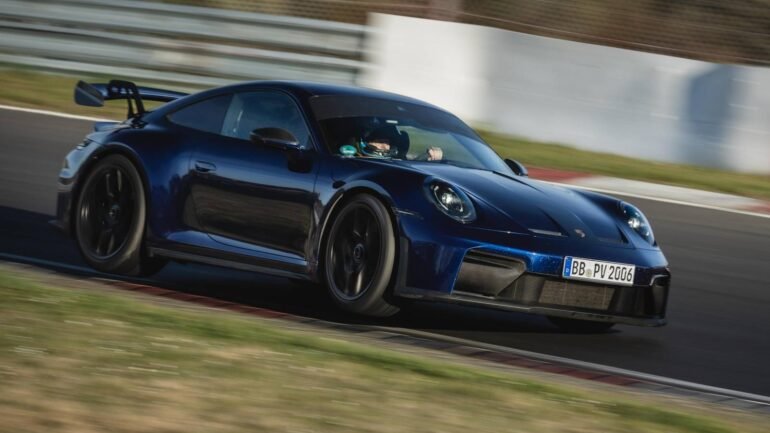
Ferraris are the greyhounds of sports cars. They are sleek, fast, highly strung, specialized in build, and very expensive. A Porsche is more like a Labrador. Bred for hunting, but all-around great to have around, good around kids, but will snarl at intruders. Easy to look after, fun to have around.
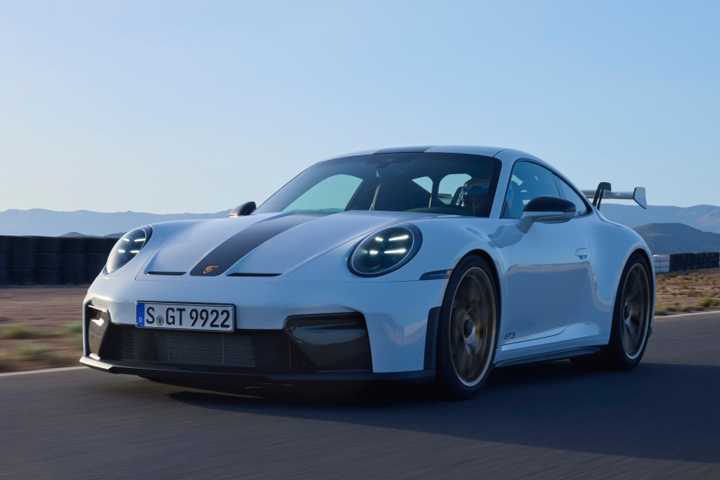
But what if you could get a Labrador as fast as a greyhound, but still with all the good Lab traits? A Porsche that can set the record around the Nürburgring, bred from stock that won at Le Mans, but is as easy to care for as a Toyota? The Porsche GT3 RS is such a Labrador.
- Base Trim Engine
-
4.0-liter flat-6 gas
- Base Trim Transmission
-
6-Speed Manual
- Base Trim Drivetrain
-
Rear-Wheel Drive
- Base Trim Horsepower
-
502 hp
- Base Trim Torque
-
331 lb-ft
- Make
-
Porsche
- Model
-
911 GT3
- Segment
-
Sports Car
Engineering That Prioritizes Durability Without Sacrificing Performance

The Porsche GT3 is part of the iconic 911 range of rear-engine sports cars. The GT3 was preceded by the Carrera RS, created as a limited run homologation special in the ’73, when a certain number of production cars needed to be made to make a racing car eligible to enter specific races.
The GT3 nameplate came in 1999, when Porsche made a homologation model of the 996 model range for the FIA GT3 Cup. Those early production models were pretty rough to drive, stripped down of everything comfortable to save weight, loud, and with bone-jarringly hard suspension. But hard-core Porsche fanatics loved them, and the GT3 was later added as a production model to 911 range, removing the limited homologation numbers.

Although Porsche moved beyond the legendary Mezger engines in the mid-2010s, the philosophy that drove the Mezger units still lives on in today’s GT3 RS. It is a naturally aspirated, very high-revving 4.0-liter flat-six. This engine uses precision-balanced internals, dry-sump lubrication, pistons and connecting rods are motorsport-grade, while the intake and exhaust systems are optimized for repeated high-RPM cycling. This engine is designed to regularly work at 9,000 RPM without failing. This sets it apart from many supercars that risk failure with sustained RPM at these levels. All sports cars can fail, but GT3 RS owners report very few major issues, unlike the Italian exotics with less robust drivetrains.
A Chassis Built To Last
A powerful engine needs a matching chassis, and the GT3 RS has such a chassis. Everything, from suspension arms to aerodynamics, cooling systems, bearings, and mounts, is built at racing specs. The durability of the RS and other GT3 cars is tested by racing them for hours around the murderous Nürburgring.The aerodynamics, such as the rear wing and active flaps, are designed in wind tunnels, but also endurance tested for maximum performance and durability.

New Porsche GT3 Package Delivers Speed for a Steep Six-Figure Price Tag
There’s a similar package for the previous GT2 model, and it’s only a bit less expensive.
The Benchmark For Track Speed

The Porsche GT3 RS is generally considered the benchmark for naturally aspirated sports cars, able to take on and beat hypercars that can cost three times as much. This is a reflection of the GT3 RS’s ability to perform at such levels on demand, for long periods, and to keep doing so.
Engineering Forged In Endurance Racing

The 24 Hours of Le Mans is the world’s most famous endurance race. Winning there requires top-level power, speed, handling, and super reliability. Porsche holds that record for overall wins there at 19, as well as 100 class wins. Porsche is always a factor in endurance racing around the world. A modified Porsche won the grueling Paris Dakar rally in 1984. The lessons learned in these races are applied to Porsche production cars, none more so than the GT3 RS.
The Porsche GT3 RS is basically a street version of the Porsche 911 RSR and GT3 Cup racing cars. The whole car, from suspension geometry to cooling circuits, is built on the experience gained over the years of endurance racing.
Taking On The Toughest Tracks

Porsche is indelibly linked to the Nürburgring North Loop or Nordschleife. It was dubbed the green hell by F1 World Champion Jacky Stewart in the ’70s, and for good reason. Over twelve miles of winding track through a thick forest, with over 1,000 feet of change in elevation from the lowest to the highest point. There are 73 corners, too many for most drivers to memorize.
Naturally, the Nürburgring is one of Porsche’s main testing tracks. It holds the all-time lap record of 5:19.55 minutes in a 919 Hybrid Evo, the production car record in a 911 GT2 RS, and the record for a production car with manual transmission with the GT3 at 6:56.29.
Toyota-Like Reliability: The Secret Behind Porsche’s Consistency

Referring to the Porsche 911 in general and the GT3 RS in particular, having Toyota-like reliability sounds like a stretch. Obviously, if something goes wrong with a Porsche, it would be far more expensive to fix than on a Toyota.
But if we go back to the Labrador metaphor, you can take your 911 for twenty scorching laps around the most formidable track you can find, and still use the same car to drive you home, no hassle, no fuss, almost like a Toyota. This is not something you would do in a Ferrari or Lamborghini.
A Practical Daily Drive

At first glance, the Porsche GT3 RS is not a daily drive. It has a massive wing on the back, and the interior has a racing cage vibe going. The suspension is hard and uncompromising, and you would need a strong racing affinity to live with that, and the sound of the engine at speed. This is why many drivers prefer the more ‘normal’ GT3 models, without the RS edginess.
That said, even the RS can be driven like a normal car without the niggles associated with other supercars. It does not overheat in traffic, its electrics and transmission are quite bulletproof, and you won’t constantly get warning lights on the dashboard.
Warranty And Reliability

The Porsche GT3 comes with a limited warranty of four years or 50,000 miles, the same for the powertrain, and maintenance for one year or 10,000 miles. A Toyota comes standard with a three-year or 36,000-miles limited warranty, and a five-year or 60,000-miles powertrain warranty.
J.D. Power rates the 911 as an overall model, not the GT3 specifically, and it gets a ‘Best’ 91/100 for quality and reliability, and 88/100 overall, and 89/100 for driving experience.
A Pedigree That Prioritizes Repeatability, Not Just Peak Numbers

Porsche SSR Performance GT3 RS Biturbo (GT2) Spy Shots Nurburgring
Because Porsche is so deeply rooted in racing, including endurance racing, its cars are designed to be a combination of high-performance and everyday practical driving. Despite the GT3 RS’s demonstrable performance abilities, even this nearly race-ready thoroughbred can be driven on a daily commute.
Built To Last

There are supercars with more power, better straight-line acceleration, and much higher price tags. But none of these can keep going at top revs for hour after hour, weekend after weekend, without breaking down sooner rather than later.
Engineering DNA

Porsche’s legacy comes from the venerable VW Beetle, the original bullet-proof car. While Porsche built increasingly sophisticated engines, the air-cooled flat-six was the mainstay drivetrain until 1998, when it introduced liquid cooling to allow greater performance.
But the meticulous focus on solid engineering is baked into the company’s corporate DNA, and repeatable performance is the result.
Source: Porsche