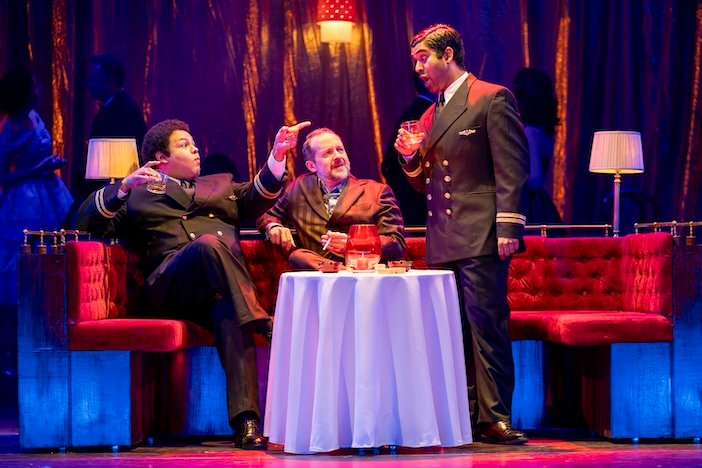
The irony of staging Così fan tutte over Valentine’s weekend is inspired. Mozart’s comedy of duplicity and temptation arrives as a delightful tonic to the mawkish sentiment that proliferates this occasion — particularly when delivered by a production team as accomplished and inventive as Improbable.
It’s testament to Mozart’s enduring genius — alongside librettist Lorenzo da Ponte — that his playful, often puerile exploration of love and relationships still feels so vital. Così fan tutte, the third and perhaps least celebrated of their collaborations (following The Marriage of Figaro and Don Giovanni), offers something bracingly modern: a dissection of how desire actually operates versus how we pretend it does.

The plot is transparently absurd. Two young officers, Ferrando and Guglielmo, wager with the cynical philosopher Don Alfonso that their beloveds — sisters Fiordiligi and Dorabella — will remain faithful in their absence. Disguised as exotic Albanian suitors, the men return to test their fiancées’ constancy, aided by the scheming maid Despina, and attempt to seduce each other’s sweethearts. Predictably, hearts stray, and chaos ensues.
It’s an incredulous premise. And this is precisely why Improbable’s setting makes it work. Director Phelim McDermott has transplanted the action to a 1950s Coney Island pleasure garden, what he describes as “a world of otherness, where identity is more fluid and it’s easy to fall in love with the ‘wrong’ person.” It’s inspired. The fairground becomes the perfect petri dish for Mozart’s experiment in emotional inconstancy.

Before a note is sung, over the overture we’re drawn in through a delicious opening montage: circus performers — fortune teller, sword-swallower, strongman — emerge from a magician’s box carrying title cards that spell out the plot with increasingly humorous results. It sets the tone perfectly, this silent circus chorus adding texture throughout the performance in a rich, colourful tableau.
As such, Tom Pye’s production design recreating Coney Island’s gaudy splendour is worth the ticket price alone; the fairground rides become active participants: spinning teacups denote swirling affections; the Tunnel of Love provides the setting when opposite couples pair off. When Fiordiligi sings her aria from a rotating Ferris wheel cupola, we’re given a visual metaphor for emotional vertigo Mozart himself would applaud.

While Così may lack the signature tunes of Figaro or Don Giovanni, in the hands of this cast Mozart’s score is brought vividly, movingly to life. Lucy Crowe and Joshua Blue as Fiordiligi and Guglielmo, Taylor Raven and Darwin Prakash as Dorabella and Ferrando deliver emotional truth alongside entertainment. The sextet as the disguised suitors enter — the cast bounding between motel rooms — crackles with precision and physical comedy, vocal lines interweaving as deftly as the characters’ tangled loyalties.
Bass-baritone Andrew Foster-Williams anchors the production as Don Alfonso, while Ailish Tynan’s Despina proves her rich tonality as mellifluous as her comic timing is impeccable — her Einstein-esque Dr Magnetico eliciting belly laughs throughout the Coliseum. Crucially, the ensemble’s duets, trios, and sextets showcase harmonies and coloratura that absolutely master Mozart’s intricate architecture.

What strikes me most, watching this production today, is how progressive Mozart’s vision remains. Yes, the premise carries a whiff of chauvinism — why is it always women’s fidelity being tested? — but Mozart levels the playing field. The men may set the trap, but the women turn the tables. We are, ultimately, as bad as each other. In an era that prescribed rigid social roles, Mozart granted his female leads genuine agency and emotional complexity. That feels radical even now.
The opera’s conclusion arrives with characteristic Mozartian haste — three hours of elaborate deception resolved in minutes as all is forgiven and the “correct” couples are reunited. Yet that very swiftness contains its own subversive charge. Can we simply reset to our original positions after such profound betrayal? Has anything truly been learned, or are we merely agreeing to pretend?

Perhaps that’s why Così feels so refreshingly contemporary. In an age of dating apps and negotiated relationships, Mozart’s refusal to sanctify romantic love — his acknowledgment that desire is capricious, that we are all capable of self-deception, that “happily ever after” requires selective amnesia — rings truer than any Valentine’s card sentiment.
In the hands of this production team and this exceptional cast, Così fan tutte makes for a far more memorable Valentine’s outing than dinner and chocolates. It’s whimsical, yes, but also honest — a gorgeous, giddy reminder that love is less about finding the perfect person than learning to navigate our own imperfect hearts. Now that’s a message worth celebrating.
Così fan tutte runs at the ENO until 21st February. For more information, and for tickets, please visit www.eno.org.
Photos by James Glossop