
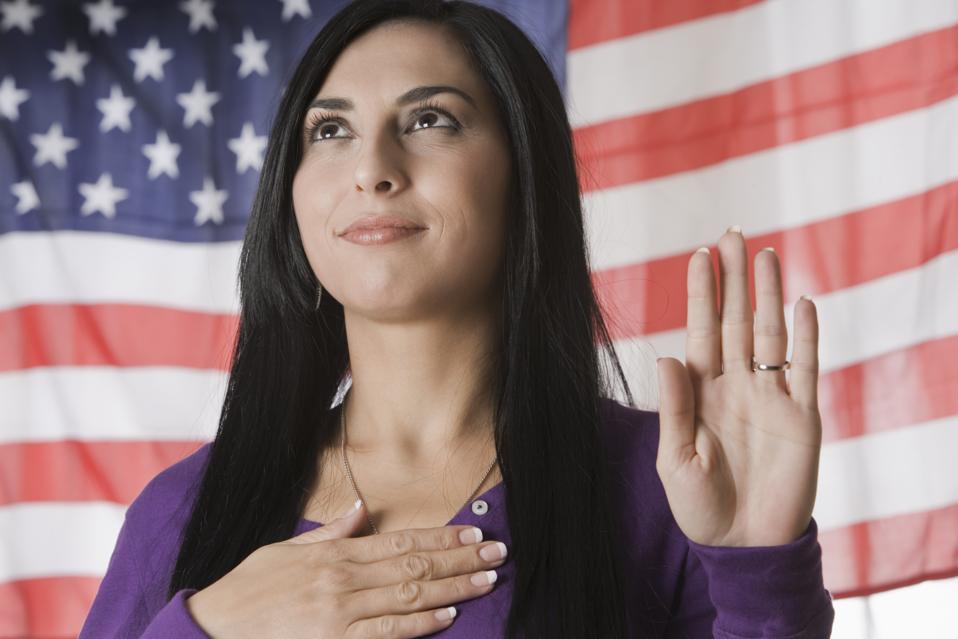
New citizen swearing allegiance to America. For example, 1000 new immigrants just became citizens at Wrigley Field. But now, U.S. immigrants will have to pass a new good moral character citizenship test.
getty
If the good moral character citizenship test now demanded from immigrants who wish to become Americans were applied to our leaders and those in powerful positions in America, many would fail. What does that suggest for the standards we are applying to immigrants if we ourselves cannot live up to them?
A New Citizenship Test
To become a U.S. citizen through naturalization, an applicant must be at least 18, have held lawful permanent resident status (generally for 5 years, or 3 years if married to a U.S. citizen), and demonstrate continuous residence and physical presence in the United States during that period. They must reside in the state or USCIS district of application for at least 3 months, and show attachment to the Constitution and U.S. laws. Applicants must also pass tests in basic English and U.S. civics (with some exceptions for older or long-term residents), register with the Selective Service if required, and eventually take the Oath of Allegiance. In addition to all these requirements, applicants will now need to pass one more test.
But the U.S. Citizenship and Immigration Services (USCIS) has just announced that immigrants seeking naturalization will now face a more demanding review of “good moral character.” Applicants must demonstrate not only the absence of serious wrongdoing but the presence of civic virtue: community service, financial responsibility, family stability, and reform when mistakes occur.
It is a noble aspiration. However, it also prompts a troubling question: How many of America’s leaders—political, corporate, or cultural—would pass the test? Let’s find out.
The Declaration of Independence was an aspirational document
getty
America’s Founding Imperfection
Looking at recent history, the honest answer to the question of how many of our leaders would pass the new test is concerning. And that should remind us of something vital: if our own presidents, cabinet secretaries, and business icons would struggle to demonstrate their worthiness under this new test, then shouldn’t we show more compassion to immigrants when they falter, too?
From its earliest days, the United States was shaped by imperfect actors. The framers of the Constitution wrote stirring words about liberty even as many owned slaves. Women, Black Americans, and immigrants were excluded from equal rights for generations.
Our democracy has always been aspirational—a nation striving toward ideals it could not fully attain. That tension does not discredit the American experiment; it defines it. If the Founders themselves would have failed a strict moral character test, perhaps we should be cautious in using it today against those seeking to join our national community.
Mishandling of Secrets
President Biden was found to have “willfully retained” classified documents at his home and office, although prosecutors chose not to charge him. Conversely, former President Trump stored hundreds of secret files at Mar-a-Lago, refusing to return them until the FBI intervened.
Under the USCIS’s new standard, both men’s actions would weigh heavily against them. Immigrants are told they must demonstrate transparency and adherence to the law. Shouldn’t presidents be held to the same standard?
Pardons and Principle
Biden’s pardon of his son Hunter, despite earlier promises to uphold judicial independence, sparked accusations of favoritism. Trump went further, pardoning January 6th rioters who attacked police officers and tried to overturn an election.
For immigrants, prioritizing loyalty over law would almost certainly disqualify them from citizenship. Why should presidents be exempted?
The Epstein Shadow
The late Jeffrey Epstein’s ability to surround himself with politicians, businessmen, and celebrities, despite his crimes, highlights the moral compromises of America’s elite. Associating with abusers for personal gain would damage an immigrant’s case irreparably. However, for the powerful, reputations may fade but lives largely continue unaffected.
Ethical Failings Across the Board
Moral lapses are not the exception; they are everywhere:
Neera Tanden, a senior Biden adviser, was cited for Hatch Act violations after posting partisan fundraising appeals.
Lynne Patton, a Trump HUD appointee, misused her position to film tenants for a Republican campaign ad, resulting in fines and a federal employment ban.
Rachael Rollins, a former U.S. Attorney in Boston, resigned after an ethics investigation revealed she leaked confidential DOJ information and accepted inappropriate gifts.
Amazon and other tech giants have reduced their U.S. tax bills through complex loopholes, depriving the Treasury of billions that ordinary families need to pay.
Brett Favre, a Hall of Fame quarterback, diverted Mississippi welfare funds to construct a volleyball arena at his alma mater.
Each of these examples illustrates what USCIS now calls the essence of bad moral character: disloyalty to public trust, personal gain over community good.
Citizenship should not involve imposing a double standard on immigrants.
getty
The Double Standard
The USCIS is correct to state that citizenship involves a significant change. But if having good moral character means avoiding major mistakes entirely, then not only would many immigrants fail — the nation’s leaders would as well.
“Let he who is without sin cast the first stone,” the biblical reference asserts. The truth is that to be human is to err. We have all faltered. Presidents and athletes, CEOs and cabinet secretaries, our Founding Fathers themselves—all have lived with contradictions.
That is why the moral character test should be balanced with compassion. It should evaluate the whole scope of a person’s life: their service, their reform, their contributions—not just their worst mistakes.
A Plea for Compassionate Citizenship
The risk of the USCIS’s new framework is not its vision but its inflexibility. Immigrants should not be held to a higher standard than the presidents they serve or the corporate leaders they work for. The standard should motivate, not condemn. It should serve as a reminder that Americans—whether born here or naturalized—are defined more by how they take responsibility, make amends, and contribute to the collective good than by their mistakes.
We as Americans need to live up to the same standard we impose on immigrants. Let us all strive to be more moral, not only in demanding it from those who wish to join us, but in holding ourselves accountable to it. In the end, citizenship is not perfection. It is participation. It is commitment. It is the daily act of striving for ideals we do not always meet. If America cannot forgive the flaws of immigrants while excusing those of its own leaders, then we are dealing with hypocrisy.
The better path is humility: to expect high standards but to enforce them with mercy, remembering that imperfection is not the enemy of democracy—it is its condition.
Conclusion
If today’s U.S. leaders would struggle to pass the good moral character citizenship test, then perhaps the real question is whether we can treat immigrants with the same compassion and understanding of their humanity that we so often reserve for ourselves.