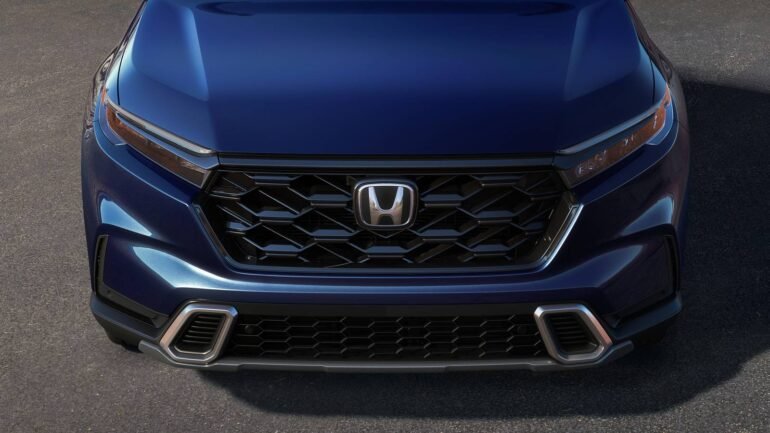
America loves its trucks. That’s been a truth as steady as sunrise for decades — a point proven every time the Ram 1500, GMC Sierra, and Ford F-150 end another year among the nation’s top sellers. But 2025 has thrown a little curveball. For the first three quarters of the year, Honda’s CR-V has outsold two out of the three.
It’s not a fluke or a one-quarter spike. Honda’s bestseller is up about three percent year-to-date, while its hybrid variant is up a remarkable fourteen percent. That means 307,501 Honda CR-Vs have been sold this year alone; 165,633 of those were the increasingly popular CR-V Hybrids.
The CR-V’s consistent climb stands out in a market where nearly every major automaker is struggling to find equilibrium between electrification, pricing pressure, and consumer confidence. It’s proof that in a year dominated by conversations about EVs and high-interest loans, there’s still enormous room for a right-sized, reasonably priced, and unpretentious vehicle that simply does what people need.
To provide the most accurate and up-to-date information, this article uses data sourced from various manufacturers and authoritative sources.
Honda Shows The Power Of Consistency

The CR-V’s success didn’t come from a bold redesign or a viral marketing push. Honda didn’t reinvent the wheel this year — it just kept turning it smoothly. The current CR-V is a study in incremental improvement: a sharp, modern design without the flash, a comfortable interior with thoughtful ergonomics, and a powertrain lineup that meets the moment.
The hybrid model is especially important. Gas prices and other economic factors are simply unpredictable, and more buyers are wary of jumping straight into EV ownership. Hybrids have become a sweet spot for families who want efficiency without anxiety. The CR-V Hybrid offers real-world fuel economy in the 40-mpg range for city driving, and it does so without the learning curve or higher sticker price that often come with plug-in options. It’s the kind of efficiency that buyers have always appreciated.
Ram Gambled And Took A Hit

Contrast that with the Ram lineup, which has been in transition. Stellantis made the unpopular move of retiring the iconic Hemi V8 for 2025 in favor of the new twin-turbo inline-six Hurricane engine. On paper, it’s more efficient and just as powerful. In reality, the change rubbed some loyalists the wrong way. Sales fell one percent in the third quarter and are down two percent for the year. Ram quickly took the hint, fast-tracking the Hemi’s return for the 2026 model year. Those trucks began trickling into dealerships at the end of Q3, but it’ll take time to see whether nostalgia alone can reverse the slide.
Meanwhile, the GMC Sierra has had a good year. Sales are up ten percent year-to-date after a solid third quarter. But even with that momentum, the Sierra still trails the CR-V in total units sold — and that’s excluding its EV variant, which has barely registered with just over six thousand deliveries. The gas-powered Sierra remains a strong performer, but like all full-size pickups, it’s feeling the squeeze from shifting buyer behavior.
A Noticeable Shift In What People Want

The most revealing part of this sales story isn’t that a Honda outsold two American pickups — it’s why. For years, trucks have benefited from image as much as utility. They were symbols of power and success, and modern trims turned them into luxury SUVs with beds. The cabins, once textile, meek, and humble, are now dressed in leather, screens, and technology with six-figure price tags. But as household budgets tighten, Trump tariffs wreak havoc, and interest rates remain high, that image-first logic is starting to crack.
A loaded Sierra or Ram 1500 can easily climb past $80,000 today. Even mid-level trims push well beyond what most families can comfortably finance. The CR-V, on the other hand, starts around $30,000 and tops out just past $41,000 for a fully equipped Hybrid Sport Touring (before options and destination). That difference in cost alone explains a lot. Buyers are scaling back, looking for versatility instead of vanity. The CR-V gives them everything they actually use — room for five, good cargo space, all-wheel drive, and fuel efficiency — without the excessive debt.
There’s also the matter of size and drivability. A CR-V fits anywhere. You can park it in an urban garage, maneuver it through school pickup lanes, and still take it on a weekend trip to the mountains. The same can’t be said for a heavy-duty pickup. People who once bought trucks for occasional hauling or towing are realizing they can rent one a few times a year and save thousands in payments and fuel. It’s not about giving up capability; it’s about right-sizing it.
Honda’s Subtle Masterclass Pays Dividends

Honda’s marketing hasn’t been flashy this year, but the company’s long game is clear: build loyalty through trust and consistency. The CR-V is an oak, proving the value of that strategy. It’s the model most likely to introduce buyers to the brand and keep them there. Reliability, strong resale value, and simple ownership experiences have become its currency. In a market flooded with buzzy new electric crossovers and luxury-leaning SUVs, Honda’s focus on fundamentals is paying off.
Honda has also managed inventory wisely. While many manufacturers have struggled to balance production amid fluctuating demand, Honda has kept its lineup steady and well-stocked. Dealers have enough CR-Vs to sell without resorting to steep incentives or long wait times, which is, in large part, a factor in the model’s success.
Trucks Aren’t Down For The Count Just Yet

None of this spells doom for American pickups. Ram’s short-term dip might look worse than it is, especially if the reintroduced Hemi brings buyers flooding back in the fourth quarter. Enthusiasts have already shown excitement about its return, and brand loyalty runs deep. Likewise, GMC’s continued growth suggests that not everyone is abandoning full-size trucks. In fact, that’s pretty far from the truth. There will always be a strong market for capable, high-end pickups, especially in regions where towing and off-roading are part of daily life.
Ram reports 262,386 pickups sold so far this year. What’s changing is the center of gravity. Trucks are no longer the default choice for buyers who just want space and presence. Compact and midsize SUVs have absorbed that crowd — and the CR-V is leading the charge. Honda’s ability to keep its SUV practical, approachable, and efficient has turned it into a proper powerhouse.

The GMC Sierra boasts 251,845 units sold this year. The Sierra EV’s modest start also illustrates how cautious the truck market remains about electrification. GMC’s electric push hasn’t yet found the mainstream buyers it needs, which could make hybrids like the CR-V look even more appealing as a “bridge” technology. It’s a reminder that the EV transition will take longer for larger vehicles, while smaller, more efficient models keep the volume steady.
The Broader Message Beyond The Sales Numbers

The 2025 CR-V story isn’t just about sales charts. It’s about consumer confidence — or rather, the erosion of it. Buyers are thinking twice about spending big on vehicles that feel excessive. As the economy worsens, more Americans want predictability, lower costs, and technology that works without complication. The CR-V embodies that mindset. It’s not trying to be a luxury SUV or an off-road beefcake. It’s just a smart, balanced vehicle that fits real life.
In an era of market volatility and brand experimentation, that simplicity has become Honda’s competitive edge. The company hasn’t abandoned hybrids now that EVs are the buzzword; it’s doubled down on what people actually want today. The results speak for themselves.
TopSpeed’s Take: Trucks Are Down, But Not Out

So yes, the CR-V is outselling two of America’s most popular trucks. It’s a clear sign of where the industry is heading, at least right now. For all the noise surrounding EV startups and luxury performance models, this Honda has reminded everyone what success really looks like: a dependable product built for ordinary drivers, selling in extraordinary numbers.
The question now is whether the trend will stick. Ram’s revived V8 and GMC’s ongoing push into electrification could shuffle the rankings again by year’s end. But even if they do, the message has been sent. The best-selling vehicles in America no longer have to come with a tailgate.