For decades, Lexus has been synonymous with comfort, craftsmanship, and bulletproof reliability. Yet behind the brand’s serene cabins and understated luxury lies another identity, one defined by engineering precision, motorsport influence, and a surprisingly rich lineage of performance-oriented machines. While Lexus may not shout about performance the way German rivals do, its sports cars have consistently delivered an unmistakable blend of refinement and excitement, proving that high speed and high comfort don’t have to be mutually exclusive. This balance has become a defining trait of the brand’s most ambitious coupes, sedans, and F-branded halo models.

- Founded
-
1989
- Founder
-
Eiji Toyoda
- Headquarters
-
Nagoya, Japan
- Current CEO
-
Koji Sato
- Status
-
Active
From the early days of the SC coupe to the jaw-dropping LC grand tourer, Lexus has evolved its performance philosophy with a consistent ethos: build cars that are thrilling on the right road, relaxing on the wrong one, and impeccably crafted everywhere in between. Rather than chasing lap-time supremacy, Lexus focuses on the driving experience, sound, feel, balance, and emotional appeal. The result is a formula that stands apart in an increasingly digital and clinical sports car landscape.
From The SC To The LC: How Lexus Evolved Its Grand Touring Formula

Lexus’ journey into the world of luxury performance began long before the LFA and the modern F division. The original SC coupe of the early 1990s represented the brand’s first exploration into a grand-touring identity, one rooted in long-distance comfort rather than outright aggression. Designed in California and widely praised for its smooth proportions, the SC was a different kind of sports car: quiet, refined, effortlessly quick, and built with a level of solidity that instantly set it apart. It wasn’t trying to be a hard-edged rival to German coupes; instead, it was designed for real-world driving, where comfort, stability, and reliability mattered most.

But the evolutionary leap arrived with the second-generation SC430 in the early 2000s, a retractable-hardtop roadster that emphasized comfortable cruising. Although not universally praised for its driving dynamics, its focus on premium materials and comfort laid the groundwork for a more ambitious future. Lexus learned from this era, understanding that while comfort was essential, customers were hungry for more emotion and drama. This paved the way for the LC, a flagship that fused the best elements of Lexus grand touring with genuine athleticism.
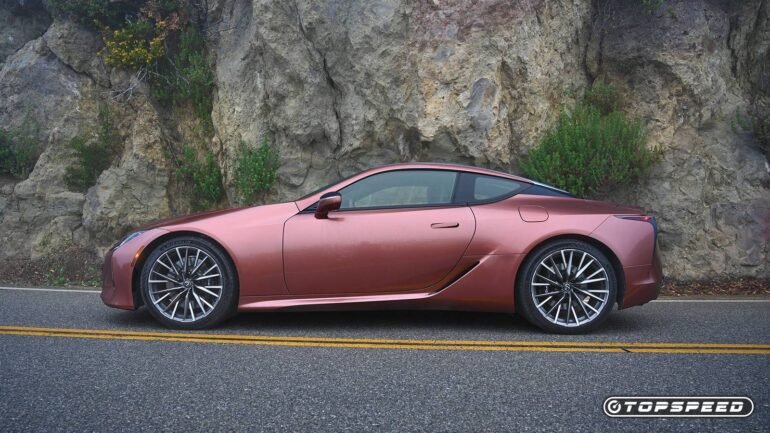
When the LC500 arrived, it marked a new chapter. The aggressive stance, concept-car styling, and a rear-drive architecture designed specifically for performance demonstrated how far Lexus had come. The LC is still unmistakably a grand tourer, but it finally achieves the balance that Lexus had long been refining: equal parts comfort, emotion, and performance capability.

A V-8 Powered Future Classic You Won’t Regret Buying
While rivals may outdo the Lexus LC, the flagship Japanese sports car has a few key ingredients that will make it a desirable future classic
Precision Engineering Meets Everyday Comfort

A core part of the Lexus identity is its ability to engineer vehicles that feel meticulously crafted yet approachable. The brand’s sports cars are not machines you need to “tame,” nor are they built to overwhelm. Instead, Lexus places enormous emphasis on chassis tuning, structural rigidity, and suspension geometry to ensure precision without punishing the driver. This engineering discipline is visible in models like the RC F and GS F, where high-speed stability blends seamlessly with a surprisingly smooth ride.

Lexus’ state-of-the-art GA–L platform is a perfect example of this philosophy. Used in the LC and LS, it provides a low center of gravity, near-perfect weight distribution, and exceptional stiffness. However, rather than turning that stiffness into harshness, Lexus leverages advanced suspension systems to filter out road imperfections while keeping the chassis communicative. Even the high-performance models avoid being twitchy or overly firm.
This precision-with-comfort philosophy extends to the brand’s steering and braking systems. Lexus tunes its electric power steering to deliver progressive, predictable feedback, never artificially heavy or hyper-reactive. Braking systems are similarly linear and confidence-inspiring, prioritizing real-world usability.

The Most Practical And Balanced Luxury Sedan You Can Buy Right Now
It’s not about speed or flash or technology for its own sake. It’s about refinement.
The V8 That Defined A Generation

No discussion of Lexus performance would be complete without highlighting the 5.0-liter V8, one of the last naturally aspirated engines of its kind, and arguably one of the most characterful powerplants of the modern era. Used in the RC F, GS F, IS 500, and LC500, this engine is the soul of Lexus’ performance division. At a time when most automakers turned to downsizing and turbocharging, Lexus doubled down on a high-revving, atmospheric V8 that delivered linear power, unmistakable sound, and unmatched reliability.

This V8 doesn’t rely on turbos to impress, it builds its power through a progressive wave of torque, culminating in a soaring top-end growl that feels mechanical and emotionally rich. Its throttle response is immediate and organic, giving drivers a direct connection to the car that turbocharged rivals often mute. Beyond its character, the V8 is also renowned for its durability, a high-performance motor that can routinely surpass hundreds of thousands of miles without drama. Few engines combine reliability and excitement so effortlessly.
Its soundtrack also plays a major role in defining Lexus performance. Engineered with help from Yamaha’s musical instruments division, the intake resonance system creates a genuine crescendo as revs climb. In the LC500 especially, the V8’s presence transforms the car into an auditory experience that many reviewers describe as one of the best exhaust notes in the industry. This engine built Lexus’ reputation for performance credibility, proving the brand could produce a world-class sports car heart, without compromising reliability or refinement.

2026 Lexus ES Updates: Everything You Need To Know
The 2026 Lexus ES has just entered a new era, upgrading its technology, luxury, and comfort. Oh, and it’s available as an EV now.
Track-Bred Technology Without The Harsh Ride

When Lexus introduced its F performance division, beginning with the IS F in 2008, the goal wasn’t to chase Nürburgring lap times or out-muscle German rivals on paper. Instead, the mission was to incorporate motorsport-informed engineering into vehicles that still felt unmistakably Lexus. The result is a lineup that leverages track technology, lightweight materials, advanced cooling systems, performance braking setups, limited-slip differentials, and rigid chassis tuning, without devolving into harsh, unforgiving rides.

Models like the RC F Track Edition showcase how far this philosophy has evolved. With carbon fiber components, Brembo carbon-ceramic brakes, improved aerodynamics, and a weight-reduction strategy, it clearly embodies a track-focused mindset. Yet even this extreme variant remains more livable than many hardcore sports cars. The steering retains Lexus smoothness, the cabin remains well-insulated, and the suspension, while firm, avoids the bone-rattling stiffness found in some European competitors.
Adaptive Variable Suspension (AVS) played a significant role in this achievement. By constantly adjusting damping in real time, it allows performance Lexus models to achieve dual personalities, aggressive when pushed, relaxed when cruising. Combined with highly supportive yet comfortable seating, the result is a sports car that can genuinely perform on a circuit but never punishes you on a long highway drive. This balance sets Lexus apart. Many brands chase track capability at the expense of daily usability.
Source: Lexus U.S.