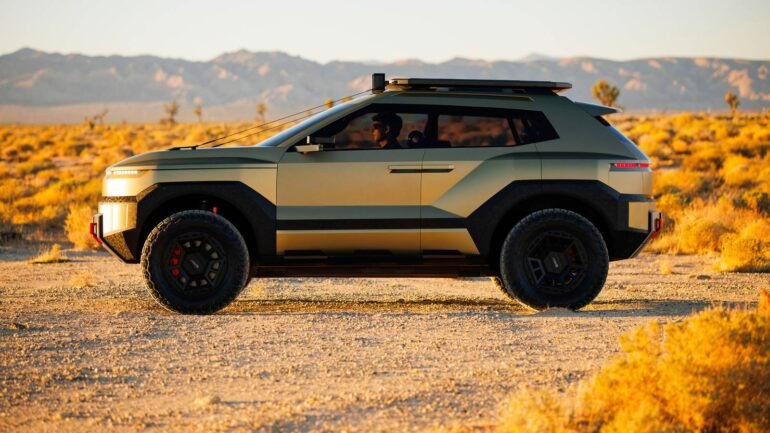
We don’t know anything about the Crater Concept’s powertrain, and we don’t care: Hyundai should build this SUV. Because it looks like it’s about the size of a Subaru Outback Wilderness or a Jeep Wrangler, but with more visual refinement than the latter and more capability than the former.
While Hyundai has shared very little about the spec, we do know it has 35-inch tires, and, we’d wager, a good ten inches of ground clearance. Those bona fides would allow Hyundai to compete in a segment that’s a total white space for the carmaker. Yes, they have XRT Pro versions of the Palisade, Tucson, and Santa Fe, but these only offer some additional capability. They’re not aimed at taking on the kind of terrain you’d only conquer in a fully lifted Toyota Tacoma Trailhunter or Jeep Wrangler Rubicon. But by showing off the Crater Concept, Hyundai is tilting in that direction, which is a very good thing.

2026 Jeep Recon Revealed As An All-Electric Wrangler Counterpart
Prepare to experience the great outdoors like never before with the 2026 Jeep Recon.
The Specs We Do Know

The angled front fender and, likewise, sliced off rear fender both allow better approach and departure. And Hyundai indicates the Crater has full-body-side rockers, skid plating, and recovery hooks (one of which doubles as a bottle opener). Plus, the Crater gets front and rear locking differentials, and specific off-road modes for snow, sand, and mud. Hyundai says they’ve also included downhill brake control (basically, hill-descent control), trailer brake control, plus O.G. elements like a compass and altimeter.
Why This Is Probably An EV

Hyundai said zilch about the Crater’s propulsion. But just look at the thick floor and ultra-short overhangs, plus suicide doors without a center pillar and only a battery system makes sense. Though an EREV might also be the game plan, since Hyundai has expressed interest in wanting to go that route. Add in the fact that they’ve scaled back their ambitions around selling some EVs in the U.S., and you can see why an EREV works here.
EREV = Adventure

There are a few reasons Hyundai might take the Crater in the EREV direction. One, an extended-range EV only uses the gas engine to charge the battery. That enables rolling on electric power for 100-150 miles. In turn, you have a smaller battery that’s great for daily driving. And you also have a lighter 4×4 rig (batteries are very heavy), and the gas engine, as a generator, doesn’t have to be huge, either. Also, you can go off the grid and not have to sweat about where to charge the battery, since gas is still easier to find than a remote EV charger.
Interior Fanciness

Car designers love to play. They’re just big kids with clever pencils. In their Hyundai Crater, you can see all that on display. Hyundai melds a real roll cage with a full-dash color head-up display, a full-width, tubular crash bar, and gear-like wheels for adjusting varying modes. Plus, Hyundai designers had fun with smaller displays rather than the oversized touchpad norm. They’ve used these to showcase what they’re calling, “Crater Man,” whose iconography playfully tells you what sort of adventure you might be choosing next. We’re not so sure if we want to select the Crater Man that looks like a skull, but we sure want to know what mode that dial fires up.
Bits And Bobs

Hyundai adds limb risers, a rooftop platform, clever auxiliary lights standing in for sideview mirrors, a med kit in the driver’s side door pocket and a fire extinguisher in the passenger-side door pocket. Plus, all four seats have four-point harnesses instead of standard seatbelts, and ample cabin padding throughout, since you can get pretty beaten up during a day of serious off-roading.
TopSpeed’s Take

We don’t know if Hyundai will build this SUV, but we would bet they won’t call it a “Crater,” since that’s a term of slang car fans use negatively, to describe an event that nobody wants—engine damage or total destruction.
But do we think Hyundai needs a legit 4×4 in their pantheon? Yes. And they know they need a pickup, too. A platform that could serve both functions, and be more rugged than anything they currently offer, would only further the carmaker’s reach into markets they currently fail to serve. XRT Pro stands for more capability, but without a halo vehicle or two carrying that flag, the label has yet to penetrate as equivalent to Toyota’s TRD Pro. Plus, legit off-road-capable EVs and EREVs will be coming from the likes of Scout Motors, Jeep—and likely, Toyota. But there’s no reason for Hyundai to sit and wait for that competition.