Weight plays a huge role in motorcycles. That’s partly why big electric powertrains haven’t succeeded in two-wheelers (they require heavy batteries). Even with internal combustion engines, we see new technologies each year in an attempt to lower engine weight. Ducati’s new V2 engine is a stellar example of focusing on weight over peak performance and size.
Now, we can also confirm that Honda is looking at new innovations to lower the weight of its engines. The news comes from Honda’s patent filings in Germany, which reveal a cunning way to reduce heft. Here’s what it is.

10 Honda Motorcycles You Should Buy Used
Buying a used Honda can sometimes be better than buying a new one, because of how reliable they are
Honda Is Working On A New Oil Pump Setup Inside The Engine

Engine oil plays a key role in the smooth operation of the engine. It’s something every automotive enthusiast knows. What most of you might not know, though, is how the oil supply is managed inside a motorcycle engine. In short, there are multiple pumps in place to ensure oil reaches all auxiliary sections of the engine (aka the right and left components). As you’d expect, multiple pumps mean multiple working parts, which means more weight for the engine.

That is precisely what Honda wants to tackle with its new invention. The brand’s idea is to use a singular pump with a connecting passage between the left and right sides of the engine. Honda says “the new invention enables a reduction in the number of components and the weight of an engine”. By how much? Well, that remains a question mark for now. Even a reduction of a few hundred grams can make a big difference, though.
Another Patent Filing Doubles Down On The Weight Reduction Idea

In addition to this, we’ve come across another patent filing by the bikemaker. It follows the same idea of reducing weight and components inside the engine, but focuses on the cooling system side of things. How? By making the liquid cooling simpler. You see, multi-cylinder ‘V’ engines usually have separate coolant channels for each cylinder. This also requires a specific temperature sensor per cylinder.
Honda’s solution is a new circulation system that pumps the coolant sequentially through the first cylinder block, second cylinder block, second cylinder head, and first cylinder head. The bikemaker also claims it ensures more efficient and even cooling than the current setup.

The Biggest Honda Motorcycle Engine In 2025
Honda’s biggest engine is also its most advanced by a long shot
Honda sums it up as:
To achieve the above-described objective, a water-cooled V-engine comprises: a first cylinder section containing a first cylinder head and a first cylinder block; a second cylinder section containing a second cylinder head and a second cylinder block; and a water pump that pumps coolant, comprising a coolant circulation channel through which the coolant pumped by the water pump circulates in the sequence first cylinder block, second cylinder block, second cylinder head and first cylinder head.
There Is No Word On Where Honda Will Use These Inventions

More often than not, patents lead nowhere. But these two inventions seem like practical solutions to practical problems. Honda also dives quite deep into the exact workings, which only suggests that the company wants to implement them in the real world. The question then is: which Honda bikes could debut these? And we’re as lost as you on this.
The second patent, in particular, is quite perplexing as Honda doesn’t have any modern ‘V’ engines on offer today. Most of its bikes have inline-four setups or parallel-twin setups. In fact, the most prominent V-twin by Honda is the 745cc mill on the dated Shadow lineup.
Could This Point Toward A Honda V4 Motorcycle?

A V4 is an even distant dream. Honda hasn’t had a production-spec V4 engine since the RC213V-S several years ago. And even that was a super-limited production machine, costing as much as a supercar. That engine wasn’t something for mass production, either. It ran the same mill as Honda’s RC213V race bike, and we haven’t seen anything close to a V4 by Honda since.
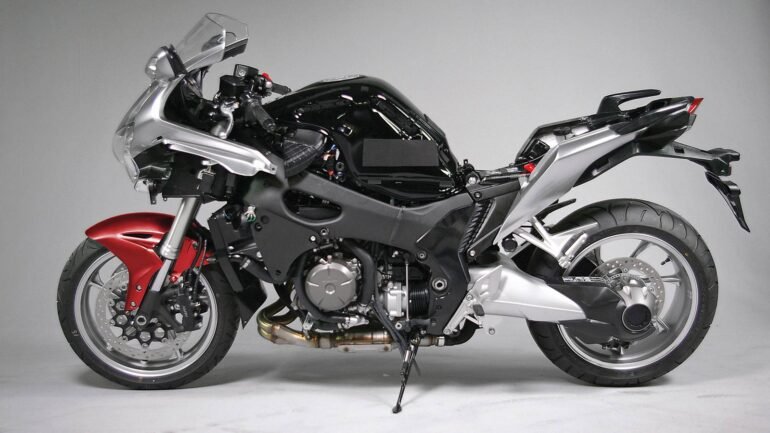
That’s not to say Honda hasn’t made production-spec V4 engines. To jog your memory, the CBR-maker had the VFR1200F in its touring bike lineup. Till that, it’s one of the wildest touring bikes, not just by Honda but also in general. We hope the new patent helps the company re-explore this idea and whip up a production V4 yet again. The VFR was ahead of its time then, but we think it has way more potential to fly off the shelves today.

If that excites you, you should also know that Honda has a supercharged V3 motorcycle incoming. Yes, you read that right; not a V4 but a V3. We know it has an electrical compressor, sits in the middleweight segment, and will debut as a streetfighter first. Interestingly, the electric blower ensures full control over how much boost you’ll get. So if you want a docile ride, you can just turn it down and enjoy a chill ride. That’s something you can’t do on traditional superchargers.