For luxury travel agencies, collecting money is surprisingly expensive.
Transaction costs — once foreign exchange fees, intermediary charges, and reconciliation time are combined — routinely run between eight and ten percent. Stablecoin transactions, by contrast, typically cost under one percent.
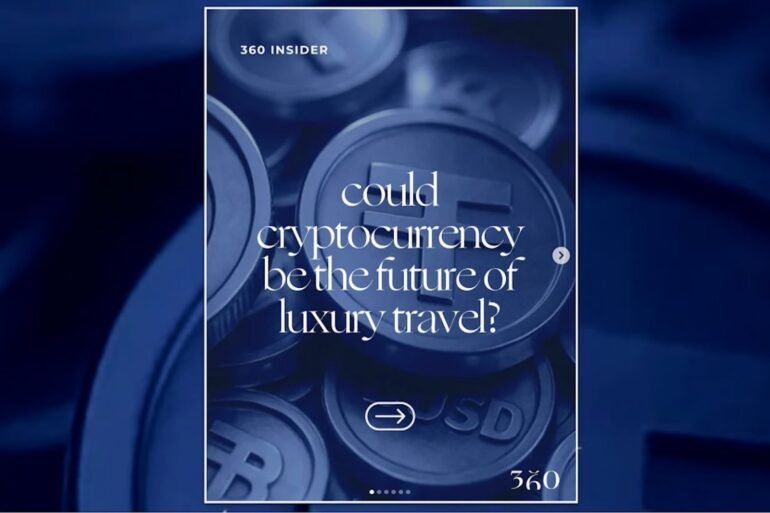
That gap is the reason behind a move that didn’t exactly make a splash when 360 Private Travel announced it would begin accepting cryptocurrency for client payments in early February.
Released on LinkedIn and Instagram over the weekend, the reaction was a couple dozen likes and barely any comment — just a short statement outlining the use of stablecoins, a brief description, and a few slides about faster, more efficient transactions. The muted response, however, may say more about the industry’s lacking familiarity with crypto announcements than about the significance of this one.
Crypto and digital currency have, after all, been hovering around the edges of luxury travel for a few years. News about its development has been sporadic at best: a hotel announcement here, a boutique agency there, and perhaps a handful of exceptional cases that have never quite caught on to inspire broader adoption across the industry.
What makes 360 Private Travel’s announcement different isn’t novelty, but a sign of a more significant shift in the thinking — as well as the appetite — of an agency to take control of its financial future.
360 Private Travel is now perhaps the largest luxury travel agency to formally integrate digital currency into its payments structure. Until now, only a small number of agencies have publicly acknowledged doing so, including Globe7, as profiled by Luxury Travel Advisor last year as part of that agency’s London debut.
In that context, 360 Private Travel’s move stands out not because it’s a first, but because it is materially larger, more global, and more deliberate about why it’s adopting crypto at all.
“We’ve seen more and more of our HNW clients asking for this over the last six to nine months,” said James Turner, CEO of 360 Private Travel, in a video interview with LTA shortly following the announcement. “We reached the conclusion that we should be doing this. It’s the right time to do it, but it has to be done correctly.”
The framing is notable since this is about client response, not branding. But one other critical distinction also sits at the center of 360’s approach.
The immediate association when anything about digital currency comes up is volatility. This, however, is not about Bitcoin or speculation. Instead, the agency is accepting stablecoins: digital currencies designed to maintain a fixed value, pegged to fiat currency — typically major ones such as the U.S. dollar or the euro.
“This is not a wildly fluctuating asset,” Turner said. “Ours is pegged to the U.S. dollar, which is the currency we deal with mostly internationally.”

(360 Private Travel)
“If we speak about stablecoin…the risk is near to zero,” confirmed Simone Urracci via email.
Urracci is a private travel designer at DreamsTeam, a high-end agency based in Milan who has been researching the potential of digital currencies for at least a couple of years.
“With ‘proper’ crypto the risk is quite high…but as we go forward, risks should decrease as well as potential upsides,” he added.
Despite resistance that still surrounds crypto in the travel industry, however justified, stablecoins are not designed to be held in the hope they appreciate. They are designed to move money quickly, predictably, and across borders, all powered by blockchain technology.
To minimize exposure even further, Turner explained that, for now, 360 converts incoming stablecoin payments into fiat currency on a daily basis. No assets are being held overnight, and the agency isn’t betting on currency fluctuations to pad its coffers. Rather, crypto is being treated as an alternative rail for cheaper and faster cross-border transfers.
Longer term, Turner does see more widespread adoption. As more suppliers begin to accept digital currency themselves, agencies could transact end-to-end in stablecoins — converting only residual balances back into fiat when needed. But that phase depends on supplier readiness and additional infrastructure. The emphasis for 360 today is on getting the foundations right for its clients.
Crypto and Foreign Exchange: Where the Real Opportunity Lies
Generally, conversations about crypto stall around its complexity. The space has its own intricate language, and it’s easy to get lost as the discussion inevitably touches on wallets, blockchains, or some other esoteric term. At its core, though, the technology is less about new money than about new financial plumbing.
Luca De Giglio, a researcher who has spent years studying digital currency adoption in the travel sector, offers a metaphor that helps distill the concept.
“Stablecoins are to payments what email was to letters,” he explained in a video interview. “Legacy payments are not internet-native. Stablecoins are. The jump in speed, efficiency, and cost reduction is significant.”
The existing payment infrastructure that underpins global travel was never designed for real-time, cross-border commerce. It relies on layers of intermediaries, cut-off times, confirmations, opaque FX rates, and reconciliation processes that remain stubbornly manual.
Those layers are not abstract — they are expensive. As LTA reported earlier this year in an investigation into commission delays and foreign exchange fees, the costs borne by the travel industry — particularly travel agencies — are significant. Once fees, charges, FX rates, time-value of delay, and time spent chasing and reconciling with intermediaries are combined, transaction costs routinely fall between eight and ten percent for agencies just to collect. In some cases, foreign exchange alone pushes that figure even higher.
By contrast, the cost of stablecoin transactions typically falls in the range of 0.5 to one percent.
“That difference is enormous,” Turner said.
For an agency doing hundreds of millions in sales annually, reducing the cost of processing by even a few percentage points has a direct impact on the bottom line. Speed matters as much as cost: Crypto also offers fewer reconciliation steps, faster settlement, transparent FX, 24/7 operation, and less time spent tracing payments or resolving discrepancies.
“In our market it would mean less cost of transaction, less time to receive commission, and a very efficient way of payment,” said Urracci. “Unfortunately, we are very far from that due to continuous change in European regulation on crypto.”
There are risks, however, especially if controls and security protocols are not in place. While the basic tools required to accept stablecoins are widely available, the guardrails are not. Fraud prevention, internal authorizations, cybersecurity, and auditability all become more critical when transactions are high value.
“We’re a luxury business and there’s a lot of attention on us. Fraud is inevitable when you’re dealing with millions of dollars,” said Turner.
360 has relied on its own technology stack to manage those challenges — building in multiple authorization layers and tightly controlled workflows. The investment required for that approach is not as easily replicated by a small, standalone agency; though, Globe7’s example suggests the boutique model isn’t without precedent.
A Global Shift, Not a Dubai Story
Geography and jurisdiction also play a role. While Dubai has emerged as a crypto hub, Turner is clear that 360’s new UAE office was not the driver of this move.
“Dubai certainly has higher demand and a lower risk threshold, but this is a broader international shift,” he said.
That broader shift is visible in other ways. Some new developments are being designed to attract digital entrepreneurs and globally mobile capital — Zanzibar’s proposed “Cyber City” being one example of how destinations themselves are beginning to position around digital finance, not just as a tourism story but as an economic infrastructure play. Money and people are moving differently, and the travel industry sits directly in the path of that change.
In contrast to Dubai, the UK remains more conservative from a regulatory and cultural standpoint, which makes implementation more complex, according to Turner. Yet the demand — particularly among globally mobile, HNW clients — is now strong enough to justify the effort.
For now, 360’s crypto capability is available for both client payments and advisor payouts. Supplier settlements are the next logical phase, and Turner estimates that meaningful supplier engagement could begin within six months once systems are ready to operate at scale.
“If it returns more value to advisors and squeezes out unnecessary costs, that’s good for the industry, for the ecosystem,” he said.
The Clearest Signal Yet
Crypto will not solve the luxury travel industry’s payment problems overnight. But 360’s move represents something more substantial than a pilot. An agency with more than 200 advisors across 60 countries claiming they made six figures in crypto payments within weeks of adoption would, if true, be a notable step forward in whether the industry can modernize how its money moves.
The travel industry’s payment infrastructure has lagged other sectors for years. For agencies willing to engage seriously with the mechanics, stablecoins may offer a way to leapfrog some of that history — not by speculating on a new asset class, but by replacing an expensive and slow one with something faster, cheaper, and already working.
The question now is whether suppliers and host agencies move quickly enough to meet them there.
Jacques Ledbetter is a Luxury Travel Advisor contributor and founder of The Luxe Ledger newsletter.
Related Stories
The Onyx Reckoning: Is the Era of Delayed Payments Over?
Op-Ed: Why AI Won’t Replace the Real Travel Pros