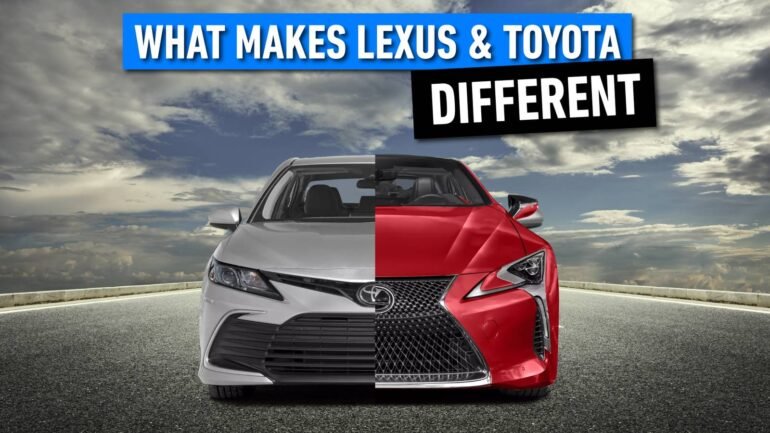
If you are looking for the best bang-for-buck vehicle brand on the market today, that title would go to long-time Japanese reliability champion, Toyota. Yet, if you care about more than sheer utility, and you want Toyota reliability in a luxurious package, what you are looking for is a Lexus.
Toyota’s luxury brand, Lexus, founded in the late 1980s, is more independent and autonomous than ever before. Yet, both brands have developed a unique symmetry over the decades and have learned to benefit each other in the long run. The complementary relationship between Lexus and Toyota has enabled the world’s largest automaker to gain a wide reach and appeal across a variety of price points and vehicle segments.
It is because the Toyota brand is such a rock-solid foundation that Lexus is encouraged to take some risks and have a bit of fun. Lexus continues pioneering innovative technology development, which eventually trickles down across Toyota’s product line as well as vice versa. Lexus’ bold and no-compromise-driven approach, along with Toyota’s “tried and true” ethos, has created what is the strongest one-two punch in the automotive industry. Let’s discuss more details about what separates the two brands and how their working relationship functions in 2024.

Toyota vs. Honda: The Lowest Ownership Costs For Their Most Popular SUVs
A surprising twist in the battle of the SUVs: which will come out on top?

To understand what separates Lexus from Toyota, no model is a more fitting example than the first Lexus ever sold in the U.S., the LS400 executive sedan. By the 1980s, Toyota, along with other Japanese brands such as Honda and Nissan, had begun finding success in the stateside market with both reliable and economical vehicles. Yet, the emergence of the luxury market, which was dominated by European juggernauts BMW and Mercedes-Benz in the 1980s, began to draw the interest of Japanese manufacturers as well.
Thus, the formation of the Japanese luxury big three, Lexus, Acura, and Infiniti, was only a matter of time. Yet, no brand was able to make as large a first impression with their first vehicle as Lexus did with the LS400. It was this big body sedan that would set the bar for what Japanese excellence could be when the cost was not an obstacle. This was a strategic angle that, at the time, was completely novel for any Japanese vehicle in the U.S.
Lexus’ Origins Explain Their Automotive Mindset

Lexus’ first-ever flagship vehicle was, by definition, a no-expenses-barred vehicle. The new brand’s first goal was only to create the best car ever made, and, whatever it cost, it was worth it. In the end, the project did cost a record one billion dollars to produce with the help of a dedicated team of thousands of engineers and automotive experts.
This development style is a key differentiation between the two brands, as there has never been a Toyota model built using this methodology. Cost-efficiency was always the primary goal of producing economical vehicles, and Toyota has turned efficiency into a science. Yet, that wasn’t what Lexus was for or what they were about.
The First Lexus Was A Legendary Statement Piece

How did a Lexus, a brand with no heritage or presence in the U.S. at the time, beat long-time luxury segment giants BMW and Mercedes-Benz at their own game on their first try? Well, first impressions are everything, and Lexus knew the LS400 had to be a success, so when we say they didn’t cut corners with the LS400, we mean that.
Every aspect that made a comparable BMW 7 Series or Mercedes S-Class great, Lexus set out to do it better. The LS400 was cheaper than both of the German competitors (a fact they despised), more comfortable, quieter, and leagues more reliable. Lexus’ customer service was second to none, and at the end of the first year of sales, the Lexus LS400 flagship sold better than any comparable model offered by BMW, Mercedes, or Jaguar. Lexus made it clear from the very start that their brand was not to be taken as a cheap imitation of German luxury, but rather, an even more refined alternative to the established norm. Their goal was to provide more value for less money than the competition, and they did exactly that. This business ethos set the tone for every future Lexus model to come after the LS400: providing the utmost luxury possible with the least amount of compromises possible.

10 Luxury SUVs That Nail The Sweet Spot Between Comfort And Performance
These premium SUVs are fast without compromising on prestige.
Lexus Redefined Luxury Ownership

The typical luxury car ownership experience before Lexus stepped on the scene was always defined by compromises. It was believed that luxurious and reliable could not be used in the same sentence. If you had the money to afford an expensive car, you should be able to afford the inevitable expensive repairs, right? Well, this is where Lexus turned the established luxury experience on its head.
Lexus believed that if you were paying a premium for a quality product, part of the luxury you are paying for is in its increased reliability. Their German and British competitors always believed that overall performance was always more important than robustness in a quality product. Yet, Lexus was convinced that consumers don’t care as much about raw performance as they believe, while factors like comfort and reliability defined the superior luxury experience. It turns out, they were right.
Lexus Takes The Crown
By the late 90s, Lexus had solidified itself as the best-selling premium import brand in America, riding on the success of their selection of sedans; the LS, ES, and GS models. By that time, everyone knew that Lexus offered higher quality vehicles than BMW or Mercedes, despite offering lower prices than their German competitors. Sure, if you wanted a sports car, the right choice was a BMW, but even then, it was clear that Lexus presented a value proposition to the majority of luxury buyers that BMW could not.
The luxury of a Mercedes and the reliability of a Toyota is what Lexus offered, and the automotive industry responded with critical acclaim to their idea. By the start of the new millennium, the American luxury market was now in Lexus’ hands, and they knew this was the perfect time to innovate the space they now controlled with a new product: the crossover SUV.
Lexus Invented The Crossover SUV Market

Lexus debuted its first-ever SUV, the LX 450, in 1996. Although popular, the LX has always been more of a niche vehicle that functioned as a large luxury cruiser with off-road capability. Yet, it was the LX line that led Lexus to understand that there was an untapped market segment waiting to be explored: a smaller up-scale SUV targeted at the suburban American, who has no need for off-roading.
In 1998, Lexus debuted the all-new RX line, the world’s first luxury crossover SUV, a vehicle that would be the trailblazer for what is today’s hottest automotive segment. The RX would set the entire automotive world ablaze with its instant acclaim, quickly encouraging copycats near and far looking to achieve the same success. By the early 2000s, the RX model had solidified itself as the best-selling Lexus model while also becoming the shining representation of Lexus’s increasing global appeal.

Every Lexus SUV Model Ranked By Reliability
Lexus is known for borrowing Toyota’s legendary reliability, and despite a perceived level of reliability across its lineup, not every model is equal.
Lexus Since Separating From Toyota

Lexus’ first decade of business was such a massive success that the luxury brand believed their autonomy was ready to move on to the next level. Thus, in 2005, Lexus officially separated from Toyota, and became its own independent brand, complete with its own design, engineering, and manufacturing infrastructure. Lexus now had more resources and freedom than ever before to create bold and innovative products, all while keeping their Toyota ethos intact. Their first plan of attack? The integration of hybrid technology in luxury vehicles.
Lexus Creates The First Luxury Hybrid
By the 2006 model year, the next chapter of the “new” Lexus would be in full swing. At the time, the new Toyota Prius had taken the world by storm, offering unprecedented fuel economy in a compact, economical package, thanks to its revolutionary hybrid technology. Lexus quickly took note of the Prius’ success and figured out how it could best take advantage of this new technology for their vehicles. Why not combine the increased fuel efficiency of the hybrid powerplant with the brand’s best-selling model, the RX crossover SUV?
Well, Lexus took this idea and ran with it, creating the first-ever luxury hybrid vehicle of any kind, the Lexus RX 400H. This combination proved to be a perfect match, providing the V-6-powered SUV with the fuel economy of a compact sedan without losing the power and smoothness of a larger engine. It seemed that, at every turn, Lexus could do no wrong and every idea was a smash hit. By 2010, Lexus’ confidence was at an all-time high, perfectly placing the brand to make its boldest move yet: creating a supercar.
Putting Performance Into The Lexus Brand

Although Lexus was the best-selling luxury car brand for a decade straight in this era, they had traditionally stayed away from the performance niche of the luxury market. They knew their bread and butter was in comfort and reliability, not creating high-strung sports cars and supercars for niche enthusiasts. Yet, that fact was not about to stop Lexus from taking on their greatest challenge yet: creating their “F” performance sub-brand and a new first-ever supercar to flex the brand’s latest initiative.
The result of this endeavor would be none other than the Lexus LFA. The LFA would mark a true full-circle moment for Lexus as it prompted them to ask the same question they did with the first-ever Lexus model, the LS400, all those years ago: “how do we create the best car ever made when cost is not an object?” The LFA and the LS400 may be completely different vehicles in intention and application, but they share the same DNA that defines any great Lexus model: the relentless pursuit of perfection.

The Incredible Story Of The Lexus LFA: The Zenith Of The Japanese ICE Age
A high-revving V10 exotic that was a decade in the making, here’s how one of the most incredible gas-powered Japanese performance cars was born
Lexus And Toyota’s Current Greatest Hits

Fast forwarding to the Lexus and Toyota of 2025, it is impressive to see the continued dominance of both brands. Yet, when you pay attention to the finer details, it is clear to see why they have both managed to see such prolonged success. Lexus has always been at least one step ahead of the competition with their innovative products and high standards for quality.
Toyota remains one of the best bang-for-buck brands, regardless of the vehicle segment, as it has been for decades. It is these two brands that are the combined force that dictates the standards for the automotive market. Let’s discuss their current most popular products and how they compare.
The Pride Of Lexus, The RX Crossover SUV

Yes, it’s true, the RX crossover SUV is the best-selling Lexus of 2024, just like it was back in the 2000s. The RX model has been the focal point of the brand for decades now and rightly so, considering it was the RX that revolutionized the current automotive landscape, now dominated by crossover SUVs. Although many of Lexus’ competitors have tried their best to imitate the recipe that made the RX successful, nobody has been able to do it quite like the original.
The 2026 RX Line is more expansive than it has ever been, now including both a plug-in hybrid model along with an F Sport Performance variant. An all-electric RX does exist, but Lexus has taken extra steps to turn this model into its own line, now known as the 2024 Lexus RZ. This decision informs us that the next-generation RX will still offer a gas-powered powertrain, allowing the RX’s success to continue regardless of what happens with the BEV variant.
The Top Toyota, The RAV4 Crossover SUV

Toyota’s best-selling model and the best-selling Japanese vehicle of the year is, hands-down, the Toyota RAV4. Why? Well, the RAV4 offers all the details that make the Lexus RX so desirable, but at a fraction of the price of the upscale Lexus. 2026 Toyota RAV4 prices start at $31,900, compared to the $51,175 starting price of the 2026 Lexus RX. This begs the question, dollar for dollar, which of these two best-sellers is a better deal for your money?
From a functional standpoint, the $44,815 2025 RAV4 Plug-in Hybrid is a true competitor to the value proposition provided by the Lexus RX. Thus, if fuel economy is a priority and interior quality and ride comfort are not a dealbreaker, you’d be hard-pressed to believe there is a better Toyota-branded SUV on the market today. The Lexus equivalent plug-in hybrid within the RX line will cost you a minimum of $66,680 for a 2026 model, and that is a lot of money for any vehicle, let alone a grocery-getter. Thus, the final call all comes down to priorities. If comfort and quality are a must, Lexus is the obvious choice. If value and price point are your driving factors, then Toyota has few competitors for the packages they offer in 2026.