Japanese brands in general have taken a cautious approach with electric vehicle (EV) development, but perhaps one of the most cautious of them all is Mazda. As an independent automaker with a much smaller research and development footprint than brands like Toyota and Honda, Mazda is more conservative in where it spends its research and development budget.
Its last EV was the MX-30, and to be brutally honest, it wasn’t a great EV at that. The range was abysmal, and being merely based on the CX-30’s platform, it wasn’t as well-packaged as what brands like Hyundai or, let alone, Tesla, were making. Thankfully, as we’ve discussed before, Mazda is now putting the hard work into fixing the shortcomings of its first EV attempt. In an interview by Autocar with Mazda CTO Ryuichi Umeshita, we take a look at the current state of Mazda’s EV development.
Current Development State

The fruits of Mazda’s EV development are set to debut a couple of years from now, but in the meantime, here’s what we know so far about what they’re currently working on.
Bespoke EV Platform

Due to the MX-30’s shared mechanicals with the CX-30, its packaging is less than optimal. The internal combustion engine (ICE)-centric platform means that it can’t feature a front trunk, since the internals for the electric motors are arranged like how Mazda would manufacture an ICE car. That’s where Mazda’s upcoming bespoke EV platform aims to fix the previous MX-30’s shortcomings. The development of Mazda’s next EV has been handed over to a new division that they announced last year called “E-Mazda”. Umeshita-san has these things to say,
“We’ve established our own electrification development team, which we call ‘E-Mazda’, and that team has been doing a great job.”

Umeshita-san also acknowledges how Mazda is currently lagging when it comes to EVs, but he says that thanks to their experience with the MX-30, the brand has a lot of good engineers, experienced engineers already. He also says they aren’t necessarily behind the market because of that. Now, whether the next-generation Mazda EV will be a high- or low-volume model has not yet been finalized. That’s because it will heavily depend on the market and upcoming regulations. Umeshita-san says, “It depends on the market and the regulations. If the regulation requires [a higher EV mix], it must be a volume car. If the regulation is eased, then we can ease the volume restraints.”
Mazda Sportiness For The EV Era

Mazda is a brand that has built an identity surrounding its sporty driving dynamics, and thankfully, we can expect that level of driving finesse with their upcoming EVs. After all, with an EV’s low center of gravity due to its batteries, they serve as a great starting point for creating vehicles with great handling. Umeshita-san has already driven one of the brand’s early prototypes, and he was eager to share what it feels like to drive.

“I’ve driven a prototype car already, which I would say is a real ‘jinba ittai’ car—our key concept of wellness between car and driver. It has very good driving dynamics. So we’re confident that our EV products will be real Mazda products.”
– Ryuichi Umeshita, Mazda CTO
Mazda’s Current Electrified Mix

While we wait for Mazda’s upcoming EV on a bespoke EV platform, we take a look at the brand’s current portfolio of electrified vehicles, which, at present, is not as diverse as that of some other brands. At the same time, their current EV portfolio isn’t fully self-developed by Mazda itself.
Self-Developed Plug-In Hybrids

Without the MX-30, its current electrified mix includes a quartet of plug-in hybrid electric vehicles (PHEVs)—the CX-60, CX-70, CX-80, and CX-90. These SUVs are based on the brand’s premium Large Product Group architecture, featuring a rear-wheel drive (RWD)-biased layout with a goal to elevate the driving experience. All four of these SUVs utilize the same plug-in hybrid system, consisting of Mazda’s familiar 2.5-liter Skyactiv-G four-cylinder and an electric motor sandwiched between the engine and the eight-speed multi-plate clutch automatic.

Unfortunately, the plug-in hybrid drivetrain used for this platform has received mixed to negative reviews. The 3.3-liter turbo mild-hybrid straight-six is better, and it’s also something I can attest to. The 2.5-liter plug-in hybrid, as powerful as it is with its 323-horsepower system output, has been known to feel rough when it transitions and mixes the electric motor and the gasoline engine.
Co-Developed Hybrids And EVs

But when Mazda collaborates with other automakers, the results are often a better-executed vehicle. When it comes to normal (non-plug-in) hybrids, the CX-50 Hybrid may be a Mazda in design and (mostly) its driving feel, but the hybrid system is from the outgoing Toyota RAV4 Hybrid. The resulting CX-50 Hybrid combines Mazda’s best in design, premium feel, and sportiness, along with Toyota’s hybrid expertise—even if it doesn’t result in the sportiest throttle feel.

As for its EVs, the recently globalized Mazda 6e, also known as the EZ-6, as well as the EZ-60, are EVs that ride on a bespoke EV platform. Unfortunately, these aren’t pure Mazda models, as these are riding on Changan’s EPA1 platform that’s also being used in the Chinese automaker’s Deepal-branded EVs. It’s Mazda’s way of speeding up its EV rollout in the EV-aggressive Chinese market in order to maintain its market share in a market that’s favoring EVs at a rate that’s only second to Norway. Volume-wise, however, China by far dominates the world’s EV sales volumes.
Mazda’s Slow But Sure Push

With Mazda being an independent and small automaker, at least relative to giants like Toyota or Volkswagen, the Hiroshima-based automaker is being careful with where it puts all of its research and development budget. As such, their slow but sure push is also affecting the rollout of some of its most ambitious models.
Iconic SP Put In Limbo

Unfortunately, this limited budget is affecting the development of the Iconic SP, which was shown as a beautifully styled rotary-powered concept at the 2023 Japan Mobility Show. This was confirmed by Autocar’s extended interview with Umeshita-san, who said that putting the technology into production was possible. Last year, the company said that only a business case was the missing ingredient to produce the Iconic SP. Now, its second challenge is Mazda allocating its resources to this new EV that’s riding on a bespoke EV platform. Umeshita says, “Technology-wise, I believe it’s possible. The only outstanding issue is financial.”
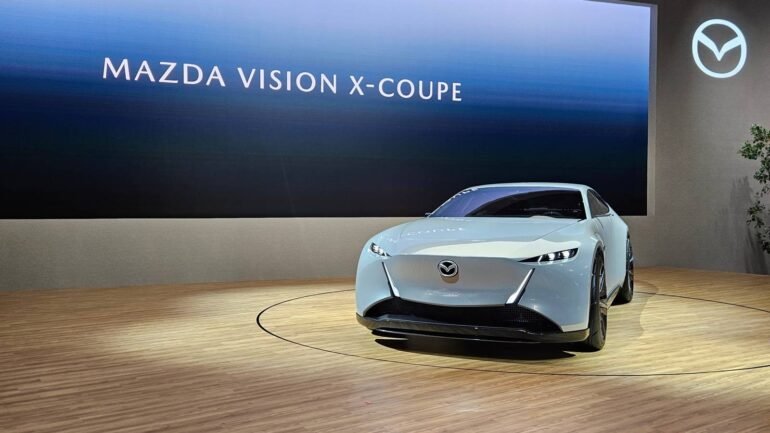
Mazda’s rotary ambitions for the carbon-neutral era are still being put into hope with the recently unveiled Vision-X Coupe. The fastback rotary plug-in hybrid vehicle features a rotary engine that can run on algae-based fuel, plus Mazda is also developing carbon capture technology that’s directly mounted at its exhaust.
Cautious On Full EV Commitment

Mazda, as a brand, said two years ago that they are an “intentional follower” in the EV era. This is especially crucial as they navigate an EV world where sales growth is fragmented across the world. There are a few major reasons for this. One, EV sales in the United States have plateaued, especially with the current President backtracking on almost every incentive and investment that the country has made in the EV industry. Second, its ICE cars are still selling well—or at least they did by the end of 2024. Now, as of the end of October 2025, Mazda’s sales have begun to slide, all the while profits are sliding due to Mazda having to absorb some of the brunt of Trump’s tariffs.
More than ever, the company needs a volume-selling model that’s locally manufactured in the United States as a way to dodge tariffs. Right now, the CX-50 is its only American-made model, meaning that Mazda is one of those brands that has suffered the most from Trump’s tariffs. The upcoming next-generation CX-5 is set to get a hybrid system, but that isn’t coming out in 2027. Here’s to hoping that the next-generation CX-5 will also see American manufacturing, too.
Sources: Autocar