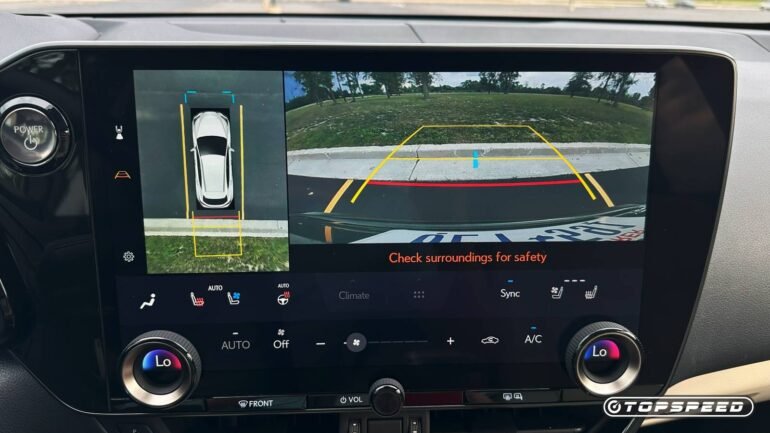
Guess what? Ford, Toyota, Lexus, and Subaru aren’t alone with their backup camera woes. Throughout this year, brands as varied as Polestar, Alfa Romeo, Dodge, and Hyundai haveall issued recalls for backup camera faults.
Let’s back up (#dadjokefail!), however, to explain what’s going on. And to explain that, in all seriousness, the ubiquitous implementation of rear-facing cameras only came about due to horrible tragedies. After their kids were struck or killed by reversing cars, hundreds of surviving family members lobbied Congress in the early 2000s to demand that rear-facing cameras become required by law. In typical congressional fashion, despite this law becoming effective in 2008, it took until 2019 for all cars sold in the country to be equipped with rear-facing cameras.
And FYI, the technology wasn’t rare by then; Toyota first had a rear-facing camera on the Crown in 1987, and Infiniti became known for rear-facing cameras and around-view cameras in the early 2000s. As for why we’re seeing so many recalls now, I asked a variety of analysts to explain what’s going on, and there isn’t a simple answer. But here’s a bit of what they had to say—and why we’re unlikely to see an end to these recalls at least until there’s a major step change in how cars are manufactured.

Ford Just Issued Five More Recalls
A wide range of models and model years are affected by these safety actions.
Ford’s Most Recent Backup Camera Headache

In some instances, such as Ford’s recent recall of larger F Series F-250, F-350, and F-450 pickups, the cameras were programmed incorrectly. Essentially, they were given a uniform light meter reading, despite Ford fixing cameras in a 360-degree range around the vehicles. That’s bad. Just imagine backing out of your garage on an early morning. Your garage is lit—while the space behind the truck is still dark, because the sun has yet to rise. A single light meter reading shared by four cameras isn’t going to tell each camera the proper exposure. So a stitched view would have some images properly exposed, some blown out, and some totally black.
Why the software was misprogrammed, we don’t know, and NHTSA’s recall doesn’t explain. But it can be remedied through a software update at your Ford dealer. Ford’s expected to issue the recall notice this coming spring, but if you own a 2020-22 F-Series truck, and you’ve seen this issue, it can’t hurt to ping your dealer.
Same But Different

This isn’t the same glitch that plagued more than 1.1 million Ford and Lincoln cars in June, or the subsequent recall that impacted a mere 200,000 Fords. Combined, those recalls affect Fords sold both before and after the F-Series recall, but the issue is different. For those cars, the challenge is that the camera images are freezing or not showing at all. Ford’s solution is similar; they need to update the software on these myriad models, ranging from the Bronco Sport to the Maverick.
A Failure Contagion

Toyota’s headaches sound more complex, but in essence, they’re identical. Toyota/Lexus have had to recall 1,024,407 vehicles, across all the models below, manufactured between 2022 and 2026, because the software that controls the Panoramic View Monitor system (a fancy term for the cameras on these models) could have a software glitch. Triggering the problem requires a cascade of events that, essentially, entail the owner starting their cars and immediately putting them into reverse and hitting the gas within very quick succession.
All aspects of that sequence can then, sometimes, cause the Lexus and Toyota cameras to display a frozen image. A distinct sequence of inputs can also send a code to the software so which will screw up the backup camera signal after the next stop and start you perform.
Like Ford, Toyota will issue a recall to patch the software, but if you own one of the below-listed cars, you could also reach out to your dealer.
| Toyota | Lexus |
| Camry | ES |
| Crown | GS |
| Crown Signia | LC |
| Grand Highlander | LS |
| Highlander | LX |
| Land Cruiser | NX |
| Mirai | RX |
| Prius | RZ |
| Prius Prime | TX |
| RAV4 | |
| RAV4 Prime | |
| Sienna | |
| Venza | |
| bZ4X |
FYI, Subarus Aren’t Spared Either

Toyota, Subaru, and Lexus share the Solterra, bZ4X and RZ platform, so these are also impacted.

Yet Another Vehicle Recalled For Problematic Reversing Cameras
It turns out Ford isn’t the only car company facing backup camera issues.
What’s Behind The Problem?

Robby DeGraff, an analyst at AutoPacfic, blamed the problem on over-complexity, with carmakers layering more and more views onto what had been a simple reverse-camera image. DeGraff says that auotmakers seldom get dinged by consumers for their vehicles failing to run, because overall quality has improved tremendously. But he says that carmakers do get black marks for tech failures. And he says the backup camera foibles provide an unfortunately useful example of over-complexity. “[Camera technology] is mostly for the better because we end up getting more comprehensive vantage points, but then we’ve also graduated from just a simple single lens to a system with multiple cameras and sensors.” DeGraff worries that all that complexity bakes in the likelihood of failure.
“It’s really kind of mind-boggling that such a critical yet basic safety feature has become overly engineered and now riddled with issues.”
– Robby DeGraff, Manager, Product and Consumer Insights, AutoPacific
Environmental Factors

Sam Fiorani, a VP with a different analyst firm, Global Vehicle Forecasting, says we take for granted that our home security cameras, thermostats, TVs, smart speakers, and phone cameras seem to glitch out less frequently. But he gives some slack to carmakers because your whip is exposed to everything from epic rainstorms to road grime and chemicals, to massive swings in humidity and temperature.
He adds that you’re used to the added few seconds of your phone or laptop’s boot-up, but “…cars and trucks are expected to be ready as soon as the start button is pushed or the key turned in the ignition.” Fiorani then layers in another facet of daily automotive use we don’t tend to think about, either, especially when it comes to reversing cameras:
“Normal vehicle operation also includes the slamming of trunks and tailgates where electronic hardware, such as rear-view cameras, will be treated to sudden impacts and still be expected to work every time.”
– Sam Fiorani, VP, Global Vehicle Forecasting
Random Coincidences—Not A Conspiracy

David Whiston, a senior auto analyst at Morningstar, said he doesn’t think there’s some industry-wide failure going on with either the hardware or software of backup cameras. He said that only Magna, the supplier to Ford of the cameras used on their F-Series trucks, has even mentioned the issue, but in his mind, the recurrence for Toyota and other brands is more coincidental.
“I have not heard anything systemic about camera flaws from anyone. I can’t say if the problems are traceable to one Tier II or III firm or a mass quality issue or anything like that.”
– David Whiston, Senior Autos Analyst, Morningstar Research
Eventually, Simplification Could Be The Answer

What will break the endless drip of recalls? Simpler cars. Fiorani says that what automakers call “software-defined vehicles,” or SDVs, should provide a more streamlined build than what happens today. Because currently carmakers are really dealing with a legacy process. Fiorani says that since the 1970s, carmakers have just been layering on more components with their own digital and mechanical interfaces, from a heated and cooled seat you operate through a touchscreen, to an infotainment system that streams audio bounced from satellites or through cell signals, and each adds another layer of complexity.
The Fix

Currently, carmakers rely on a combination of CPUs and separate electronic control units (ECUs). The latter are smaller, sub-computers that might only handle, say, climate control. But Mercedes, for example, is debuting new vehicles on its MMA platform—first the CLA and soon, the forthcoming GLB—that use what the carmaker is calling Mercedes-Benz O.S. or just MB.OS, that unifies the technological redundancies within their cars.
Rivian will provide a similar, unified offering for all Volkswagen Group cars fairly shortly. One huge advantage for SDVs will be rolling software updates, very much like what your phone does now, constantly repairing faults and enabling increased capabilities. That latter component is something carmakers want, both to sell you more options, and to enhance features such as advanced safety.
TopSpeed’s Take

Cars are too expensive. So now we’re keeping them longer—12 years on average. So while the SDV solution sounds good, right now, we’re stuck with the rust buckets we have. And Fiorani believes that the quality of modern cars is in fact superior to at any time in history. “Parts suppliers are extremely good at what they do and continually develop better and better components. Thousands of lines of operating code and the rugged physical parts work flawlessly in nearly all situations,” he says. However, he also notes that even small errors that wouldn’t cause, say, your garden hose to be recalled, matter so much more in a moving vehicle. So we have to live with recalls, he says. And by the way, they’re certainly better than a regulatory structure that didn’t acknowledge these hazards or repair our cars, almost always at no extra cost.
“For obvious reasons, a one-percent error across millions of driven miles will be an issue. It’s crucial to the safety of the vehicles and occupants, even when the issue seems to be minor.”
– Sam Fiorani, VP, Global Vehicle Forecasting