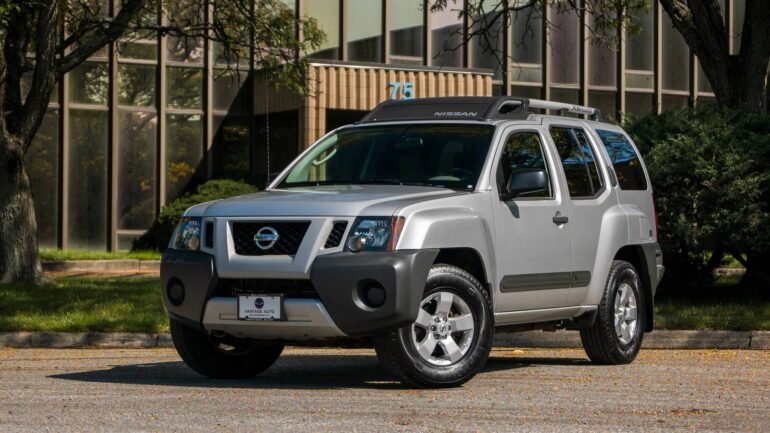
The Nissan Xterra last saw the light of day in 2015, and since then, the Japanese automaker has been lacking a body-on-frame SUV that slots below the Armada. The Xterra was a compact body-on-frame SUV, which gave it a unique selling proposition since its closest rival (albeit somewhat indirectly due to their size difference), the Toyota 4Runner, is a larger midsize body-on-frame offering.
However, Nissan Americas Chairman, Christian Meunier, reportedly confirmed that the Xterra may see the light of day once again in 2028. The motivation for bringing back the Xterra is due to softening demand for EVs, as this body-on-frame SUV is reportedly going to be a hybrid. It’s the perfect recipe to satisfy America’s insatiable demand for a body-on-frame off-roader with family-friendly qualities, as seen in the Toyota 4Runner’s success.
However, 2028 is still a few years away, and even if Nissan executives have confirmed it is coming, a lot of things could still happen in the next two years. Ever since news broke out about the Xterra’s return, there has been renewed interest in this SUV. If you’re one of those people who suddenly realized the value of the Xterra, the used car lot is your best friend. How significant was the Xterra for Nissan in America, and what do you need to know about used examples if you’re interested in owning one?
To provide the most accurate and up-to-date information, this article uses data sourced from various manufacturers and authoritative sources.
What The Xterra Stood For

The Xterra debuted in 1999 for the 2000 model year, as Nissan saw the appeal for a rugged SUV that was oriented to those who wanted a no-frills off-roader that would match their outdoorsy lifestyle. According to Jerry Hirshberg, then-President of Nissan Design International (NDI), the “impetus for Xterra designers was to create an affordable, rugged, quality piece of equipment.”
Everything You Need, Nothing You Don’t

This was the marketing tagline for the Nissan Xterra, and it was clearly shown by the way the car looked. Elegance and poise were clearly thrown out the window. The first-generation model truly embodied this design brief. In fact, Hirshberg at the time also remarked that the Xterra was designed to look better if it was dirty than when it was clean. Functionality was clearly at the top of the Xterra’s priorities, and that was evident all over the vehicle. The exterior was simple, while the interior was all-out utilitarian and filled with hard-wearing but far-from-premium materials.
When a mid-cycle facelift was introduced in 2002, the style quotient was taken up a notch. In my opinion, this was the peak design of the Xterra, and had a truly handsome look whilst still retaining its adventure-ready nature. By this time, Nissan had also upgraded the Xterra’s creature comforts somewhat by adding a 300-watt Rockford Fosgate sound system. It also received an upgrade to its powertrain, wherein the main highlight is the new 3.3-liter supercharged V-6 from the Frontier, pumping out 210 horsepower (which was good enough for the time).
The Xterra Begins Hitting Its Stride

The Nissan Xterra truly hit its stride when the second-generation model debuted in 2005. That’s because the Xterra started to broaden its appeal by giving it a modern design, whilst still maintaining the rugged, no-frills nature of the outgoing model. Clean lines and more color options helped increase its appeal, while a more modern but still rugged interior also made it a more family-friendly option. Nissan, however, added more luxuries to the Xterra as time went by. When it got a mid-cycle facelift in 2009, higher trims now got optional leather upholstery, automatic climate control, a Rockford Fosgate sound system, and a choice of either a 4.3- or 5.8-inch NissanConnect infotainment system.
The biggest highlight of the second-generation Xterra was its mechanicals. It adopted the F-Alpha platform of the Nissan Titan and Armada, while its engine got even larger. The four-cylinder and 3.3-liter V-6 were discontinued in favor of a mighty 4.0-liter V-6 that produced 261 horsepower. A choice of a five-speed automatic or a six-speed manual was available; a Dana 44 differential came as standard in the manual and Pro-4X models. The Pro-4X was your go-to variant if you wanted the best of the best in off-roading capability, as it came with an electronic rear locking differential, as well as hill start assist/descent control in the automatic; manual models received a clutch interlock bypass switch.
The Xterra Lives On, Sort Of

Unfortunately, the Xterra was discontinued in 2015. Nissan cited declining sales, stricter emissions rules, and poor fuel economy, among other reasons, for ending the model. Elsewhere, however, the Xterra lives on in the Middle East and Southeast Asia, but not necessarily as a direct successor.
The Rugged SUV Is Now Reborn As The Terra

The Xterra shared similar mechanicals with the Frontier. In parallel with this design philosophy, the Navara also spawned an SUV called the Terra, which was seen as a spiritual and indirect successor to the Xterra in markets outside North America that received this model. The Nissan Terra first came out in 2018, and it was the brand’s answer to the likes of the Toyota Fortuner and Ford Everest. However, with these models being a more mainstream body-on-frame SUV, the Terra added a few tricks up its sleeve. It now comes with the Nissan Intelligent Mobility safety suite, a proper infotainment system, and a durable 2.3-liter twin-turbo or 2.5-liter turbo diesel engine.
A Familiar Name With A Few New Tricks

However, in Southeast Asia, competition in this space is fierce. The Terra was originally intended to be released before 2018, but Nissan paused development between 2014 and 2015 due to indecision about how to position the SUV in the region relative to the similarly-priced X-Trail crossover SUV. As such, it came out in 2018 with competitors that were already more advanced, and thus, a lower price was mostly its unique selling proposition.
Thankfully, a mid-cycle facelift in 2021 significantly improved the Terra’s positioning in the region’s highly popular body-on-frame midsize SUV segment. I was fortunate enough to have a press car of both the older and current Terra, and the mid-cycle facelift was actually very pronounced. Thicker sound insulation and double-glazed windows were added, the hydraulic steering became lighter, and the interior was overhauled to be more premium, while the tech got a significant glow-up, too. There was even a Bose sound system on higher trims. Though the Terra may not be directly succeeding the Xterra, its development philosophy was largely similar—albeit with the need to feel more luxurious and mainstream, since in Southeast Asia and the Middle East, body-on-frame SUVs are a default family vehicle for many.
What To Know About A Used Xterra

Now, if you want to scratch that Xterra itch and can’t wait for the new one to arrive (which isn’t even guaranteed considering the possible challenges that could happen in two years), a used Xterra might be worth a look.
Look Out For The Following Issues

YouTube channel Z1 Off-Road recently purchased a used second-generation Nissan Xterra, and the channel has a handy walkthrough on what to check before buying a used one. Some of the things they noted you should check for range from minor ones like a scraped skid plate (an inevitability considering most previous owners would have driven it off-road), a clogged axle breather, which is supposed to release pressure from the pressure buildup as you drive, or something more serious like axle seal leaks or rust on the frame. Some of the common problems include differential seal buildup, which is only something you should take note of, rather than even worry about.
Average Price And Reliability Rating

Actually, this is pretty much it, and that’s a testament to the reliability of the Nissan Xterra. It’s a mechanically sound vehicle that’s extremely robust. iSeeCars has determined that the Xterra has an average lifespan of 140,633 miles or about 10 years, and a 13.7 percent chance of reaching at least 200,000 miles. The second-generation model also has a higher reliability rating than the already reliable first-generation model.
Lastly, if you’ve reached this far into the article, then you’re probably dead set on getting a used Xterra. Spanning two generations over 15 years, the price of a used Xterra highly varies, but on average, iSeeCars determines that the Xterra has an average used price of $9,864. 2015 was the final model year of the Xterra, and if this model year is what you’re looking for, then you’ll have to shell out $14,161 on average. For reference, a base 2015 Nissan Xterra 4×2 S started at $25,760 without taking into account the 10 years of inflation difference.