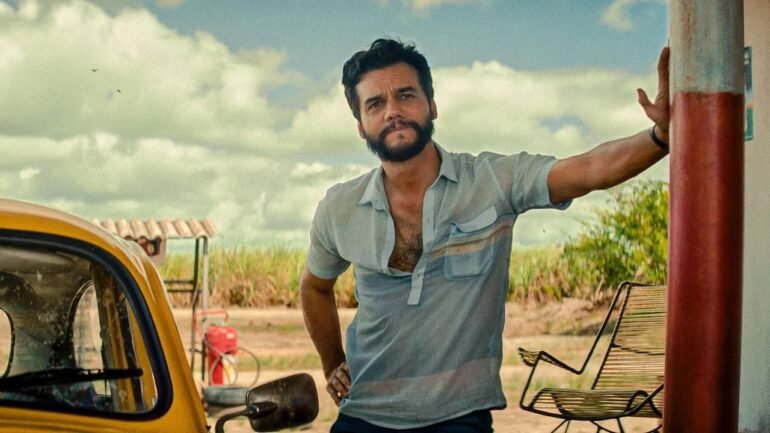
On Location peels back the curtain on some of your favorite films, television shows, and more. This time, we take a look at The Secret Agent.
If you only saw a few sun-streaked stills from Kleber Mendonça Filho’s new film “Secret Agent”, set largely in the Northeastern Brazilian city of Recife—during a confetti-covered week of Carnival, in 1977 no less—it might seem like a charming opportunity for escapism. In reality, the political thriller follows a man desperately plotting his own escape from the threats of Brazil’s two-decades-long military dictatorship, the tentacles of which have wrapped themselves around every element of daily life. Here, the joyous and the boisterous contrast the dark and insidious, allowing viewers to both be delighted by colorful street scenes and celebrations while the rot of fear creeps in, as the details surrounding our main character (Wagner Moura) and his predicament are revealed.
For Mendonça, the film was a chance to return to his hometown of Recife, and paint a portrait of a city full of contrasts, using everything from historic movie theaters to popular waterfront parks in the sultry hours after sunset to tell a story that has already garnered four Oscar nods. To get a sense of how Mendonça time-traveled through Brazil past and present, while drawing on references very close to home, we hopped on the phone with the director himself. Below, he walked us through the very real places that shaped the film and its unmistakable visual identity.

First things first: Was the film shot entirely on location in Recife, Brazil?
We shot 90% in Recife, which is where I come from, and so I know the city very well. It’s a strong character for a film. I even wrote the scenes to be shot very specifically in locations that I know by heart.
We also traveled to Brasilia, and we did two days in São Paulo because I wanted the locations to be very specific. Of course in cinema, you can always shoot in some back street and call it São Paulo, but I really wanted to show the difference in the style of the three cities, even if they only appeared briefly in the film.
And then when Armando talks to his lawyer in Brasilia, I wanted to actually have a moment where the lawyer goes downstairs and finds a payphone, and you can tell that it’s Brasilia because of the architecture. We found a wonderful location right at what they call the commercial sector in Brasilia, which was mostly built in the late ‘60s and early ’70s. And there was a very particular shot with the postman, who’s bringing the telegram, and that was very specifically Brasilia.