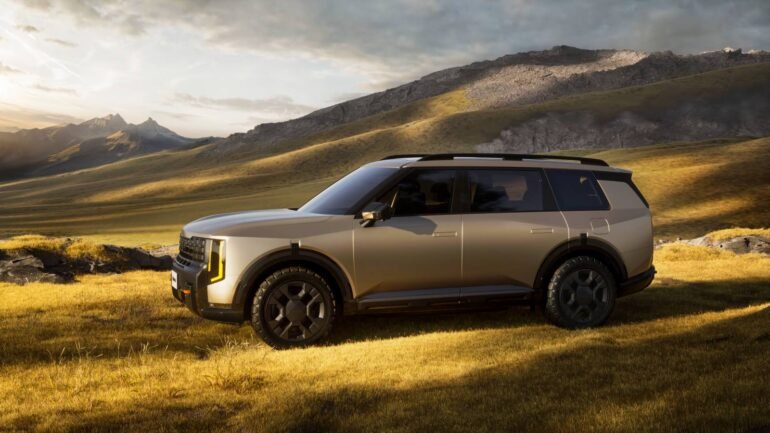
There’s a lot we don’t know about the forthcoming 2027 Kia Telluride. What we do know is that the next Telluride will be more chiseled looking, while still retaining its familiar design. Kia isn’t dumb. What they’ve just revealed ahead of the full balloons-and-champagne launch of the Telluride in a few weeks at the L.A. Auto Show says as much. Just look at these images to see the “Telluride-ness” shining through. Though, to be clear, this is a very real update.
Way back in April, when I asked Tom Kearns, a VP and senior chief designer at Kia, about the future Telluride, he made it very clear that the carmaker knew the SUV was the vehicle that put Kia on the map. In carmaker-speak, it plays “a grade above” its price tier. Kia achieved that in at least a few ways, but one was clearly riffing off some fundamental SUV traits honed by makes like Land Rover, while still making the Telluride its own brand.
Here’s what we know so far about what Telluride 2.0 will bring, based on both what Kia has revealed to date and by reading the tea leaves of where the Telluride needs to go.
It’s Roomier

If the Hyundai Palisade did any trailblazing on behalf of Kia, it was in stretching the platform that both the Palisade and Telluride share. Each is made on the same Alabama assembly line. The Palisade grew by 2.5 inches, and the wheelbase was stretched by 2.7 inches. The Telluride will grow 2.3 inches longer, and its wheelbase grows by three inches. You can bet that, dimensionally, the new Telluride and new Palisade will be within a few tenths of an inch of the same size.
That will result in a roomier cabin for the Telluride, and I expect Kia will add a sliding second row to the Telluride that the Palisade offers on some (but not all) of its trims.
Better Engine Choices

The current Telluride gets mediocre (combined 22 FWD/20 AWD) fuel economy from its 3.8-liter V-6. I’m pretty certain Kia will switch over to the Palisade’s smaller 3.5-liter V-6, in part to gain at least somewhat better fuel efficiency. In the Palisade it yields 287 horsepower and 260 pound-feet of torque.
Maybe, You’ll Want the Hybrid?

In my review of the 2026 Palisade, my one niggle with an otherwise stellar package was that the V-6’s peak torque doesn’t arrive until 5,000 RPM, and I’ll be curious to see whether Kia tweaks their execution and engine mapping differently. Mind you, the Palisade still moves well, and I think only a nit-picking auto journalist is going to beef about this V-6. But it might be preferable to instead go for the same, 2.5-liter turbocharged four-cylinder hybrid with a total system output of 329 horsepower and 339 foot-pounds of torque that’s just dropped for the Palisade. That’s a better setup, mostly because its low-end muscle is going to make the Telluride feel quicker. And, of course, because Hyundai’s predicted combined fuel economy of up to 34 MPG rivals the 36 combined MPG of what Toyota gets in the Grand Highlander.
X-Pro Grade Gets Brawnier

I recently wrote about why more carmakers—from Subaru to Honda—are adding an off-road-“ish” grade of muscularity to their family haulers. At the New York Auto Show, John Buckingham, who heads up exterior design at Kia, put his finger on at least the “look” that buyers want to see.
“We are enjoying a time of ruggedness and capability. After COVID, people’s enthusiasm for going out, going camping, adventuring, increased. And we’ve only seen that adventuring spirit increasing. They want the cars to reflect that lifestyle.” —John Buckingham, VP Head of Exterior Design, Kia North America
Kia will go farther than where X-Pro sits currently. Expect the X-Pro grade to continue with 18-inch wheels and chunkier rubber. But now ground clearance climbs from 8.4 to 9.1 inches. I’d be shocked if the e-differential in Hyundai’s XRT PRO doesn’t also come to the Telluride X-Pro, too. FYI, I’m dead certain Kia will have benchmarked XRT Pro’s ride and handling for on- and off-road, too, because it’s excellent at both. Yes, Kia and Hyundai share assembly and parts, but they’re actually rivals, pushing each other, so that neither brand starts to mimic the other.
Physical Switchgear

Kia’s revamped the digs of the Telluride, going for what looks like a mix of chunkier hardware “jewelry” and a single digital panel stretching from the instrumentation to the infotainment screen. But note in this close-up that there are physical rockers to adjust climate functions, plus one central knurled roller for audio volume. In its release, Kia emphasized the meatiness of the cabin build, which you can see in the use of open-pore wood panels across the dash, and metallic vent controls and trim. (Yes, they’re made of actual metal, according to Kia.)
Sticking to Fundamentals
Kia’s Tom Kearns told me that with Telluride, they didn’t want to screw up what was already working. But they also wanted to advance the qualitative feel, with a sheen of extra refinement, and you can see that in the tauter body and cleaner cabin, which looks a bit less cluttered (above I’ve inserted the 2027 dash vs. the outgoing Telluride dash). This is similar to what you’re seeing on the Ford Expedition that launched this year, too, where there’s a definite push upscale. The Telluride already busted that ceiling when it debuted in 2019, but now it has peers, especially on interior quality, from the likes of Ford and Hyundai.
TopSpeed’s Take

Right now, the 2025 Kia Telluride starts at $36,390. Figure that bumps up a little bit, but not too much, and you have Kia’s ironclad recipe for success with the 2027 Telluride. We still don’t know prices, of course, or on-sale date. The latter (since they’re calling this a 2027 model) probably kicks to at least late springtime of 2026. Is this already a shoo-in for 2026 SUV of the year accolades? We don’t have a betting line here at TopSpeed, but I wouldn’t bet against it!