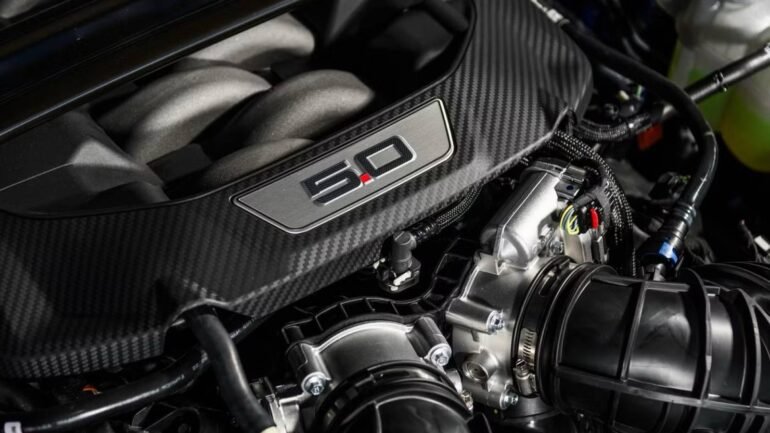
With most American car brands phasing out their V-8 powertrains in favor of smaller turbocharged units and electrified drivetrains, Ford has remained loyal to the V-8 powertrain. The Blue Oval has fully embraced electrification with its Mustang Mach-E and F-150 Lightning, alongside the e-Transit, but that hasn’t affected its ICE catalog, including the Mustang sports car and its 5.0-liter V-8 Coyote unit.
Thanks to a simple but potent design, the Coyote has proven itself to be a reliable engine, which is why the brand has been keeping it around since its introduction 15 years ago. Granted, it is an engine that requires hands-on attention to stay resilient, but in doing so, you can expect it to last well beyond 200,000 miles.
The Birth Of The Coyote V-8

Ford began development of its Coyote V-8 project in the late 2000s for the upcoming-generation Mustang and F-150 model lines. The goal for the engine was to optimize the balance of performance and efficiency, developed under the project Cammer codename. Ford commissioned the engineers to focus on integrating advanced technologies to improve power, reliability, and emissions.

The first iteration of the Coyote adopts an all-aluminum block and heads to reduce weight. It features dual overhead camshafts with independent variable cam timing on both intake and exhaust, which allows for improved torque delivery across a broad RPM range while maintaining fuel efficiency.

Ford also incorporates a deep-skirt block design to enhance structural rigidity and reduce vibration, as well as high-flow cylinder heads with optimized port geometry for better breathing at high engine speeds. From its inception, Ford kept the displacement locked at 5.0 liters, as it declared this to provide the best balance of performance aspirations without resulting in packaging constraints for both its pony car and truck. The design also emphasizes robustness to handle modern fuel standards and increased power outputs.
The Coyote-Powered Mustang Hit The Road With Fury

The first Mustang with the Coyote V-8 applied produced 412 horsepower and 390 pound-feet of torque, setting a benchmark for naturally aspirated V-8s at the time. This model combines a proven modular architecture with modern electronics, including an intuitive engine management system that executes precise fuel and ignition control and advanced knock sensing. This versatility meant that Ford could fit the engine to multiple platform designs with varying power outputs, including higher-performance variants specifically developed by the likes of Roush and Shelby. The Coyote’s development reflected a focus on durability, serviceability, and aftermarket potential. These are key factors that contribute to it being a cornerstone of Ford’s V-8 strategy and a modern example of combining traditional small-block performance with contemporary engineering solutions.

12 Things You Should Know About The Ford Coyote Mustang Engine
We look back at one of Ford’s most legendary engine nameplates, its significance, and how it has evolved over the generations.
How 2026 Sets A New Standard For The Coyote

The 2026 Ford 5.0‑liter Coyote V‑8 builds on decades of evolution but retains its core architecture. This includes its 90‑degree naturally aspirated V‑8 configuration, built with an all‑aluminum block-and-head construction with dual overhead camshafts, four valves per cylinder, and twin independent variable camshaft timing. The goal of these inclusions is to improve torque responsiveness across the rev range.

Blocks found in 2026 models benefit from modern casting techniques, including plasma‑transferred wire‑arc liner coating intended to lower mass and improve heat dissipation efficiency and cylinder wall integrity. Experts see this as the most important update over the cast‑iron liners applied to earlier models. Engineers gave it a forged steel crankshaft and powdered‑metal connecting rods to handle higher RPM loads.

These engines also include a deep‑skirted crankcase design plus four‑bolt main bearing caps for improved bottom‑end stiffness and oil‑control stability. Cylinder heads feature high‑flow ports and chrome‑filled hollow valves, with larger intake valves and exhausts in later versions, for the sake of improving breathing for both low‑end torque and high‑RPM power.

Piston‑cooling jets spray oil under load to manage thermal stress. In doing so, the 2026 Mustang produces 480 horsepower at 7,150 RPM and 418 pound-feet at 4,900 RPM. Fuel delivery has evolved to a dual‑injection system combining direct and port injection for improved efficiency and cleaner combustion chamber surfaces. Coil‑on‑plug ignition and an electronically controlled throttle ensure precise ignition and airflow.
The Coyote Was Designed To Keep Prowling

The goal intended for executing these improvements is for the sake of better balancing high-performance outputs with reliability and efficiency. Proper maintenance that you should be conducting to keep the engine robust includes routine oil changes, periodic intake cleaning to keep oil consumption and carbon buildup in check. The robust internal components and conservative naturally aspirated layout make the Coyote relatively immune to boost‑related stress, giving it a reputation for long life and consistent performance under daily driving or spirited use, making it a benchmark for modern naturally aspirated V8s.

Mustang GT 0-60: Is It fast Enough To Beat Its Rivals?
The C8 Corvette, Toyota GR Supra, Chevy Camaro, and more challenge the Mustang in the sports coupe arena. Here’s how the GT holds up.
The Coyote’s Dominance On Track

Ford’s Coyote V-8 has become a cornerstone of Ford Performance’s modern motorsport efforts, and in recent years, the marque has deployed it in top-level GT racing with substantial success. The latest example of this is the Ford Mustang GT3, which features a specialized 5.4‑liter application of the Coyote V‑8, specifically prepared by Ford Performance and Multimatic Motorsports, who have been a long-time partner of the American brand’s racing division for the sake of meeting GT3 regulations.

The world first got to see the Mustang GT3 make an official competitive appearance at the 2024 24 Hours of Daytona. This was a big deal for Ford, as it marked the return of Mustang to top‑flight international endurance racing for the first time in decades. One year after this, the GT3 had already delivered concrete results. On track against some considerable rivals. The Number 64 Mustang GT3 took a class victory in the IMSA WeatherTech GTD PRO race at Detroit’s Motor City Grand Prix after qualifying on pole, adding to its earlier win at Daytona and helping cement Ford’s resurgence on track.

Across its global program, the Mustang GT3 and its grassroots sibling, Ford Mustang GT4, have accumulated more than 30 wins worldwide and scored full‑season championships. This performance underscores the Coyote’s adaptability and competitiveness across a broad spectrum of racing formats. The most recent of these is a very successful stint at the 2025 WEC Lone Star Le Mans, which took place at the Circuit of the Americas two months ago.
A True All-Rounder, On And Off The Track

Ford chose to keep the Coyote naturally aspirated in the GT3 program, as opposed to adopting turbochargers. The brand says that its reason for relying on pure air is for better durability and simplicity. If there are fewer moving parts, the drivetrain will be subject to lower thermal loads and easier maintenance, which is an ideal configuration for endurance racing. That is the reliable reputation that fans of the Coyote appreciate, especially when subjected to street and drag builds. The Coyote’s compact dimensions and modular architecture also mean that it can better integrate into race‑car chassis without compromising balance or weight distribution.

Dyno Test Reveals How Much Power The Gen-4 Coyote Engine Really Makes
Unleashing a new era of power, here’s how the 5.0-liter Coyote Gen 4 engine from Ford stands at the forefront of automotive innovation.
Ford Isn’t Getting Rid Of The Coyote

The Ford Coyote V‑8 has secured its place as a core engine in Ford’s performance and mainstream lineup due to its modularity, reliability, and adaptability. Ford shows no signs of abandoning it, even as electrification reshapes powertrain strategies. As mentioned, we’ve seen several brands start to phase their V-8 powertrains out, but Ford insists that engines like the Coyote remain a cornerstone of modern automotive catalogs.
The engine is smooth, flexible, and builds power monumentally. It also delivers tremendous low-end torque.
– Lyndon Conrad Bell, TopSpeed Journalist

The Coyote’s all-aluminum architecture, dual overhead cams with independent variable timing, and robust bottom end make it lightweight and efficient enough to make it compatible with possible future hybrid systems without sacrificing durability or high-RPM performance. Ford has already begun exploring mild-hybrid and full-hybrid integrations in high-performance contexts, using the Coyote as a platform to combine traditional V‑8 torque with electric assistance, improving both low-end responsiveness and fuel economy while maintaining the naturally aspirated character enthusiasts demand.

Examples of such hybridization include a conventional compact and high-output electric motor and an integrated battery system within the transmission housing or between the engine and crank. Opting for this configuration enables torque fill at low speeds and regenerative braking without compromising the engine’s longevity. The Coyote’s proven thermal management and precision fuel and ignition control systems also simplify hybrid integration compared with older cast-iron blocks. Ford has also leveraged the Coyote in research and development for next-generation performance hybrids, using data from Mustang, F-150, and even Bronco applications to refine cooling, lubrication, and packaging for combined V‑8 and electric outputs of up to 800 horsepower in performance applications.
Sources: Edmunds, MotorTrend, Car and Driver, RepairPal, and Kelley Blue Book.