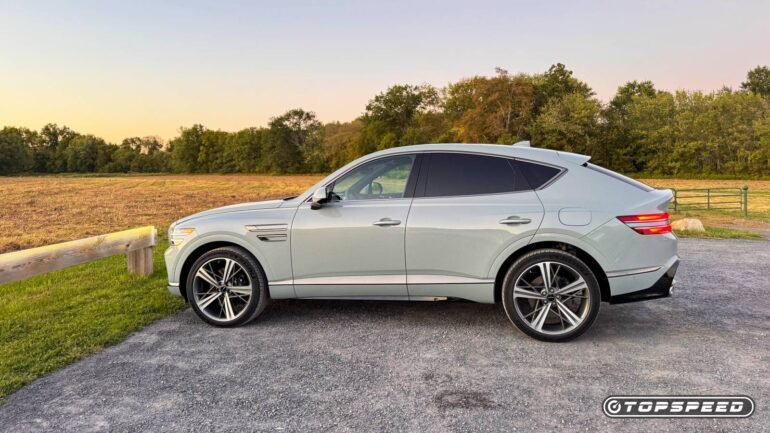
I’ve just spent a few days driving the fast, powerful Genesis GV80 Coupe. This is the slope-backed version of the squared-off GV80. It’s not cheap, starting at $81,850, but its rivals, like the Porsche Cayenne and BMW X6, are equally expensive—if not even pricier. My colleague, William Clavey, recently argued that the GV80 Coupe isn’t up to snuff versus those options from Germany. That’s legit. It’s not, because it’s very clearly not meant to beat the Germans at what they do best. Rather, the GV80 is meant to out-deluxe the digs of a Volvo XC90 and be faster. It slays at both tasks.


- Base Trim Engine
-
3.5L Twin-Turbo V6
- Base Trim Transmission
-
8-speed automatic
- Base Trim Drivetrain
-
All-Wheel Drive
- Base Trim Horsepower
-
375 hp
- Base Trim Torque
-
391 lb-ft
- Fuel Economy
-
20/24 MPG
- Make
-
Genesis
- Model
-
GV80 Coupe
- Segment
-
Midsize Luxury SUV
Meanwhile, clearly, the GV80 points a sword at Lexus, too. Arguably, the GV80 Coupe’s cabin is at least as sweet as the interiors of both the GX 550 and the LX 600. Plus, if this Genesis trails the handling of Germans like a Mercedes GLE, the GV80 surpasses the agility of heavier models like the GX. You know what we have here? A legit luxury crossover that isn’t pretending (like Range Rover) that you have any intentions of going off-road. Likewise, it isn’t pretending, like BMW, that you have an Autobahn in your backyard. Here’s why I think the GV80 Coupe recipe is at least 70 percent on the right track.
To provide the most accurate and up-to-date information, this article uses data sourced from various manufacturers and authoritative sources, as well as our experts’ own experiences.
Let’s Talk Crossover Coupes And Why They’re Niche

Mr. Clavey is 100 percent correct. Crossover coupes are weird. And in the case of the BMW X6, weird to look at, too. But you know why they exist, right? Because carmakers—especially ones like Genesis, and for that matter, Mercedes—survive and thrive on SUVs, not cars. And buyers can do the math. In the table below, I’ve included a $77,000 BMW M3 to prove how much more car you get for about the same money as alternatives.
The SUVs aren’t nearly as much fun. Nope. They’re relatively soul-less, too. And buyers don’t care. This is like arguing about going for the super charming studio apartment in the pre-war building versus the soulless two-bedroom with a Jacuzzi tub and modern HVAC. It’s no contest.
Genesis GV80 Coupe Passenger And Cargo Volume VS. Rivals
| Model | Genesis GV80 Coupe | BMW X6 | Lexus GX 550 | BMW M3 |
| Headroom (front / second row; inches) | 40.2 / 37.6 | 39.3 / 37.5 | 39.4 / 43.1 | 40.6 / 37.8 |
| Shoulder Room (front / second row; inches) | 60.6 / 57.8 | 60 / 57.7 | 59.5 / 57.2 | 56 / 54.6 |
| Legroom (front / second row; inches) | 41.6 / 38.7 | 40.4 / 35.7 | 41.2 / 36.7 | 41.6 / 35.6 |
| Cargo (seats up/folded; cu. ft.) | 30.2 / 62.1 | 27.4 / 59.6 | 40.2 / 76.9 | 13 / n/a |
This Isn’t About Third-Row Availability

Those stats stack up pretty closely. Sure, you can get a GX 550 with a third row. Go get the standard GV80, not the Coupe, if that’s what you fancy. But note that Lexus doesn’t offer a coupe-like GX, and that’s one reason the headroom in the box-like Lexus’s second row is excellent, especially when compared to the BMW. But the second row of the Genesis has much better legroom than either the X6 or the GX 550.

And wow, look! The BMW X6 barely has better second-row legroom than coach class in a BMW M3! Now, let’s not kid ourselves. X6 buyers don’t care about the second row that much. But they do buy an X6 for relatively civilized manners compared to a taut M3, and the X6’s greatly superior cargo hauling.
That’s the exact point of coupe-like SUVs. They’re sporty “enough,” and also versatile “enough” to be family-friendly transport. And what the Genesis is offering is better second-row legroom than the X6, and even versus the considerably larger GX 550.
The Powertrain Is Innovative And Quick!

You know what’s wrong with turbochargers? They drink gasoline relatively heavily, and they take a heartbeat—or three—to deliver propulsion. Genesis’s way around this (on the GV80 Coupe’s top two trims) is what they’re calling an e-supercharger. This is a clever workaround. Rather than a mechanical supercharger, which works somewhat like a turbocharger but also creates gas-sucking drag, the e-supercharger provides secondary forced induction at lower engine RPM, when turbos struggle to spool air quickly.

Genesis’s workaround is to use the car’s start-stop, 48-volt mild-hybrid power to force-feed air to the compressor, rather than rely on exhaust gases to spool the turbos. Once the turbochargers reach a higher RPM, the e-supercharger is no longer needed and is taken out of the mix.
The GV80 GOES Like You Wouldn’t Expect

You can jump to 60 miles per hour in 5.2 seconds. That’s not Porsche Cayenne quick, which, in base trim, runs about the same $87,000 price, and Car and Driver says it can do that deed in 4.7 seconds. How much do you value 0.5 seconds? Meanwhile, the GV80 Coupe’s retort is more about real-world situations. That’s not chasing a quarter-mile record. It’s jumping from 20 to 40 MPH to pass an RV. Or bombing from 45 to 65 MPH to merge onto a busy Interstate. Here, it excels, and does so without exhaust bellowing or violent, operatic faux-engine noises piped through the sound system.
The GV80 accelerates like a locomotive, surging forward on a wave of glorious boost. The 30-50 and 50-70 mph runs felt plenty quick and made for easy overtakes.
– Niel Stender, HotCar Editor-at-Large
Likewise, when the road bends, it’s capable enough, if not downright sporty. I’ve now driven the GV80 Coupe versus the Lexus LX 700 through the same corners, and the GV80 Coupe offers more poise and steering feedback. Genesis’s German rivals will snap you through an auto-cross set of cones with whiplashing alacrity. The Genesis is quieter and more relaxed than that, which is its clear remit.
Tech That Works, Something Often Absent From Modern Design

There are essentially three display fields you’re staring at in this cockpit. First, there’s a 27-inch OLED that pans from the driver’s instrument cluster to beyond the center of the dash. But that’s not what Genesis is nailing so well. In fact, as their German rivals go with more and more tech and panoramic capability, they’re also ditching physical controls.

Sorry, I don’t like that. Instead, Genesis is layering the physical with the digital. Like Lexus is doing with their GX, Genesis is including climate functions directly incorporated into the center screen. But here they go further, giving the driver a third display below the center panel that nests both climate and audio functions. And Genesis includes both a volume and a tuning knob. Nutty that I should need to write this, but radios work just fine with physical controls! Of course, you still get plenty of niceties, including:
- Premium leather seating
- Ventilated rear seats
- Digital rearview mirror
- Power-adjustable second-row seating
- Soft-close doors
- Loads of driver aids
Another Reason For The Crossover Coupe

You know what? You can tow with the GV80 Coupe. Here’s how it stacks up versus the X6 and the GX 550.
2025 Genesis GV80 Coupe Towing VS. Rivlas
|
Genesis GV80 Coupe |
BMW X6 |
Lexus GX 550 |
|
|
Maximum Towing |
6,000 Pounds |
7,200 Pounds |
9,063 Pounds |
Here, the Genesis is clearly trailing the competition. The reality is that a 6,000-pound rating is reasonable enough to tow a smaller car, and you could certainly tow a small boat, a pair of side-by-sides, or the random U-Haul for moving your kid into their college dorm. You’re not doing that with a sports coupe. So customers are buying a rig like the GV80 Coupe because of that added versatility.
What’s Clearly Missing From The Equation

Genesis has two levers that they don’t pull here. The first is what will surely come to their Magma lineup, which, if you haven’t been reading voraciously, may have slipped past your radar. Magma is meant to be a rival to BMW’s M division and Mercedes’ AMG cars. The image above is of the X Gran Equator concept, which dropped at the New York Auto Show this past spring.
At the time, Genesis explained that they wanted to stretch Genesis both in performance and toward off-roading capability, too. The X Gran Equator shows Genesis aiming directly at Range Rover and Mercedes’ G-Wagen. Or at least versions of the Lexus lineup that get more 4×4’ing gear, such as the GX 550+ Overtrail.
It’s No Supercar SUV, Though Its Value Rivals The Germans

The other element missing is ultra-high-end performance. You can get a $129,700 BMW X6M with 627 horsepower. That’s way more power than the GV80. For just a hair less ($127,000), Porsche will sell you a twin-turbocharged V-8 Cayenne with 493 horsepower. But if you just look at a price-parity comparison, the GV80 Coupe is holding its own, even if you get the base V-6—though the e-supercharger version isn’t that much more costly.
Genesis GV80 Coupe Performance Specifications VS. BMW X6
|
Model |
Genesis GV80 Coupe; $81,850-$89,400 |
BMW X6 xDrive40i; $76,275 |
|
Powertrain |
3.5-Liter Twin-Turbo V-6 |
3.0-Liter Inline-6 |
|
Horsepower |
375 @ 5,800 RPM / 409 @ 5,800 RPM |
375 @ 5,200 RPM |
|
Torque |
391 @ 1,300 RPM / 405 @ 1,300 RPM |
398 @ 1,850 RPM |
TopSpeed’s Take: The GV80 Coupe Isn’t Pretending To Be, It Just Is
The Genesis GV80 Coupe is very good at being very luxurious, very fast, and very poised. It is not a Porsche Cayenne, or an outlandishly fast Audi SQ8. If you’re shopping for the Genesis, you know that you’re not looking for sizzle as much as serenity. Like you would from Lexus—if Lexus sold a car like this. Since they don’t, nor do Acura or Infiniti, Genesis is very happy to offer you what you want. Which is why they get the win in my book. Even if I agree that coupe SUVs are an acquired taste.