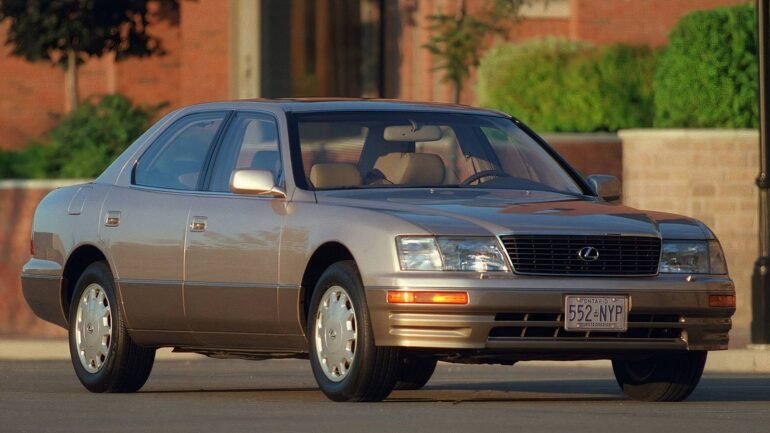
Lexus has enjoyed a long reputation of being a faithfully reliable luxury car brand in the U.S. market, primarily because of how it leverages its parent company’s highly resilient drivetrain technologies. Thanks to this, you can expect these cars to cover hundreds of thousands of miles before you encounter any major mechanical faults, provided you conduct the appropriate maintenance as per the brand’s allocated intervals.

Available Models
Lexus
- Founded
-
1989
- Founder
-
Eiji Toyoda, Toyota
- Headquarters
-
Nagoya, Japan
- Owned By
-
Toyota Motor Corporation
- Current CEO
-
Takashi Watanabe (President)
The Lexus LS 400, owned by Matt Farah, has always been the highest mileage model from the brand on record, having racked up well over 1,000,000 miles. This is an incredible feat for a luxury sedan that is highly unlikely to be beaten by modern models, making it a truly unique case. The Lexus LS has never been able to take the luxury sedan crown from the Mercedes-Benz S-Class, but it definitely has the Germans beat when it comes to dependability.
The Legendary Million-Mile LS

Back in February, 2019, Matt Farah revealed that his trusty and beat-up 1996 Lexus LS 400 had finally surpassed the 1,000,000-mile threshold on the odometer. This model’s digital odometer is limited to six characters and locks in place once it reaches 999,999 miles, so there’s no real way for us to know how many miles it is on as of today.
As a result, Farah really hasn’t issued any updates regarding this car, but it remains a figure that any Lexus across the world is yet to beat. The journey to this figure wasn’t an easy one, as he got the help of over 100 other drivers to take the car around the U.S. His journey started in 2014, when he purchased the LS with an already impressive 897,000 miles for just $1,500.
How Farah Got The LS To 1,000,000 Miles

While the Lexus LS 400’s 1UZ-FE 4.0-liter V-8 is known to be an impressively reliable drivetrain, Farah had to spend over $17,000 on repairs and upkeep over the course of four years to keep the LS on the road. Obviously, this is substantially more than what the car would be worth, but this task goes beyond financial responsibility. Luxury sedans typically depreciate to the depths that they do, because they are typically more expensive to maintain.
Common repairs consisted of rebuilding the transmission three times and fixing leaks from seals and gaskets. Farah also had to apply for a commercial insurance policy to cover the multiple drivers, which cost him up to $4,500 every year. During this time, the Lexus LS enjoyed a rather fulfilling life, including its participation in MotorTrend‘s figure-eight test, clocking in some laps at Miller Motorsports Park, and acting as the pace car for a Lemons race. The Petersen Automotive Museum even put it on display during one of its exhibitions.

The 2026 Lexus LS Heritage Edition Is A $99K Farewell To A Legend
This send-off trim will be the last since the launch of the LS in 1989.
Impressive Performance And Reliability Returns

The facelifted XF20 1996 Lexus LS 400 features an all-aluminum construction 4.0-liter 1UZ-FE V-8, featuring a DOHC layout with 32 valves and multipoint fuel injection. The unit produces 264 horsepower at 5,400 RPM and 270 pound-feet of torque at 4,600 RPM.
This drives the rear wheels via a four-speed automatic Aisin Warner A341E transmission, featuring an overdrive fourth gear, torque-converter lockup and electronic control. In terms of performance, the brand claims the system hits 0 to 60 MPH in around 7.0 seconds, with a 155-MPH top speed, but real-world tests indicate it to only be capable of an 8.5-second run.
Not The Most Frugal Sedan By Modern Standards

On the efficiency front, the LS 400 doesn’t perform all too badly on the EPA’s testing cycle, considering it is an older V-8. The agency estimates that it will consume 17/24/19 MPG on the city/highway/combined cycle, resulting in you spending $7,750 more on fuel compared to the average new vehicle. This translates to you spending $3,150 on fuel every year and $5.24 to drive 25 miles.

The Lexus LS600 Is Used Hybrid Sedan Under $20,000 That Makes More Sense Than Anything New
This remarkable luxury hybrid sedan is one of today’s best buys, putting many current vehicles to shame with its elegance, performance and efficiency.
How To Get Your LS To 1,000,000 Miles

If you want to get a first-generation Lexus LS and cover 1,000,000 miles on your own, it will be possible, but not without some financial investment. According to Edmunds, an LS 400 in outstanding condition currently sits at around $3,000, but we see clean models with less than 75,000 miles on the clock going for just under $17,000, as these are slowly evolving into collectors’ items. The second-generation model, which is mechanically similar, sells for way less than $10,000, even in good condition.

According to RepairPal, some of the common repairs that you’d have to conduct include brake pad replacements for $508, air pump replacements for $2,454, axle shaft seal replacement for $768, and a heater control valve replacement for $699. Kelley Blue Book indicates that the 1996 LS range will cost you about $551 to maintain every year, but this can increase to $1,200, depending on the interval. A timing belt replacement must take place every 90,000 miles, which will cost about $900.
Common issues for the LS include power steering pump leaks, an ECU capacitor leakage, oil leaks, and poorly functioning ignition components due to a weak fuel pump or failing ignition coils.
How The Lexus LS Made Its Mark In The U.S.

Lexus kicked off its luxury push in 1989 with the first-generation LS 400, and the car immediately set the tone for the brand by showing how well Toyota could build a refined sedan that undercut European rivals while beating them in build quality and cabin quietness. Engineers spent years developing the LS 400, and the brand used it as the foundation for its entire U.S. launch strategy with a clear focus on smoothness, precision, and customer service.

The LS 400 arrived with a strong value message and a level of finish that surprised shoppers who expected a newcomer to fall short of German benchmarks. Early reviews praised its refinement, ride comfort, and V-8 smoothness, and buyers reacted quickly because the sedan delivered a luxury experience that matched the established players yet cost far less to own. Sales climbed fast through the early nineties because the LS 400 established a reputation for strong reliability and trouble-free long-distance comfort. The model helped Lexus build trust among first-time luxury buyers, and it gave the brand enough volume to expand into more segments. By the mid-nineties, the LS 400 kept a solid presence in the US market and supported Lexus’ growth into a leading luxury name.

Why the Third-Generation Lexus LS 430 is the Best Budget Luxury Sedan
The third-generation Lexus LS 430 is the best used budget sedan
The Million-Mile Lexus CT200h

The aforementioned LS isn’t the only Lexus to crest the 999,999-mile mark. A 2014 Lexus CT200h achieved the same result over roughly ten years, while still running on its original Toyota Prius-based hybrid architecture consisting of a 1.8-liter four-cylinder engine paired with a direct-drive eCVT and electric motor drive system.
Like the LS, this model did require some maintenance, including one hybrid battery replacement, two new sets of head gaskets, a new water pump, thermostat, front-left wheel bearing, oil-filter housing, and dampers. These don’t include the repair and replacement of common wear items like tires and brakes, which typically require periodic attention.

Owners of other high-mileage CT200h examples report that these models can coast past 200,000 miles without experiencing any noteworthy faults, often needing only regular oil changes, hybrid coolant service, and light mechanical work. iSeeCars indicates that this HEV hatchback is able to benefit from an average lifespan of 170,400 miles or 15 years, resulting in it achieving an 8.1/10 reliability score. J.D. Power awards the final 2017 model year a 76/100 consumer-verified overall score, which includes 73/100 for the driving experience, and 78/100 for resale.
Sources: MotorTrend, Edmunds, EPA, iSeeCars, and J.D. Power