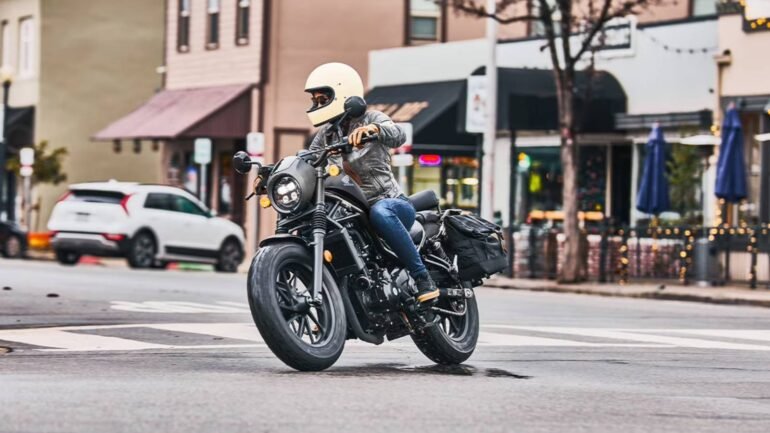
The word ‘cruiser’ brings to mind a lazy, torque-rich V-twin, acres of chrome, and loud pipes. Add some customization for bonus imagination points. However, customers today want more convenience as well. Cruisers make for great first bikes because of their low seat height and steady handling. This has given rise to the modern cruiser. For the most part, they have switched to parallel twin engines to reduce cost, complexity, and weight. Their chassis is no different from a street bike or sports bike. And riding them is like riding any modern motorcycle, except for reduced suspension travel and the low seat height.
This is the formula that Honda has taken for its modern cruiser range, and with it has come the formula for the most fuel economy as well. This isn’t just the Honda cruiser with the best fuel economy in 2025, this is one of the most fuel-efficient cruisers you can find on the market today!
To give you the most up-to-date and accurate information possible, the data used to compile this article was sourced from authoritative sources such as Honda Powersports.
The Rebel 300 Is The Honda Cruiser With The Best Fuel Economy In 2025
Fuel Economy: 78 MPG

The Rebel series of cruisers is one of two different cruiser formats that Honda has on sale today, the other being the Shadow series. The Fury is a standalone model with a driveline more in line with the Shadow series. The Rebels are more modern cruisers, with frames that use the engine as a stressed member, and with a parallel twin engine configuration that they share with other Hondas in different formats – street bikes, sport bikes, and even adventure bikes.
However, the most fuel efficient one is the smallest one, and it isn’t difficult to see why. The Rebel 300 is powered by a single cylinder engine, which offers all the benefits like light weight that a thumper is packaged with. This means that the Rebel 300 offers a staggering 78 MPG, which is a figure only a few motorcycles can beat, and no other Honda cruiser can.
Honda Rebel 300 Engine

The Rebel 300 is powered by the same single cylinder engine that powers the CB300R, CBR300R, CRF300L, and CRF300L Rally. Honda’s habit of sharing parts and engine tunes across models means that the 286 cc liquid-cooled thumper is very sturdy and can put up with a lot of abuse. It has a similar tune across these models, with the CBR300R sports bike understandably getting a 30 horsepower tune. The adventure and cruiser bikes get a slightly lower 27 horsepower output, which means that it is great for fuel economy.
Liquid Cooling And DOHC Make The Engine Modern

The case for good fuel economy is furthered by a six speed gearbox equipped with a slipper clutch. The Rebel 300 has liquid cooling and a DOHC head with four valves, but that’s as far as the tech goes: the throttle is operated by cables, so there is no traction control, quickshifter, or ride modes. You do get the E-clutch system as standard for MY26, but we’re focusing on the MY25 bike here.
Honda Rebel 300 Chassis

The entire Rebel series of cruisers has a number of common things about the chassis parts. The frame is a tubular steel setup that uses the engine as a stressed member, like a modern motorcycle. Its suspension consists of regular telescopic forks at the front, and twin rear shocks to attain a low seat height. You have two-step preload adjustment for the rear.
There’s No ABS On The Baby Rebel

The brakes are simple as well, a 296 mm front disc with a two-piston floating caliper, and a 240 mm rear disc with a single piston caliper. Honda has discontinued the ABS trim of the Rebel 300 now. Aluminum alloy wheels with 16 inches inch diameter are present at both ends, and Honda has also used aluminum for the subframe.
Honda Rebel 300 Dimensions
|
Fuel Tank Capacity |
3.0 gallons |
|
Length/Width/Height |
86.2/NA/42.9 inches |
|
Wheelbase |
58.6 inches |
|
Rake |
28 degrees |
|
Trail |
4.3 inches |
|
Seat Height |
27.2 inches |
|
Ground Clearance |
NA inches |
|
Curb Weight |
364 pounds (ready to ride) |
Honda Rebel 300 Features

None of Honda’s cruisers have flashy features, and it is the same with the Rebel 300. A circular reverse LCD instrument cluster displays basic information like speed, fuel level, clock, gear indicator, and an odometer and twin trip meters. The warning lamps are traditional LEDs below the LCD unit. As a cruiser, you don’t really need any more information than that, although it would have been nice.
A Few Simple Accessories Allow Personalization

The pillion seat is an optional extra, and costs $155. There isn’t an SE model for the Rebel 300, but just like the others, there are a few parts like the fork boots and headlamp cowl that are available individually, and should make it look more like an SE model. The official accessories catalog also has a 12V socket, custom seat (that looks like an SE part), adjustable brake lever, tank pads, and luggage and luggage mounting options.
Honda Rebel 300 Competition

The beginner cruiser segment is massive, and there is a surprising variety of models available. However, we’ll have to discard quite a few of them when we’re considering fuel economy, because anything with two cylinders will never have as much efficiency as something with a single cylinder in this segment. The thirstiest ones will be the ones with the V-twin engines, like the Benda Chinchilla 300 ($4,899), and QJ Motor SRV300 ($4,999).
V-twin engines are generally heavier than even parallel twins, which leads to them requiring heavier components like a chassis and suspension, all of which are bad for fuel economy. The V-Star 250 doesn’t make as much power as the others, and it is carbureted, meaning lower fuel consumption despite the engine layout. In the same vein, we’ll have to discard the CFMoto CL-C 450 ($5,799) because it has 50 percent more displacement, and a parallel twin engine.

That leaves us with only one realistic option: the Royal Enfield Meteor 350. This is a simple air-cooled thumper, and has one of the largest tank ranges in the business as well. Ride it sensibly, and it is capable of going further on each gallon than the Rebel 300, which is quite a feat considering it has only a 5 speed gearbox, air-cooled engine, and weighs significantly more than the Honda! It is also important to note that of the three models below, only the Royal Enfield currently offers ABS.
Honda Rebel 300 Vs Rivals
|
Honda Rebel 300 |
Royal Enfield Meteor 350 |
Yamaha V-Star 250 |
|
|
Fuel Economy |
78 MPG |
84.3 MPG |
78 MPG |
|
Price |
$4,849 |
$4,899 |
$4,799 |
|
Engine |
Single cylinder, liquid cooled, DOHC, 4 valves/cyl |
Single cylinder, air cooled, SOHC, 4 valves/cyl |
60 degree V-twin, air-cooled, SOHC, 2 valves/cyl |
|
Displacement |
286 cc |
349 cc |
249 cc |
|
Fuel Delivery |
Fuel injection |
Fuel injection |
Carburetion |
|
Power |
27 HP @ 8,500 RPM |
20 HP @ 6,100 RPM |
21 HP @ 8,000 RPM |
|
Torque |
19.6 LB-FT @ 6,500 RPM |
19.9 LB-FT @ 4,000 RPM |
15.2 LB-FT @ 6,000 RPM |
|
Gearbox |
6 speed, slipper clutch |
5 speed |
5 speed |
|
Curb Weight |
364 LBs (wet) |
421 LBs (wet) |
324 LBs (wet) |