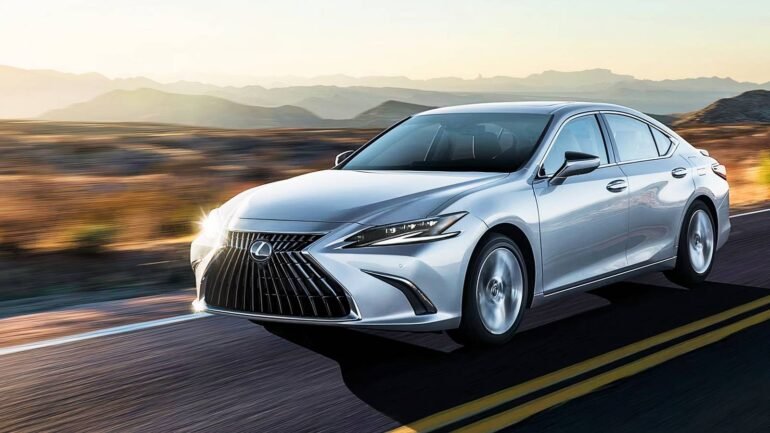
Luxury cars will always be a niche proposition across the global market, but there will always be some demand for these types of products. Demand for premium experiences in personal mobility is becoming an increasingly important factor with each generation of cars, which is why we are seeing traditionally budget cars evolve into more premium products. The Lexus ES is an example of a luxury car that has always prioritized reliability without compromise.
The soon-to-be-replaced current-generation 2025 Lexus ES is an example of a luxury car that benefits from impressively low maintenance costs that even outscore the likes of the Toyota Tacoma. This is especially true when considering the 300h hybrid variant. Lexus is able to achieve this by building it on the TNGA platform, while leveraging Toyota’s impressive new generation of powertrains.
How Much You’ll Spend To Maintain The ES 300h

According to the Edmunds True Cost To Own calculator, you can expect a base-level Lexus ES 300h to cost you $5,849 on maintenance, $1,087 on repairs, and $8,401 on fuel. By comparison, the Tacoma will cost you $6,250 to maintain over the same period. The ICE ES costs about $500 more to maintain over the same period. You can also expect to lose $15,176 of the ES’s initial purchase price after three years and $21,107 after five years and 60,000 miles. $8,894 of this loss occurs after the first year of ownership.

According to CarEdge, you can expect to spend $1,975 on the 300h’s maintenance and repairs over five years and 60,000 miles. You can also expect the very same model to lose 44 percent of its value over three years while covering 12,000 miles a year, resulting in a $24,769 sale price. By 10 years, it’ll be worth about $13,770, reflecting a 30.86-percent residual value.
Lexus ES True-Cost-To-Own Estimates
|
Year 1 |
Year 2 |
Year 3 |
Year 4 |
Year 5 |
Total |
|
|---|---|---|---|---|---|---|
|
Insurance |
$1,711 |
$1,771 |
$1,833 |
$1,897 |
$1,963 |
$9,175 |
|
Maintenance |
$236 |
$924 |
$525 |
$1,476 |
$2,688 |
$5,849 |
|
Repairs |
$0 |
$0 |
$0 |
$429 |
$658 |
$1,087 |
|
Taxes & Fees |
$4,584 |
$319 |
$298 |
$280 |
$261 |
$5,742 |
|
Financing |
$3,140 |
$2,534 |
$1,882 |
$1,181 |
$429 |
$9,166 |
|
Depreciation |
$9,264 |
$3,234 |
$2,645 |
$2,964 |
$2,590 |
$20,697 |
|
Fuel |
$1,582 |
$1,630 |
$1,679 |
$1,729 |
$1,781 |
$8,401 |
|
True Cost to Own |
$20,517 |
$10,412 |
$8,862 |
$9,956 |
$10,370 |
$60,117 |
iSeeCars backs this with an 8.7/10 overall score, which includes 8.6/10 for reliability, 7.6/10 for retained value, and 10/10 for safety. The publication indicates that you can expect the model to lose 30.3 percent or $13,151 of its value over three years, resulting in a $30,289 residual value figure.

Its reliability assessment also indicates that it benefits from an average lifespan of 15.9 years and should cover 174,223 miles without any major mechanical faults. Its probability of reaching 200,000 miles is 32.7 percent if you typically drive 10,362 miles every year. J.D. Power awards it an 82/100 consumer-verified overall rating, which includes 88/100 for quality and reliability, 73/100 for the driving experience, and 74/100 for resale, alongside an 87/100 rating for the dealership experience.

Why This 5-Year-Old Hybrid Beats Most Brand-New Cars In Reliability
If you’re looking for a reliable used hybrid car today, this Japanese sedan is one of your best bets.
The ES 300h’s Highly Appointed Interior

The 2025 Lexus ES 300h is one of the best HEV cars you can buy for less than what you would spend on an average new car today. The premium American-based Japanese brand kicks pricing off at $44,835 for the entry-level trim. Despite being a base model, it comes equipped with all the comfort and convenience features you’ll need, including dual-zone climate control, electrically adjustable front seats with heating, and perforated NuLuxe interior upholstery. You also get the eight-inch touchscreen infotainment system connected to the brand’s in-house-developed 10-speaker premium audio system. It also features wireless Android Auto and Apple CarPlay.

The $50,005 Luxury is admittedly more expensive than the average new vehicle in the U.S., but you get the added benefit of additional adjustments for the driver’s seat, quilted and perforated semi-aniline leather upholstery, front seat heating and ventilation, wood trimmings, ambient lighting, an electronically adjustable rear sunshade, a wireless smartphone charger, and a heated multifunction steering wheel with wood and leather trimmings.

The Ultra Luxury is the most expensive model in the range, with a $53,725 starting price , but this includes every available feature as standard, such as rear door sun shades, a 10.2-inch heads-up display, and the larger 12.3-inch touchscreen infotainment system. The F-Sport Design costs $49,220 and mimics the Luxury trim, apart from a couple of bespoke visual exterior and interior cues. For $51,130, you can upgrade this to the F Sport Handling package, which adds performance dampers, adaptive variable suspension with bespoke F Sport tuning, and additional driving modes.

There’s also the $1,630 technology package, which includes a larger infotainment system and head-up display. Lexus’s $2,790 Premium package is available for the base and luxury trims, and adds the following options:
- Heated and ventilated front seats with Lexus Memory System
- Rain-sensing windshield wipers
- Heated leather-trimmed steering wheel
- Fast-response interior heater
- Power-folding outside mirrors
- Wood trim
The ES 300h’s Basic HEV Drivetrain Configuration

The Lexus ES 300h features an identical powertrain to the Toyota Camry, which consists of a naturally aspirated 2.5-liter four-cylinder Atkinson-cycle engine connected to a pair of permanent-magnet-synchronous motors. Unlike the Camry, you can only have the ES 300h with the front-wheel-drive system, producing a combined 215 horsepower. In true Toyota fashion, there’s no idea of how much torque the system produces.
2025 Lexus ES 300h Performance Specifications
Naturally, you shouldn’t be expecting the best performance from this model. Lexus claims that the 2025 ES 300h will sprint from zero to 60 MPH in 8.1 seconds before hitting a 112 MPH limited top speed. As is the case with all naturally aspirated Toyota hybrids, the ES 300h features a direct-drive eCVT system as opposed to a conventional automatic transmission, making it the perfect fit if you find yourself traversing slow-moving urban and extra-urban environments. It is possible to use this model in full EV mode, but this is only under very strict conditions at slow-moving speeds, which is a common consideration for almost all hybrids in this segment.

2026 Lexus ES Updates: Everything You Need To Know
The 2026 Lexus ES has just entered a new era, upgrading its technology, luxury, and comfort. Oh, and it’s available as an EV now.
Attractive Fuel Consumption Returns

While you sacrifice power when driving a Lexus ES 300h, you do get to benefit from some of the most impressive fuel consumption returns that you can enjoy from the segment. According to the EPA‘s estimates, you can expect this model to return a 43/44/44 MPG consumption on the city/highway/combined cycle and cover 581 miles on a single 13.2-gallon tank of gas, with some help from a 1.6-kWh lithium-ion battery pack.
2025 Lexus ES 300h EPA Estimates
|
Fuel Consumption (City) |
43 MPG |
|
Fuel Consumption (Highway) |
44 MPG |
|
Fuel Consumption (Combined) |
44 MPG |
|
Range |
581 Miles |
|
Five-Year Fuel Savings |
$3,250 |
|
Annual Fuel Cost |
$1,050 |
|
Cost To Drive 25 Miles |
$1.79 |
|
Cost To Fill The Tank |
$42 |
|
Tank Capacity |
13.2 Gallons |
|
Battery Capacity |
1.6 kWh |
Based on these same estimates, you can also expect to save $3,250 in fuel costs over the course of five years. A year’s worth of gas will cost you $1,050, while you’ll find yourself spending $1.79 to drive 25 miles. You’ll also be spending about $42 to fill up the tank. These costs further promote it as a viable option compared to the Tacoma, based on running costs alone.

Here’s How Expensive It Is To Replace A Lexus ES Hybrid Battery
This is how much you’ll need to spend to have your ES Hybrid’s battery replaced.
A Comprehensive Warranty Has You Covered

Lexus issues all of its hybrid vehicles with a standardized warranty package as standard, which includes a 36-month or 36,000-mile basic warranty, a 60-month or 60,000-mile powertrain warranty, and 60-month coverage for corrosion with unlimited miles. The brand also covers all hybrid components for 96 months or 100,000 miles, while the battery features a class-leading coverage of 120 months or 150,000 miles. You have the option of extending the basic warranty package up to 10 years or 125,000 miles via Lexus.
Lexus’s Standard Warranty Offering
Lexus implemented this warranty offering in 2020, extending from the previous eight-year or 100,000-mile coverage. Toyota covers the hybrid battery for defects and manufacturing issues, ensuring repair or replacement at no cost within the warranty period. Additionally, the hybrid component warranty covers the electric motor and power control unit. Routine maintenance and wear-and-tear items, such as the 12-volt battery, fall outside this coverage. As we’ve mentioned, Lexus’s hybrid systems are typically very reliable and trustworthy, but the brand has had its fair share of recalls in this department over the years.