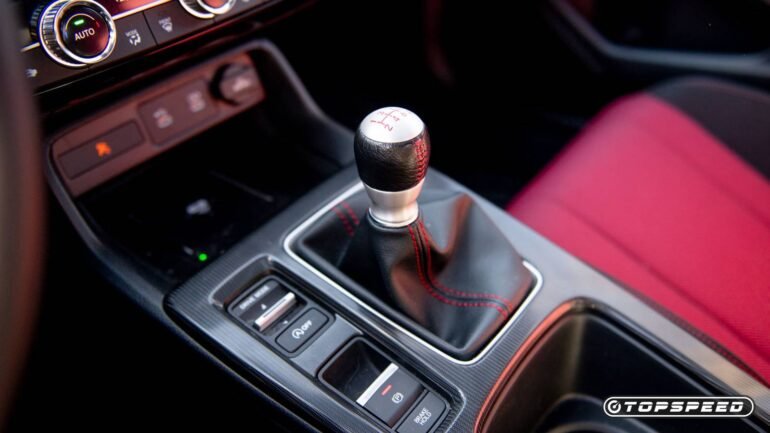
Manual cars have been suffering a slow and steady death, especially in the mainstream car segment. The mass adoption of hybridization, together with a substantial demand increase for self-shifters and more affordable automatic transmission options have also contributed to its demise. Manual transmissions still exist in the world of performance cars, which is a factor that is highly unlikely to ever change, but if you want to have some fun on a budget in the U.S., there really aren’t that many options.

- Base Trim Engine
-
1.5L I4 ICE
- Base Trim Transmission
-
6-speed manual
- Base Trim Drivetrain
-
Front-Wheel Drive
- Base Trim Horsepower
-
200 HP @6000 RPM
- Base Trim Torque
-
192 lb.-ft. @ 1800 RPM
- Base Trim Fuel Economy (city/highway/combined)
-
27/37/31 MPG
- Base Trim Battery Type
-
Lead acid battery
- Make
-
Honda
- Model
-
Civic Si Sedan
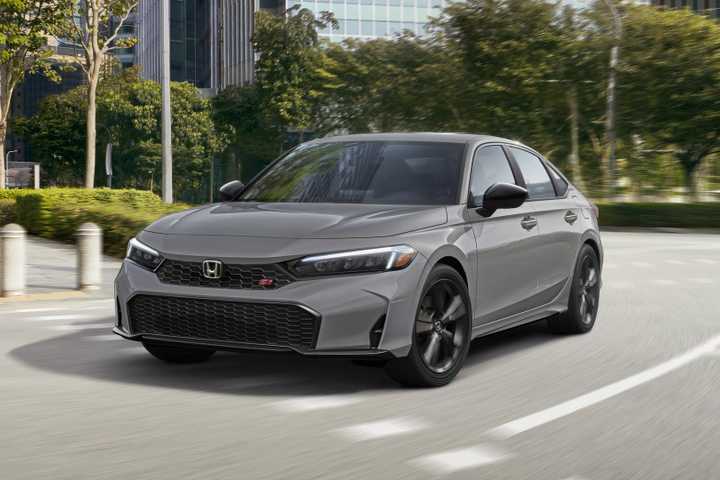
The 2026 Honda Civic Si is a great example of a mainstream model with a manual transmission. With pricing starting at $30,995, it’s not as much of a competitive deal, especially when compared to its predecessors, but in the context of the new vehicle market, it makes for a reasonably priced enthusiast-minded sedan with long-term reliability.
The Civic Si’s Appealing Reliability Standards

According to iSeeCars, the Honda Civic has an 8.1/10 reliability, 9.3/10 retained value, and 9.0/10 safety rating, resulting in an 8.8/10 overall score. The publication suggests that this model will cover an average lifespan of 13.5 years or 163,492 miles, with a 27.5 percent probability of reaching 200,000 miles.
Edmunds indicates that you can expect to spend $43,686 on a Civic Si ownership experience over the course of five years and 60,000 miles, with $3,883 accounting for maintenance, $917 for repairs, $12,926 for fuel, and $8,916 for depreciation. Value retention is impressive, partly thanks to its reliability standards, with iSeeCars suggesting that it will lose $6,762 or 27.9 percent of its value after five years of ownership.
J.D. Power issues the entire 2026 Honda Civic range with an 85/100 consumer-verified overall score, including 84/100 for quality and reliability, 84/100 for the driving experience, 90/100 for resale, and 83/100 for the dealership experience.
Impressively Dependable Drivetrain

The 2026 Honda Civic Si features a 1.5-liter inline-four-cylinder turbocharged engine, designed to balance performance with practicality. The configuration consists of a 16-valve dual overhead-cam layout with the company’s i-VTEC valve control and dual-cam Variable Timing Control. Joining this is a direct fuel injection system, and a 73 mm by 89.5 mm bore and stroke with a 10.3:1 compression ratio, optimizing both efficiency and performance.
A Simple But Effective Turbocharger

Forced induction comes from a compact turbocharger, with an intercooled system to modulate intake temperatures, resulting in a broad torque band that translates into strong and usable thrust during normal and spirited driving conditions. The setup aims to minimize turbo lag, partially thanks to a lightweight single-mass flywheel mated to the six-speed manual transmission.
Materials Are The Cornerstone Of Reliability

From a materials and design standpoint, the turbocharged L-Series leverages Honda’s well-honed production consisting of aluminum-based internals, modern combustion chamber shaping, and direct injection. These systems help velocity and efficiency while controlling weight and thermal load. The turbocharger, intercooler, and modern ignition and fuel systems are all designed to perform consistently under a variety of loads.

I Drove What Is (Probably) The Next Honda Civic Si
Honda’s Next-Generation Hybrid Study is a sign of good things to come for more than just sports cars.
The Civic Si’s Engine Isn’t Perfect

The Civic Si is a reliable manual semi-performance car if you stick to the maintenance schedules without delays, but this car can show a few recurring weaknesses depending on use and maintenance. A commonly reported problem is oil dilution, where unburnt fuel mixes with engine oil. This is a situation that appears to be more frequent with repeated short trips or cold-start cycles. That dilution thins out oil viscosity and can impair lubrication, raising wear on bearings, piston rings, or turbo internals.
Turbocharger faults also surface occasionally, with key symptoms being whining noises, a loss of boost, or sluggish throttle response. This may indicate early turbo wear or boost-leak problems, sometimes stemming from poor lubrication or degraded intercooler plumbing. Other complaints include misfires, often tied to spark-plug wear or injector problems, as well as rough idling, or diminished acceleration, especially when the engine control, ignition coil, or fuel-delivery components begin to age.
Regarding recalls, earlier generations of Civics fitted with the turbocharged L-Series between 2016–2018 underwent technical service bulletins and extended warranties to address oil-dilution and misfire issues. Some models from 2018 to 2021 also saw a recall for faulty fuel-pump components that could swell and potentially cause engine stalls or failure to start.
If you own a 2025 or 2026 Civics Si, you should still monitor oil levels, maintain strict oil-change intervals, and watch for early warning signs like unusual noises, drops in turbo boost or misfires. This will help prevent the issues that earlier examples of this engine have suffered from.
Manuals Remain The Most Dependable Transmission Choice

Manual transmissions remain the most reliable option because they use a simple and direct mechanical layout that limits failure points and keeps long-term durability high. A manual gearbox such as the one found in the 2026 Honda Civic Si relies on a solid set of gears, a clutch, and a shift linkage that you control directly. This system reduces the number of wear-prone components.
An automatic or dual clutch unitdepends on pumps, solenoids, torque converters, multi-plate clutch packs, and complex control modules. Each part introduces more risk of heat buildup, fluid breakdown or electronic faults. A manual system runs cooler because it does not rely on hydraulic pressure to maintain gear engagement, and that lower thermal load slows wear on bearings and synchros.
Drivers also control shift timing, which reduces shock to the drivetrain and keeps the gearbox in healthier condition over years of use. When problems develop, a manual transmission usually needs inexpensive parts such as a clutch disc or shift bushings, rather than major internal rebuilds. Mechanics can service these units quickly due to straightforward construction, which keeps ownership costs predictable. Manufacturers also refine manual gear sets with strong alloys and precise machining, which further improves reliability under daily driving stress.

The Japanese Four-Cylinder Engine Is So Reliable It’s Still In Production After Almost 25 Years
This Honda engine remains a crucial part of its production strategy.
Modest Performance Returns

The turbocharged 1.5-liter four-cylinder engine produces 200 horsepower at 6,000 RPM and 192 pound-feet of torque at 1,800 to 5,000 RPM, with a 6,600 redline limit. This results in the Civic Si being able to cover a 0 to 60 MPH acceleration sprint in 6.6 seconds before hitting a limited 135 MPH top speed limit.
Respectably Appealing Efficiency Abilities

On the fuel efficiency front, the 2026 Honda Civic Si boasts an EPA-estimated 27/37/31 MPG on the EPA’s city/highway/combined cycle, while covering 384 miles on a single 12.4-gallon tank of gas. You will be spending $1,750 more on fuel over five years, compared to the average new vehicle. This translates to a $1,950 annual fuel cost and $3.21 to drive 25 miles. A full tank of gas will set you back by about $49.

This Is The Cheapest Gas-Powered Sedan To Own In 2025
If you are looking for a gas-powered sedan that is cheap to run, own, and buy, you can’t go far wrong with this new Honda compact sedan.
Pricing Starts At $30,995

Pricing for the 2026 Honda Civic Si currently starts at $30,995. Standard exterior features include full LED lighting at the front and rear, with auto-on-and-off functions. You also get heated and electrically adjustable door mirrors, dual chrome exhaust finishers, a gloss black decklid spoiler, and remote keyless smart entry.
Comprehensive Standard Features

The cabin is host to a 9.0-inch touchscreen infotainment system featuring wireless Android Auto and Apple CarPlay, HondaLink, and Google built-in with Amazon Alexa, a 10.2-inch digital instrument cluster, and a 12-speaker Bose premium audio system. Comfort and aspirational features include a leather-wrapped multifunction steering wheel, aluminum shift knob, automatic single-zone climate control, red ambient lighting, and sport pedals. The manually adjustable front seats are heated.
The Genius Of The Si’s Suspension

The Honda Civic Si is a relatively low-powered performance car, but a lot of its genius lies in its chassis. This consists of a front MacPherson strut and rear multi-link suspension, with a front tubular and rear solid stabilizer bar. The Si sits on a set of 18-inch matte black alloy wheels, and also features Normal, Sport, and Individual dynamic driving modes and Active Sound Control, making for a more emotive aural experience during enthusiastic driving.
Sources: The NHTSA, iSeeCars, Edmunds, and J.D. Power